
Anguish as Kenya’s government demolishes houses in flood-prone areas and offers $75 in aid

1 / 3
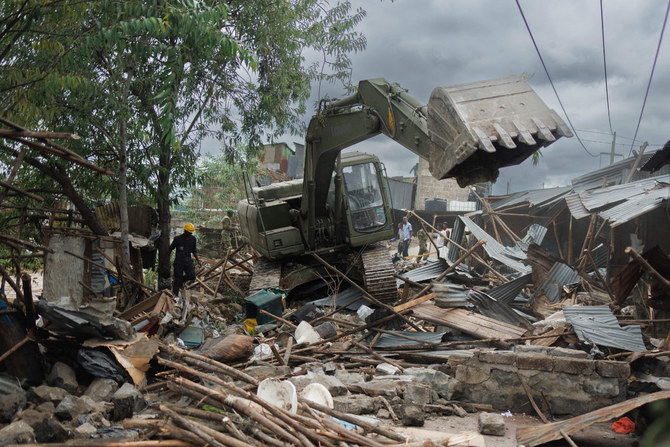
A bulldozer demolishes houses on riparian land in the Mukuru slums area of Nairobi on May 8, 2024. Kenyan security agencies continued to demolish homes near riverbanks in Nairobi as floods cause havoc in the country. (AFP)
2 / 3
A bulldozer demolishes houses on riparian land in the Mukuru slums area of Nairobi on May 8, 2024. Kenyan security agencies continued to demolish homes near riverbanks in Nairobi as floods cause havoc in the country. (AFP)
3 / 3
People stand along a river as they watch houses in riparian land being demolished in the Mukuru area of Nairobi, Kenya, on May. 7, 2024. (AP Photo)
Short Url
Updated 09 May 2024
Follow

Anguish as Kenya’s government demolishes houses in flood-prone areas and offers $75 in aid

  • People living near rivers, dams and other flood-prone areas told to vacate as heavy rains continue to pound
  • The number of those affected by the flooding in Kenya has risen to 235,000, with most of them living in camps

NAIROBI, Kenya: Kenya’s government has begun bulldozing homes built in flood-prone areas and promising evicted families the equivalent of $75 to relocate after a deadline passed to evacuate amid deadly rains.

In the capital, Nairobi, a bulldozer ripped through iron-sheet walls as people watched in despair. Security forces with guns and batons stood guard and fired tear gas at some residents. The government last week told thousands of people living near rivers, dams and other flood-prone areas to vacate as heavy rains that have left 238 people dead in recent weeks continue to pound.
Most of those whose houses are demolished say they do not know where to go, even though the government claims they were notified about options. Human Rights Watch has accused the government of an inadequate response.
“Now what are we going to do? We love our president, and that is why we supported him. He should come to our aid,” Jekenke Jegeke told The Associated Press.
President William Ruto, who visited the vast Mathare informal settlement along the Nairobi River on Monday, said those whose houses had been demolished would be given 10,000 Kenyan shillings ($75) to help them resettle elsewhere.
Three people, including two children, have died in Mathare after being run over by bulldozers in the demolitions — one before the president’s visit and two after it — according to civil society groups.
Opposition leader Raila Odinga last week warned the government against demolishing more houses without a resettlement plan in place.
The number of those affected by the flooding in Kenya has risen to 235,000, with most of them living in camps.
Interior Minister Kithure Kindiki on Tuesday reiterated an evacuation order to 200 families living in the Kijabe area an hours’s drive from Nairobi, where about 60 people were killed and houses were swept away when water broke through a blocked railway tunnel last week.
That disaster prompted the government’s evacuation order. It is not clear how many homes across Kenya have been demolished since then.
Meanwhile, Kenya’s Cabinet has said that water levels in the country’s two major hydroelectric dams – Masinga and Kiambere – have risen to “historic levels,” with people living downstream on the Tana River told to leave.


‘Solar sheep’ help rural Australia go green

Updated 5 sec ago
Follow

‘Solar sheep’ help rural Australia go green

  • The panels have had another surprising side effect: Because the grass is shielded from the elements, it’s of more consistent quality

DUBBO: Australian farmer Tom Warren’s solar panels look like any other — until you spot the dozens of sheep grazing and napping, helping the country transition to green energy and earning him a decent income while doing it.

More than 30,000 solar panels are deployed across approximately 50 hectares at Warren’s farm on the outskirts of Dubbo, around 400 kilometers west of Sydney.

The farmer and landowner has been working with renewables firm Neoen for more than a decade and said he was initially worried the panels would restrict his sheep’s grazing.

It quickly became clear those fears were unfounded.

“Normally they would seek out trees and camp under the trees, but you can see that the sheep are seeking out the shade of the panels,” he told AFP at the farm in Dubbo.

“So, it’s a much better environment for them as well.”

The farm produces about 20 megawatts of power, he said — a “substantial amount” of the energy needs of the local area.

While he can’t disclose how much he earns from the panels, he said he’s taking in much more than he would from just farming.

“The solar farm income is greater than I would ever get off agriculture in this area — regardless of whether I have sheep running under the panels or not,” he said.

The panels have had another surprising side effect: Because the grass is shielded from the elements, it’s of more consistent quality.

That, in turn, has improved the wool produced by the sheep.

“The wool is actually better and cleaner,” Warren said.

“All over, we’ve had about a 15 percent increase in the gross revenue coming from the sheep running under the solar farm.”

Fellow farmer Tony Inder, based around 50 kilometers south in the town of Wellington, agrees.

His flock is much larger — 6,000 sheep grazing on two plots of land covering 4,000 hectares.