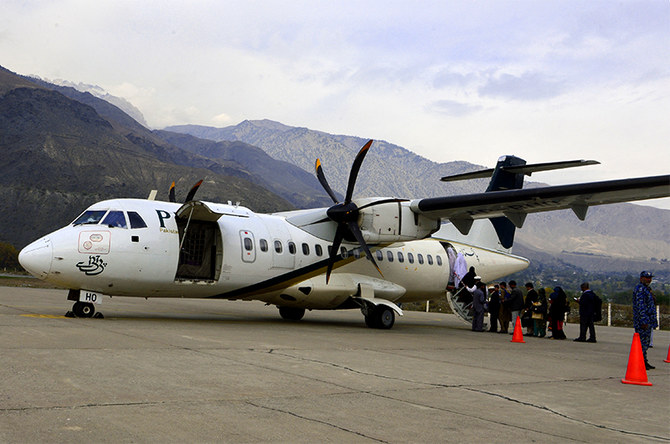
ISLAMABAD: Pakistan’s national carrier, Pakistan International Airlines (PIA), will from next week resume flight operations to the country’s scenic Swat valley after nearly 17 years, a spokesperson for the airline said on Thursday.
Taliban militants took over Swat from 2007-2009, destroying tourism, but army operations to clear out militant safe havens and improved security in recent years have allowed tourism to re-emerge on the Hindu Kush mountain range.
“PIA is going to resume flight operations to Saidu Sharif, Swat, after 17 years,” PIA spokesman Abdullah Hafeez Khan told Arab News, referring to Swat's only airport, closed since 2004 and equipped to handle small ATR-70 aircraft.
The purpose of resuming the flights now, Khan said, was “to encourage tourism in the region.”
“There is huge potential,” the spokesperson added.
He said there would be two weekly flights from Lahore, with a 15 minute stopover in Islamabad: “Then it [flight] will proceed to Saidu Sharif.”
In January 2019, Pakistan loosened travel restrictions in the hope of reviving tourism by offering visas on arrival to visitors from 50 countries and electronic visas to 175 nationalities.
Pakistan was last a prominent tourist destination in the 1970s when the “hippie trail” brought Western travelers through the apricot and walnut orchards of the Swat Valley and Kashmir on their way to India and Nepal.
Since then, deteriorating security had chipped away at the number of visitors. Security has since improved dramatically in recent years, with militant attacks down sharply in the mainly Muslim country of 220 million people.
A 2019 Gallup report said tourist traffic at cultural sites in Pakistan had seen an increase of 317 per cent over five years. Tourism has also been helped by a five-day visit to Pakistan in 2019 by British royals Prince William and Kate Middleton.


![]()

PIA to resume flights to Swat Valley airport after 17 years
Short Url
https://arab.news/rsk72
PIA to resume flights to Swat Valley airport after 17 years
- Taliban militants took over Swat during 2007-2009, destroying tourism in the picturesque valley
- Operations to clear out militants, improved security in recent years have allowed tourism to re-emerge
Latest updates


© 2026 SAUDI RESEARCH & PUBLISHING COMPANY, All Rights Reserved And subject to Terms of Use Agreement.