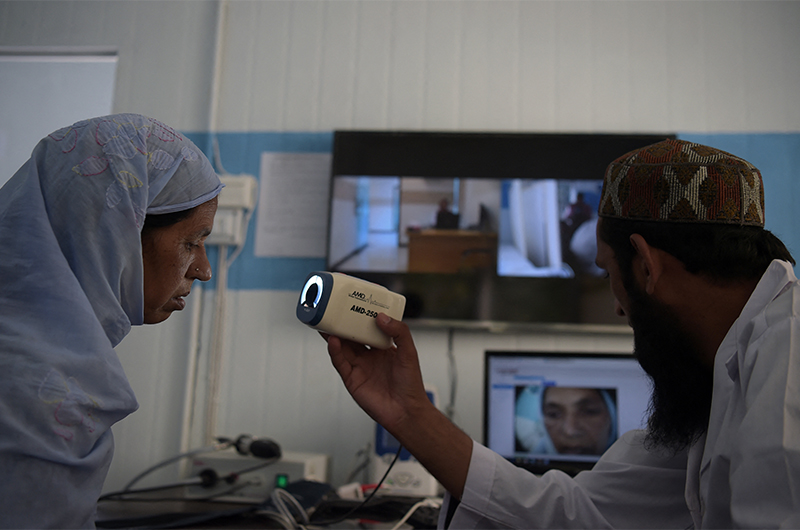
- Pakistan’s first women-led telemedicine firm raises $1 million in pre-Series A round
- Government says creating enabling environment for e-businesses by providing connectivity, funds
KARACHI: Telemedicine has witnessed a surge in Pakistan since the outbreak of the coronavirus pandemic, health experts have said, with some companies reporting up to 900 percent growth over the last year.
Doctors and disease specialists around the world have recommended alternatives to face-to-face doctor or clinic visits since the COVID-19 outbreak to help limit exposure to the virus and free up resources for those who may really need them. Remote diagnoses through telehealth services has grown around the world, with 154% growth in the United States, according to the US Centers for Disease Control and Prevention (CDC).
Over the past decade, telehealth, a broader term used to define all medical services and health education delivered digitally, has grown steadily as an industry. According to Global Market Insights, the market size in 2019 was around $45 billion and is projected to grow to more than $175 billion by 2026.
“We [Pakistan] have witnessed 800-900% growth in telemedicine after the pandemic outbreak,” Dr. Anam Daayem, a digital health care expert and COO of the company Ehad Virtual Health, told Arab News. “Globally the percentage is not that much because they were already using telemedicine.”
Government officials could not be reached to confirm Daayem’s figures.
Riding a wave of increasing investor interest in telehealth, a local startup, Sehat Kahani, announced on Monday that it had secured $1 million in a pre-Series A round of funding to expand its network in Pakistan.
“We have experienced massive 425 percent growth in the last 12 months only,” Dr. Sara Saeed Khurram, co-founder and chief executive officer of Sehat Kahani, said at an event to mark the closing of the funding round.
“We have empowered 3.1 million people in Pakistan with health-tech and consultations,” Khurram told Arab News. “A lot of doctors from the Middle East and North Africa have also joined our network.”
Khurram founded Sehat Kahani with Dr. Iffat Zafar Aga, making it the first Pakistani women-led enterprise to raise funding in a pre-Series A round.
Telemedicine was first introduced in Pakistan in 2003 under the Pakistan-US Science and Technology Cooperation Program that helped train 45 doctors and nurses from various institutions within a period of six months.
But the concept did not catch on in subsequent years.
“Pakistan is already 15 to 20 years behind in the digital health field when we compare it with the rest of the world,” Daayem said. “However, the trend gained significant pace during the COVID-19 pandemic when people reduced physical exposure and turned to online facilities. Many of them realized that telemedicine was the best option available to them.”
Abdullah Butt, an expert in the field, said the telemedicine sector had previously suffered due to a lack of market penetration, which had improved due to the coronavirus.
“After the emergence of COVID-19, we experienced unprecedented growth, but we still have a long way to tap the true market potential,” he said. “Doctors and patients are still reluctant to use the digital health space due to fear of financial documentation and lack of technological awareness.”
Ahmed Ali Siddiqui, senior executive vice president of Meezan Bank, told Arab News there was “huge potential” for investment in telehealth.
“The telemedicine trend is gaining momentum since the outbreak of the coronavirus pandemic and its outreach is gradually expanding,” he said.
Senior Pakistani government officials said Pakistan had provided an enabling environment for the growth of telemedicine.
“The basic requirement for telemedicine and related e-businesses is connectivity,” Syed Aminul Haque, federal minister of information and communication technology, said while addressing the Sehat Kahani event on Monday. “For enhanced connectivity, the ministry is seriously pursuing a vision for digital Pakistan.”
Officials said the State Bank was also trying to provide financial support to telehealth ventures.
“The central bank has made cheap loans available to startups and those expanding their businesses,” Dr. Reza Baqir, State Bank governor said. “Now our new regulations enable startups to conveniently remit disinvestment proceed through designated banks without any regulatory approval.”