

Russian missile attacks in Syria defy cease-fire with Turkey

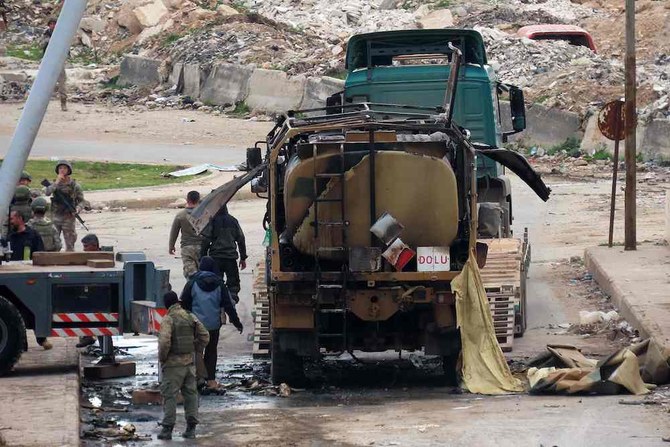
A destroyed fuel tanker that exploded in proximity to a Turkish military convoy near the rebel-held northwestern Syrian city of Idlib, March 15, 2021. (AFP)
Short Url
Updated 16 March 2021
Follow

Russian missile attacks in Syria defy cease-fire with Turkey

  • The Russian attack from Kweyris base in regime-controlled Aleppo targeted oil refineries under Turkish control in northwestern Syria
  • Ankara immediately sent a notification to the Russian Federation to stop firing and put its troops in the region on alert

ANKARA: Russian ballistic missile strikes in northern Syria on Monday in defiance of the cease-fire with Turkey in March 2020 could have broader repercussions, experts say.

The Russian attack from Kweyris base in regime-controlled Aleppo targeted oil refineries under Turkish control in northwestern Syria. It was the second such attack in nine days.

As Syria marks a decade of civil war, this region is considered vital for providing households, farmers, bakeries, and other businesses with oil.

The refineries here are used to refine about 40 percent of the crude oil that comes from the region controlled by the Syrian Kurdish YPG forces, which is mostly used for generators, heating or running machines.

Ankara immediately sent a notification to the Russian Federation to stop firing, and it put its troops in the region on alert.

Some experts believe that Russia is looking to consolidate its geopolitical interests in the region, while warning Ankara about any potential rapprochement with the United States.

However, the attacks may push Ankara into searching for allies in any standoff with Russia.

“The Biden administration should keep its promises and work with us to end the tragedy in Syria and protect democracy,” Turkish President Recep Tayyip Erdogan said yesterday.

Emre Ersen, an expert on Turkey-Russia relations at Marmara University in Istanbul, said the latest incident once again shows the fragility of the geopolitical balance in Syria, since it came only a few days after the meeting held between the foreign ministers of Turkey, Russia and Qatar regarding the solution of the Syrian crisis.

On March 11, the three countries launched a new trilateral consultation process to contribute for a lasting political solution in Syria.

“It has also reminded everyone that despite the development of a special relationship between Ankara and Moscow in the last few years, their differences regarding the solution of the regional conflicts could easily trigger a new crisis in the bilateral relations,” Ersen said.

According to Ersen, such tensions could also affect the outcome of the Russian Su-35 jet negotiations, even though Turkey has so far sought to compartmentalize these issues in its relations with Russia.

“The two countries still need each other in order to realize their objectives in Syria. That is why the so-called Turkish-Russian “marriage of convenience” in Syria is going to be maintained at least in the short term,” he said.

Navvar Saban, from the Istanbul-based Omran Center for Strategic Studies, said Russia and Turkey still have joint fronts in Idlib, the Euphrates Shield and eastern Syria, and each front has its own characteristics and goals.

He thinks that the latest Russian attack aims to test how much the Turkish side wants to advance by targeting these refineries.

“It is a direct message to show what they can target and to understand the Turkish response,” he said.

“It is a fragile agreement on different fronts. Russians have the upper hand for now and Turkey needs to send a clear and direct message to maintain the balance of power,” he added.

“Russia wants Turkey to ensure the security of the M4 highway and to eliminate the extremist groups in that area. On the eastern side, Russia wants a ceasefire agreement to prevent Turkey from advancing any more in that area,” Saban said.

However, there is disagreement among experts over how far Damascus can undertake military action against Turkey independently from Russia.

Anton Mardasov, a nonresident scholar at the Middle East Institute’s Syria program, does not think that the new missile attack is related to any warning from the Russian side.

“The last few missile strikes were an independent initiative by Damascus,” he said. “Outside observers grossly exaggerate Russia’s influence on the Syrian army,” Mardasov added.

According to Mardasov, Moscow is not interested in a new scandal over Syria.

“The main thing for Moscow is to remove its economic burden, so it prefers to act quietly,” he said. “Damascus is interested in PR before the elections and a new scandal in order to drag Russia into reconstruction.

“Russia is interested in constantly testing Turkey’s position for strength, but not during this period of time.”


Israel’s ‘deliberate intention of preventing births among Palestinians’ meets ‘legal criteria of Genocide Convention’: Reports

Updated 10 sec ago
Follow

Israel’s ‘deliberate intention of preventing births among Palestinians’ meets ‘legal criteria of Genocide Convention’: Reports

  • Births in Gaza fell by 41% during conflict as maternal deaths, miscarriages surged
  • ‘The destruction of maternal care in Gaza reflects the deliberate infliction of conditions of life calculated to bring about the destruction of the Palestinian people, in whole or in part’

LONDON: Births in Gaza fell by 41 percent due to Israel’s war on the territory, with the conflict resulting in catastrophic numbers of maternal deaths, miscarriages and birth complications, two reports have found.

The data on pregnant women, babies and maternity care in the war-torn Palestinian enclave also revealed a surge in newborn mortality and premature births, The Guardian reported on Wednesday.

Dangerous wartime conditions and Israel’s systematic destruction of Gaza’s health systems were blamed for the alarming statistics.

The two reports were conducted by Physicians for Human Rights, in collaboration with the University of Chicago Law School’s Global Human Rights Clinic and Physicians for Human Rights — Israel.

Researchers highlighted Israel’s “deliberate intention of preventing births among Palestinians, meeting the legal criteria of the Genocide Convention.”

The reports build on earlier findings by PHR’s Israel branch. They place the testimonies of pregnant women and new mothers within the context of health data and field reports, which recorded “2,600 miscarriages, 220 pregnancy-related deaths, 1,460 premature births, over 1,700 underweight newborns, and over 2,500 infants requiring neonatal intensive care” between January and June 2025.

PHRI’s Lama Bakri, a psychologist and project manager, said: “These figures represent a shocking deterioration from pre-war ‘normalcy,’ and are the direct result of war trauma, starvation, displacement and the collapse of maternal healthcare.

“These conditions endanger both mothers and their unborn babies, newborns, and breastfed infants, and will have consequences for generations, permanently altering families.”

She added: “Beyond the numbers, what emerges in this report are the women themselves, their voices, choices and lived realities, confronting impossible dilemmas that statistics alone cannot fully capture.”

Maternal and newborn care in Gaza has been damaged by Israel’s destruction of health infrastructure, as well as fuel shortages, blocked medical supplies, mass displacement and relentless bombardment.

As a result, survival in Gaza’s overcrowded tent encampments has become the sole option for pregnant women and new mothers.

During the first six months of Israel’s war on the territory, more than 6,000 mothers were killed, at an average of two every hour, according to UN Women estimates.

It is also believed that about 150,000 pregnant women and new mothers have been forcibly displaced by the conflict.

In the first months of last year, just 17,000 births were recorded in Gaza, a 41 percent fall compared to the same period in 2022.

The researchers examined Israel’s apparent strategy to undermine Palestinian births, highlighting a targeted strike in December 2023 on the Al-Basma IVF clinic.

The attack on Gaza’s largest fertility center destroyed about 5,000 reproductive specimens and ended a pattern of 70-100 IVF procedures each month.

The strike was deliberately designed to target the reproductive potential of Palestinians, the Independent International Commission of Inquiry later found.

“Reproductive violence constitutes a violation under international law; when carried out systematically and with them intent to destroy, it falls within the definition of genocide of the Genocide Convention,” the reports said.

“The destruction of maternal care in Gaza reflects the deliberate infliction of conditions of life calculated to bring about the destruction of the Palestinian people, in whole or in part.”