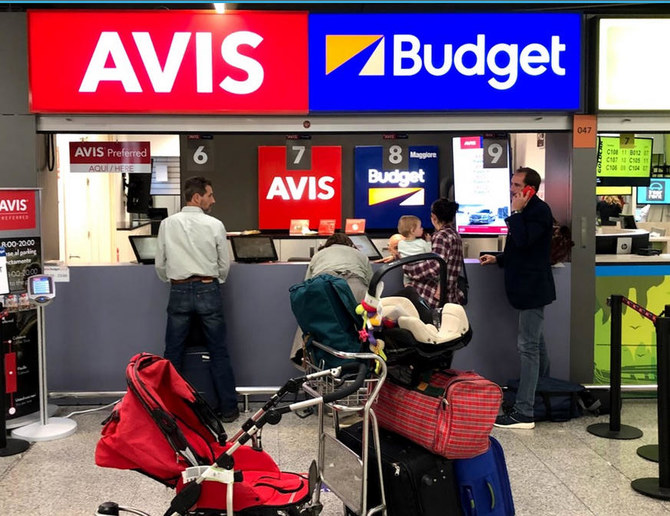
Saudi Budget boss sees recovery in car hire market helped by pilgrims in second half of year

Budget Saudi Arabia expects to see a pickup in rentals in the second half. (Supplied)
Short Url
Updated 15 March 2021
Follow

Saudi Budget boss sees recovery in car hire market helped by pilgrims in second half of year

  • Market expected to pick up after Ramadan
  • Sector hit hard by coronavirus pandemic

RIYADH: The Saudi car hire market will recover in the second half of the year led by short term rentals from Umrah and Hajj pilgrims, Budget CEO Fawaz Danish, told Asharq Business.
The resumption of international flights to the Kingdom is expected to boost demand, he said.
Car hire companies have been among the hardest hit by the pandemic with global travel coming to a near standstill. US-based Hertz became one of the first casualties in the sector after seeking bankruptcy protection in the early days of the pandemic.
Still, the influx of millions of pilgrims to the Kingdom offers great potential for the hire sector, Danish said.
The United International Transportation Company, trading as Budget Saudi Arabia, posted profits of SR187 million ($49.8 million) last year, which Danish said was a good performance considering prevailing market conditions.
Budget Co. has distributed SR310 million of its profits to shareholders.
Danish added that the planned listing of Theeb Rent a Car on the Tadawul stock exchange would be a further boost for the sector.


Saudi Fund for Development, Omani Ministry of Finance sign MoU to establish industrial city

Updated 02 February 2026
Follow

Saudi Fund for Development, Omani Ministry of Finance sign MoU to establish industrial city

RIYADH: The CEO of the Saudi Fund for Development, Sultan bin Abdulrahman Al-Murshid, and the Omani Minister of Finance, Sultan bin Salem Al-Habsi, signed a development memorandum of understanding to support the establishment of the Thumrait Industrial City Project in Oman.

The project is funded by Saudi Arabia through the SFD with $40 million.

The signing ceremony was attended by the Saudi Ambassador to Oman, Ibrahim bin Saad bin Bishan, and several officials from both sides.

The MoU aims to develop the industrial, logistical, developmental, and social sectors in the Dhofar Governorate through the establishment of the integrated Thumrait Industrial City, covering an area of ​​approximately 3.94 million sq. meters.

The city will be equipped with all necessary infrastructure services. The project includes the construction and equipping of administrative and service buildings as well as public facilities. It also includes road works and electrical installations, as well as water networks and the construction of two wastewater treatment plants.

Engineering consultancy services will also be provided, reflecting the expected developmental impact in enhancing the industrial and service sectors in the governorate.

The CEO of the SFD affirmed that this MoU reflects the Kingdom’s efforts, through the fund, to support development sectors in Oman and strengthen the close development partnership between the two sides.

This will be achieved through the implementation of high-quality projects that contribute to developing infrastructure and creating an integrated and stimulating environment for industrial and logistical activities, which will positively impact the empowerment of the private sector and enhance economic as well as social development.

For his part, the Omani Minister of Finance emphasized that the signing of this agreement stems from a desire to strengthen developmental, economic, and investment relations and encourage partnerships across various sectors between the two countries.

At a time when the world is getting fragmented due to geopolitical tensions and ongoing wars, Saudi Arabia’s development fund is becoming a beacon of hope, as it continues to provide soft loans and grants for emerging economies.

Established in 1974 and commencing operations in 1975, the Saudi Fund for Development has financed more than 800 development projects in over 100 countries, with a cumulative value exceeding $21 billion.

SFD’s financing spans across multiple sectors, including health, education, and transport, as well as water and energy, with the aim of improving living conditions, enhancing capacity building, and creating job opportunities for millions of people in emerging nations.