Sisi urges Libya to maintain ‘Libyan-Libyan’ dialogue, advance political settlement

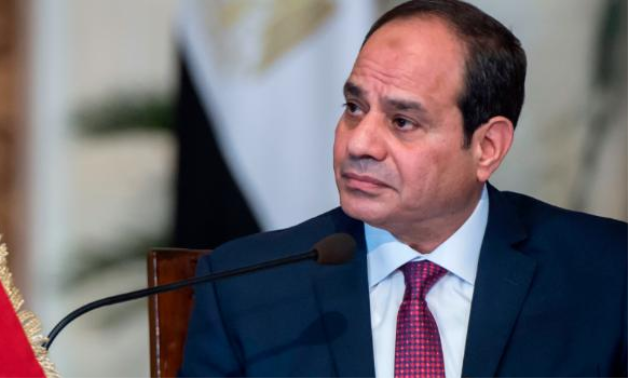
Sisi attends a press conference at the presidential palace in Cairo on December 11, 2017. (AFP)
Short Url
Updated 14 March 2021
Follow

Sisi urges Libya to maintain ‘Libyan-Libyan’ dialogue, advance political settlement

CAIRO: Egypt’s President Sisi has stressed the importance of reaching a political settlement in Libya and has urged the country’s leaders to maintain a “Libyan-Libyan” dialogue to curb foreign interference. 

President Abdel Fattah el-Sisi said it was important to build on positive steps towards a political settlement in Libya during a phone call with the new head of the Libyan Presidential Council Mohamed Al-Menfi.

Sisi also congratulated Menfi on the formation of a new executive authority in Libya and on the new government obtaining the parliament’s confidence, according to a statement by the Egyptian presidency.  

Menfi, during the phone call, hailed Egypt’s sincere efforts in seeking to restore security and stability in Libya.

The phone call comes only few days after Libya's parliament voted to back the unity government led by interim PM Abdel-Hamid Dbeibeh.


Iraq welcomes the appointment of Iran’s new supreme leader

Updated 5 sec ago
Follow

Iraq welcomes the appointment of Iran’s new supreme leader

  • Armed faction Kataeb Hezbollah said it reflects a profound understanding “of the existential challenges confronting the nation”

BAGHDAD: Iraq’s Prime Minister Mohammed Shia Al-Sudani welcomed on Monday the appointment of Mojtaba Khamenei as Iran’s new supreme leader after his predecessor and father was killed in US and Israeli strikes.
“We express our confidence in the ability of the new leadership in the Islamic Republic of Iran to manage this critical stage,” and to further strengthen “the unity of the Iranian people” amid the current challenges, Sudani said in a statement.
He stressed that Iraq stands in solidarity with Iran and supports “all steps aimed at ending the conflict.”
Iran wields significant influence in Iraqi politics, and also backs armed groups whose power has grown both politically and financially.
Iraq has for decades been a proxy battleground between the US and Iran.
Pro-Tehran Iraqi groups were among the first to welcome the new supreme leader.
The powerful Badr organization said the new leadership represents a “blessed continuity of the path of the Islamic revolution.”
The Asaib Ahl Al-Haq faction said choosing Mojtaba Khamenei shows continuity and “reinforcement of the Islamic republic’s role as a central pillar in the axis of resistance.”
Armed faction Kataeb Hezbollah said it reflects a profound understanding “of the existential challenges confronting the nation.”
“The best successor to the best predecessor,” said Kataeb Hezbollah, which is part of the Islamic Resistance of Iraq — a pro-Iran alliance that has been claiming attacks on US bases since the start of the war in the Middle East.
Senior Iraqi politician and moderate cleric Ammar Al-Hakim wished the new supreme leader “success in following the path of his martyred father... in upholding the word of truth.”