

Panic on the streets as Lebanese pound hits new low

1 / 4
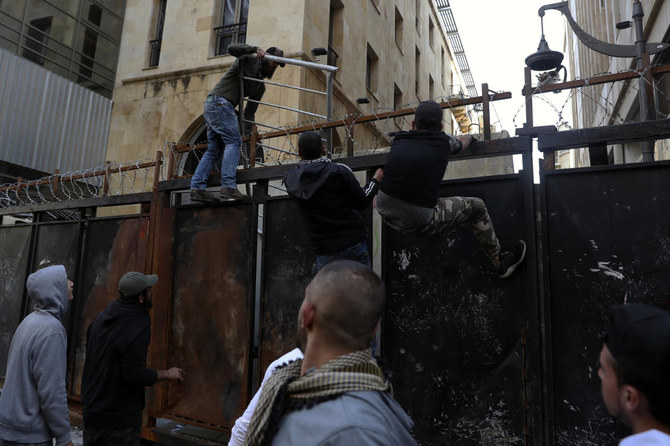
Anti-government protesters climb a metal wall installed by security forces to prevent protesters from reaching the Parliament building, during a protest in Beirut, Lebanon, Saturday, March. 13, 2021. (AP)
2 / 4
Riot police fire tear gas against anti-government protesters, during a protest near Parliament Square, In Beirut, Lebanon, Saturday, March. 13, 2021. (AP)
3 / 4
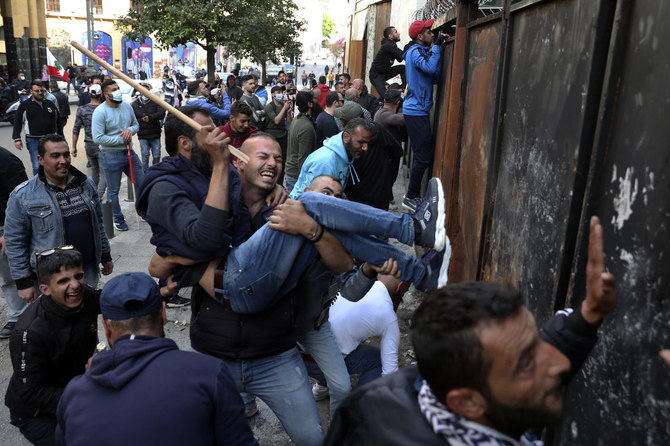
Anti-government protesters throw stones towards police near Parliament Square, In Beirut, Lebanon, Saturday, March. 13, 2021. (AP)
4 / 4
Anti-government protesters climb a metal wall installed by security forces to prevent protesters from reaching the Parliament building, during a protest in Beirut, Lebanon, Saturday, March. 13, 2021. (AP)
Short Url
Updated 14 March 2021
Follow

Panic on the streets as Lebanese pound hits new low

  • ‘People are frightened, hungry,’ warns MP after shops halt sales
  • In addition to Beirut, there were also protests in other cities such as Tripoli, Sidon and Tyre, as well as road closures in different parts of Lebanon

BEIRUT: Lebanese supermarkets halted sales and businesses closed their doors on Saturday as the country’s embattled currency slumped to a record low on the black market.

With the dollar exchange rate exceeding 12,000 Lebanese pounds, panic erupted on the streets as shopkeepers and major outlets stopped selling goods to avoid incurring losses.

Amid growing alarm at the country’s increasingly precarious state, activists in working-class areas in Mount Lebanon climbed the minarets of mosques and called on people to take to the streets.

A spokesperson for the Oct. 17 revolution said: “We will stay in the squares until the corrupt system falls.”

Hundreds of protesters in Martyrs’ Square in downtown Beirut pounded on metal barriers blocking access to parliament and hurled rocks at security forces manning  roadblocks.

Anti-riot personnel launched tear-gas grenades after violent clashes erupted between protesters and security forces.

In the past three days, Lebanon’s currency has endured a roller-coaster ride, rising to 9,000 Lebanese pounds against the dollar before falling to 10,000 Lebanese pounds.

But in a dramatic collapse on Saturday, the Lebanese pound fell from 11,750 to 12,200 against the dollar, with the slump worsening by the hour despite efforts to close online trading platforms.

Economist Louis Hobeika told Arab News: “The strong demand for the dollar is caused by the decline in confidence in the country. People are panicking about the future.”

Hobeika rejected the idea that banks are buying up dollars.

“The dollar trading volume in the Lebanese market does not exceed $2.5 million. The banks want to increase their capital on the request of the Banque du Liban collectively and need $3.5 billion — and this cannot be secured from the Lebanese market.”

Protesters traveled to Martyrs’ Square from different regions, with retired soldiers leading many groups.

The demonstrators raised Lebanese flags, played revolutionary and patriotic songs over loudspeakers, and chanted angry slogans.

A group of protesters near the Banque du Liban joined with families of the victims of the Beirut port explosion demanding that the investigation into the blast be stepped up and not politicized.

Baalbek business owners blocked roads after they closed their stores.

In Sidon, drivers formed roadblocks with their cars, while there were also protests on the streets of Tyre.

In the Bekaa region, some gas stations were demanding 70,000 Lebanese pounds for a can of petrol as fears grew over the state of the fuel market.

George Al-Baraks, a member of the Syndicate of Gas Station Owners, said that “there is no gasoline or diesel crisis.”

He said that distribution “will be rationalized in order to maintain fuel deliveries, in line with the approval of the Banque du Liban to open credits for ships of import companies and oil facilities.”

Panic in Lebanon is growing as the stalemate between President Michel Aoun and Prime Minister-designate Saad Hariri shows no signs of ending.

MP Rola Tabsh Jaroudi told Arab News: “Those who are obstructing the formation of the government must bear the consequences of the chaos in the street.

“Hariri’s position was clear from the beginning, and he has the approval of foreign countries for what he proposed. He will remain committed to forming the government.”

On the Free Patriotic Movement’s calls for Hariri to step down, Tabsh Jaroudi said: “He is the prime minister appointed by the members of parliament, and he will not concede what he proposed, nor will he accept the bargaining that is taking place.”

She added: “People are hungry. It is their right to take to the streets to get their voices heard.”


Iraqi lawmakers to elect president Tuesday, PM appointment next

Updated 55 min 9 sec ago
Follow

Iraqi lawmakers to elect president Tuesday, PM appointment next

  • Parliamentary speaker Haibat Al-Halbussi announced on Sunday that the new parliament will convene on Tuesday to elect a president

BAGHDAD: Iraq’s parliament will meet on Tuesday to elect the country’s new president, who will then appoint a prime minister expected to be Nouri Al-Maliki after he was endorsed by the largest Shiite bloc.
By convention, a Shiite Muslim holds the post of prime minister, the parliament speaker is Sunni and the largely ceremonial presidency goes to a Kurd.
Parliamentary speaker Haibat Al-Halbussi announced on Sunday that the new parliament will convene on Tuesday to elect a president, according to the official INA press agency.
The president will then have 15 days to appoint a prime minister, who is usually nominated by the largest Shiite bloc formed through post-election alliances.
On Saturday, the Coordination Framework alliance — whose Shiiite factions have varying links to Iran — endorsed former prime minister and powerbroker Al-Maliki as the country’s next premier.
The alliance, to which Al-Maliki belongs, spoke of his “political and administrative experience and his record in running the state.”
Kurdish parties have yet to agree on a presidential candidate, who must be endorsed by other blocs and win a two-thirds majority in parliament.
The presidency is usually held by the Patriotic Union of Kurdistan (PUK). This year, the rival Kurdistan Democratic Party (KDP) named its own candidate: Foreign Minister Fuad Hussein.
Although Maliki’s endorsement effectively guarantees him the post, forming a new government remains a daunting challenge that could drag on for months and still fail.
The designated premier has one month to form a government and present it to parliament for a vote of confidence.
The 75-year-old Maliki, a shrewd politician, is set to return to power at a time of seismic changes in the Middle East, as Tehran’s regional influence wanes and tensions with Washington rise.
Government formation in Iraq must balance internal political dynamics and power-sharing among major parties, all under the continued influence of Iraq’s two main allies: Iran and the United States.
A close Iran ally, Al-Maliki will be expected to address Washington’s longstanding demand that Baghdad dismantle Tehran-backed factions, many of which are designated terrorist groups by the US.
Last month, Iraqi officials and diplomats told AFP that Washington demanded the eventual government exclude Iran-backed armed groups, even though most of them hold seats in parliament, and have seen their political and financial clout increase.
But Iraq is struggling with weak economic growth and cannot risk punitive measures by the US, which has already sanctioned several Iraqi entities, accusing them of helping Tehran evade sanctions.