

Lebanon approves World Bank rescue plan for needy families

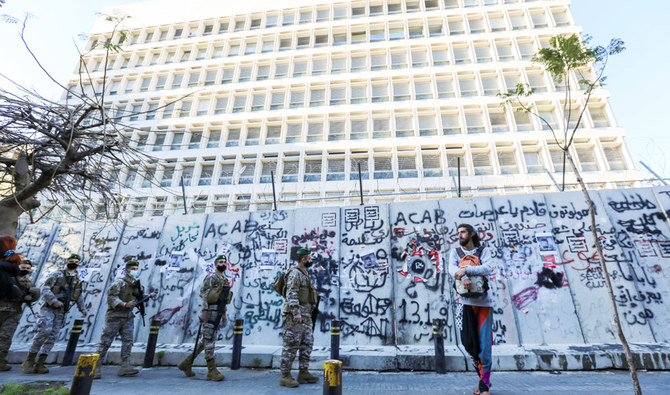
Lebanese army soldiers stand guard during a protest against the fall in Lebanese pound currency and mounting economic hardships, in Beirut, Lebanon March 12, 2021. (REUTERS)
Short Url
Updated 13 March 2021
Follow

Lebanon approves World Bank rescue plan for needy families

  • Interior minister sounds alarm on ‘diminishing security situation’

BEIRUT: The Lebanese parliament on Friday approved a $246 million World Bank emergency assistance plan to support struggling families and strengthen the social safety net amid the country’s worst economic and health crisis in decades.

Under the relief plan, 161,251 families classified as the poorest in Lebanon will receive 800,000 Lebanese pounds ($80) per month per family for one year.

The aid program will be implemented under the supervision of the World Bank.

The emergency package is expected to reduce mounting resentment against the country’s political leadership, which is widely blamed for the economic collapse and parliamentary stalemate.

Mohammed Fahmy, the caretaker interior minister, warned of “a diminishing security situation,” adding that “security is a product of politics, and all the country’s systems have diminished.”

He said: “We are part of the people and we are hungry. The political forces must resolve the obstacles to form a rescue government as soon as possible.

“We can no longer take it. The situation is very bad, the country is exposed, and I am sounding the alarm.”

French Foreign Minister Jean-Yves Le Drian warned on Thursday that “time is running out to prevent the collapse of Lebanon, and we do not see any indication that Lebanese politicians are doing what they can to save their country.”

The approval of aid follows growing protests against the economic meltdown.

Protesters attempted to march on the UNESCO Palace in Beirut while a parliamentary session took place, but tight security measures stopped them from reaching the venue.

Meanwhile, the dollar exchange rate on the black market in some regions reached new highs of 11,000 Lebanese pounds.

As the dollar exchange rate soars, the price of essential materials and commodities is increasing, while the value of people’s wages continues to decline.

The minimum wage, once equivalent to $450, has fallen below $62. As a result, public and private sector salaries have lost their value.

In its plenary session on Friday, parliament authorized the government to amend the housing loan ceilings for the Banque de L’habitat from 300 million to 450 million Lebanese pounds, and from 400 million to 600 million pounds.

Parliament also approved an agreement with the World Bank to allocate $5.5 million to support small and medium enterprises.

MP Hadi Abu Al-Hassan objected to financial aid for families, saying that people need to understand “the pain will continue and the loan will not achieve the desired goal.”

Parliament retracted proposals to support the military and security services with 1 million Lebanese pounds per month for each soldier.

The Ministry of Energy’s proposal to give an advance of 1,500 billion Lebanese pounds to Electricite du Liban (EDL) was referred to the joint committees that will meet next Tuesday.

The proposal to give aid to the military and security forces alone in the private sector was met with widespread objections, with activists and some politicians describing it as a bribe for security services.

Public administration employees, who went on strike on Friday, also objected to the plan.

The proposal was rejected by Army Command, which said it had not discussed the proposal, adding: “The military establishment is not concerned with it.”

It stressed that “the citizens have the right to demonstrate to demand their rights.”

MP Bilal Al-Abdallah said that the handling of the economic and social crisis “is a stop-gap, and we are begging for money from abroad.”

Al-Abdallah told Arab News: “We need government formation and reforms. Otherwise, the treatment is temporary.

“I objected during the session to giving the families this aid in Lebanese pounds instead of dollars.

“The Banque du Liban and the banks have made this decision because they want to keep their dollars, and people will not receive the full value in dollars as it will be calculated less than its exchange rate in the market.”

The Supreme Judicial Council on Friday approved the resignation of two judges and rejected applications for deposit submitted by other judges.


Saudi Arabia, Middle East infrastructure and AI to drive next rotation of global capital, says BNY executive

Updated 11 sec ago
Follow

Saudi Arabia, Middle East infrastructure and AI to drive next rotation of global capital, says BNY executive

  • Hani Kablawi: I’m excited about (Saudi Arabia) coming out in force, reaching out to the investor community, saying: ‘Tell us what you need to see’
  • Kablawi: We (BNY) are one of, within our peer group, the biggest investors in both AI and in digital assets

DAVOS: As global markets contend with heightened volatility and shifting capital flows, the Middle East — and Saudi Arabia in particular — is positioning itself as a destination for long-term investment, according to Hani Kablawi, senior executive vice president and head of international at BNY.

Speaking to Arab News at the World Economic Forum in Davos, Kablawi pointed to the region’s increasing engagement with international investors, combined with large-scale infrastructure ambitions, as key factors shaping where global capital could move next.

“The really exciting thing for me in the Middle East is it isn’t one thing,” Kablawi said. “It’s very different. Demand profiles are very different, investing structures are very different, and what they’re looking to achieve is very different in different places.”

Saudi Arabia, he said, was standing out for its approach to the global investment community.

“I’m excited about (Saudi Arabia) coming out in force, reaching out to the investor community, saying: ‘Tell us what you need to see’,” he said.

“We, Saudi, are united in our approach to the international global investment community, and we are able and willing to make the changes necessary to be a destination of capital and foreign direct investments over the next few years.”

While foreign direct investment into Saudi Arabia has increased significantly in recent years, Kablawi pointed out it remains from a relatively low base.

“FDIs in Saudi have gone up fourfold over the past few years,” he said, adding there was still substantial headroom for growth.

He said the Kingdom understands what international investors require, particularly around transparency, data and risk-return profiles.

Saudi Arabia also benefits from the presence of government and semi-state entities that can help de-risk projects.

“They have the structures also to provide a good risk-return trade-off,” he said, pointing to partnerships involving national funds and government-linked investors.

Major infrastructure investment is central to that strategy, spanning transportation, aviation, ports, logistics, rail and economic cities.

“They have announced the big projects. We know what they look like,” Kablawi said. “Now it’s about the structuring of those projects in a way that attracts investment.”

Globally, capital flows remain heavily concentrated in the US, even during periods of market stress. Drawing on BNY’s data, which covers $58 trillion in assets under custody and administration, Kablawi said US assets continue to sit above long-term trend lines.

“US equities currently represent 64 percent of our total equity holdings, and government securities in the US are 72 percent of our total holdings,” he said.

During the market volatility seen last April, he added, holdings in US Treasuries fell only marginally.

“That represented two things,” Kablawi said. “One is, from a reserve currency status perspective, no alternatives yet. And from an equity perspective, continued interest in the Magnificent Seven (seven dominant US technology giants), tech stocks, AI, and the accessibility of those investments to global investors.”

Looking ahead to 2026, BNY’s analysts expect interest rate easing in the US, alongside a broadening of equity investment beyond the largest technology names. Kablawi also highlighted Europe as an area where both equities and fixed income remain underheld, despite growing infrastructure ambitions across the region.

“There’s a lot of demand for infrastructure investment all around the world,” he said, pointing to announced spending in the UK, Germany and the Middle East.

“In 2026, we’re going to be watching and hopefully helping with some of those rotations going towards long-term productive finance,” he added.

Technology is another defining theme.

Kablawi said BNY is focusing on areas it can control, particularly investment in artificial intelligence and digital assets.

“We are one of, within our peer group, the biggest investors in both AI and in digital assets,” he said.

Since last year, BNY has rolled out more than 130 AI use cases into production and made its enterprise AI platform available to all employees.

He added the firm now has around 140 “digital employees” supporting day-to-day operations.

“The connectivity between traditional finance and digital finance will grow,” Kablawi said. “The rails that exist that BNY is offering between traditional finance and digital finance will continue to grow.”

Looking ahead, he stressed progress will depend on continued innovation: “Anybody who’s got a little bit of an early mover advantage, it’s only an early mover advantage,” he said. “A lot of people will be pushing into it. You can never be complacent, but we like where we are.”