

Staff accuse BBC of ignoring its own diversity rules

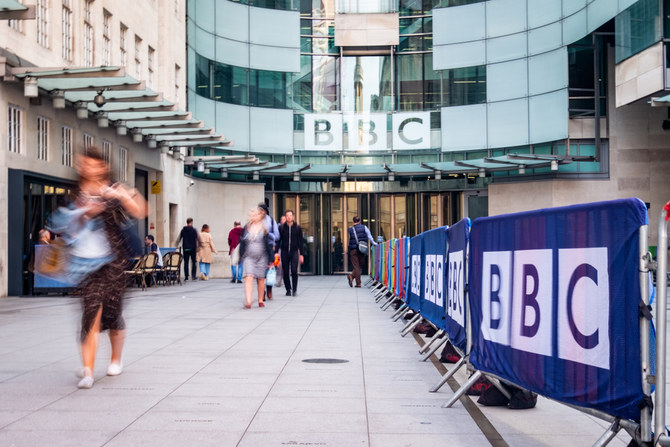
Several employees have complained, describing the reshuffle as evidence that the BBC “only pays lip service to diversity.” (Shutterstock/File Photo)
Short Url
Updated 13 March 2021
Follow

Staff accuse BBC of ignoring its own diversity rules

  • Criticism follows sacking of board member Kamal Ahmed
  • Veteran journalist: ‘BBC happy to have brown people at table but not at any position of influence in terms of editorial output’

LONDON: Staff members have criticized the BBC for ignoring its own diversity regulations just a month after the sacking of board member Kamal Ahmed, The Independent reported on Saturday.

The BBC culled its news board while following through with an £80 million ($111 million) savings proposal. Several key positions, including editorial director — held by Ahmed — were closed.

The resulting board is exclusively white, with two vacancies temporarily filled by white members.

In 2019, the BBC introduced a diversity policy that required at least two minority members in each senior leadership group, which the new formation of the board is violating.

Several employees have complained, describing the reshuffle as evidence that the BBC “only pays lip service to diversity.”

The Independent relayed the concerns of the journalists, who range from junior staff members to senior figures.

One journalist said: “This is very, very bad for the future of BBC News. Kamal was an ally and a voice who spoke up for minority audiences and under-represented groups at a senior level. He was often the only senior ally in the room at editorial meetings. He championed and empowered younger journalists.

“Not only does this send a worrying message about the future direction of BBC News, but it shows that we aren’t learning from our very big mistakes of the past.

“Tim Davie (the new director general) says he wants a BBC that represents all audiences. By pushing out the only non-white member of the news board, we have fallen at the first hurdle.”

A BBC spokesperson said: “The final membership of the board has not been announced. Two out of the eight posts … remain vacant.”

But staff members have expressed concern that potential non-white members appointed to the board will be considered as “token hires.”

Another BBC worker said: “The problem here is they’ve yet again shown how tone-deaf they are at that level. Now what they’re basically saying in all of their responses is ‘don’t worry, what we’re going to do now is hire two token people of color,’ as if it’s diversity by number.”

A veteran BBC journalist said: “The BBC is happy to have brown people at the table, but not at any position of influence in terms of editorial output.”

One employee who is considering leaving the BBC said: “It’s a really disheartening, scary time. The talent is leaving at an alarming rate. I can’t stay in an organization that’s becoming increasingly embarrassing to defend.”

Another said: “It’s a complete farce the idea that they’re going to modernize when actually they’ve got people very content with things staying as they are. The culture seems really alienating at the moment and how easily this decision was made without any consultation.”

The broadcaster said the restructuring decision last month was part of ambitions to “modernize BBC News.”

A leaked internal email seen by The Independent said: “Diversity and inclusion are a priority — for the news board and for everyone … We have interim cover in place for the HR Director and International roles. Recruitment is progressing to find a permanent candidate for both positions.”


Israel says ban on Gaza media access should stay: court document

Updated 05 January 2026
Follow

Israel says ban on Gaza media access should stay: court document

  • Israeli authorities have told the Supreme Court that a ban on international media access to Gaza should remain in place, arguing it is necessary for security reasons

JERUSALEM: Israeli authorities have told the Supreme Court that a ban on international media access to Gaza should remain in place, arguing it is necessary for security reasons, according to a government submission filed by the public prosecutor.
Since the outbreak of the Gaza war in October 2023, Israeli authorities have barred foreign journalists from independently entering the devastated territory.
Instead, Israel has allowed only a limited number of reporters to enter Gaza on a case-by-case basis, embedded with its military forces inside the blockaded territory.
The Foreign Press Association (FPA), which represents hundreds of foreign journalists working in Israel and the Palestinian territories, filed a petition with the Supreme Court in 2024 seeking immediate and unrestricted access for international media to the Gaza Strip.
Since then the court has given several extensions to the Israeli authorities to come up with a plan, but at a hearing last month it set January 4 as a final deadline.
Late on Sunday, the Israeli authorities filed their response with the court, a copy of which was obtained by AFP.
In the submission, the government said the ban on media access to Gaza should continue, citing security risks in the territory.
“Even at this time, entry of journalists into the Gaza Strip without escort, as requested in the petition, should not be permitted,” said the government submission.
“This is for security reasons, based on the position of the defense establishment, which maintains that a security risk associated with such entry still exists.”
The Israeli authorities said the ceasefire in Gaza, which came into effect on October 10, continues to face regular threats.
At least 420 Palestinians have been killed in Gaza by Israeli forces since the ceasefire took effect, according to Gaza’s health ministry.
The Israeli military said three of its soldiers have also been killed by militants during the same period.
The Israeli authorities said in their submission that the search for the remains of the last hostage held in Gaza is ongoing, suggesting that allowing journalists into the territory at this stage could hinder the operation.
The remains of Ran Gvili, whose body was taken to Gaza after he was killed during the Hamas attack on October 7, 2023, have still not been recovered despite the ceasefire.
All other 250 hostages seized on that day — both the living and the deceased — have been returned to Israel.
The Supreme Court is expected to issue a ruling on the matter, though it is unclear when a decision will be handed down.
An AFP journalist sits on the board of the FPA.