

Asia gold: More takers as prices dip, Indian premiums rise

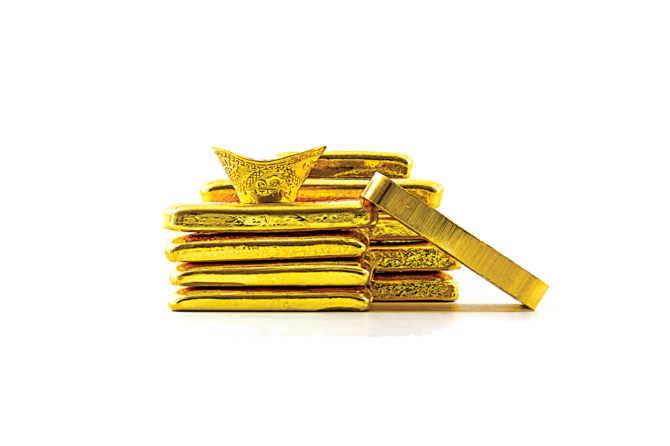
Local gold futures in India traded around 44,400 rupees per 10 grams on Friday, near a one-year low of 44,150 rupees they touched earlier in the week. (Shutterstock)
Short Url
Updated 13 March 2021
Follow

Asia gold: More takers as prices dip, Indian premiums rise

  • Local gold futures in India traded around 44,400 rupees per 10 grams on Friday

MUMBAI, India: Demand for physical gold surged in some Asian hubs this week on the back of low domestic prices, with fresh retail interest also allowing dealers to charge higher premiums in India.

Local gold futures in India traded around 44,400 rupees per 10 grams on Friday, near a one-year low of 44,150 rupees they touched earlier in the week.

“Retail demand has been gaining momentum. Showrooms, especially in small towns, are witnessing good footfalls,” said Amit Modak chief executive officer at jeweler PN Gadgil and Sons.

Dealers charged premiums of $6 an ounce over official domestic prices, inclusive of 12.5 percent import and 3 percent sales taxes, compared with last week’s premium of $5.

Jewelers have been replenishing inventory as sales have improved significantly in the last few weeks, said a Mumbai-based dealer with a bullion importing bank, adding investors have started coin and bar purchases at current rates.

In Singapore, $1.60-$2.50 premiums were charged over benchmark spot gold prices, compared with last week’s $1.60-$2.

“Quite a few customers — more so from the retail and wholesale side, including high net worth individuals — picked up gold because prices are lower,” said Brian Lan, managing director at dealer GoldSilver Central.

As for silver, refineries and mints continued to grapple with a backlog of orders, Lan added.

In China, premiums rose to $8-$10 an ounce from $6-$7 last week, dealers said.

There was some safe haven buying as well, said Peter Fung, head of dealing at Wing Fung Precious Metals in Hong Kong.

Lower prices also boosted demand in Japan, which saw premiums of $0.75.

Bangladesh cut gold prices for the second time this month, with the best quality gold priced at 69,109 taka ($817.47) per Bhori (11.664 grams), amid lower global rates, the Jewelers’ Association said.


First EU–Saudi roundtable on critical raw materials reflects shared policy commitment

Updated 16 January 2026
Follow

First EU–Saudi roundtable on critical raw materials reflects shared policy commitment

RIYADH: The EU–Saudi Arabia Business and Investment Dialogue on Advancing Critical Raw Materials Value Chains, held in Riyadh as part of the Future Minerals Forum, brought together senior policymakers, industry leaders, and investors to advance strategic cooperation across critical raw materials value chains.

Organized under a Team Europe approach by the EU–GCC Cooperation on Green Transition Project, in coordination with the EU Delegation to Saudi Arabia, the European Chamber of Commerce in the Kingdom and in close cooperation with FMF, the dialogue provided a high-level platform to explore European actions under the EU Critical Raw Materials Act and ResourceEU alongside the Kingdom’s aspirations for minerals, industrial, and investment priorities.

This is in line with Saudi Vision 2030 and broader regional ambitions across the GCC, MENA, and Africa.

ResourceEU is the EU’s new strategic action plan, launched in late 2025, to secure a reliable supply of critical raw materials like lithium, rare earths, and cobalt, reducing dependency on single suppliers, such as China, by boosting domestic extraction, processing, recycling, stockpiling, and strategic partnerships with resource-rich nations.

The first ever EU–Saudi roundtable on critical raw materials was opened by the bloc’s Ambassador to the Kingdom, Christophe Farnaud, together with Saudi Deputy Minister for Mining Development Turki Al-Babtain, turning policy alignment into concrete cooperation.

Farnaud underlined the central role of international cooperation in the implementation of the EU’s critical raw materials policy framework.

“As the European Union advances the implementation of its Critical Raw Materials policy, international cooperation is indispensable to building secure, diversified, and sustainable value chains. Saudi Arabia is a key partner in this effort. This dialogue reflects our shared commitment to translate policy alignment into concrete business and investment cooperation that supports the green and digital transitions,” said the ambassador.

Discussions focused on strengthening resilient, diversified, and responsible CRM supply chains that are essential to the green and digital transitions.

Participants explored concrete opportunities for EU–Saudi cooperation across the full value chain, including exploration, mining, and processing and refining, as well as recycling, downstream manufacturing, and the mobilization of private investment and sustainable finance, underpinned by high environmental, social, and governance standards.

From the Saudi side, the dialogue was framed as a key contribution to the Kingdom’s industrial transformation and long-term economic diversification agenda under Vision 2030, with a strong focus on responsible resource development and global market integration.

“Developing globally competitive mineral hubs and sustainable value chains is a central pillar of Saudi Vision 2030 and the Kingdom’s industrial transformation. Our engagement with the European Union through this dialogue to strengthen upstream and downstream integration, attract high-quality investment, and advance responsible mining and processing. Enhanced cooperation with the EU, capitalizing on the demand dynamics of the EU Critical Raw Materials Act, will be key to delivering long-term value for both sides,” said Al-Babtain.

Valere Moutarlier, deputy director-general for European industry decarbonization, and directorate-general for the internal market, industry, entrepreneurship and SMEs at European Commission, said the EU Critical Raw Materials Act and ResourceEU provided a clear framework to strengthen Europe’s resilience while deepening its cooperation with international partners.

“Cooperation with Saudi Arabia is essential to advancing secure, sustainable, and diversified critical raw materials value chains. Dialogues such as this play a key role in translating policy ambitions into concrete industrial and investment cooperation,” she added.