

Myanmar cracks down on journalists documenting anti-coup protests

1 / 2
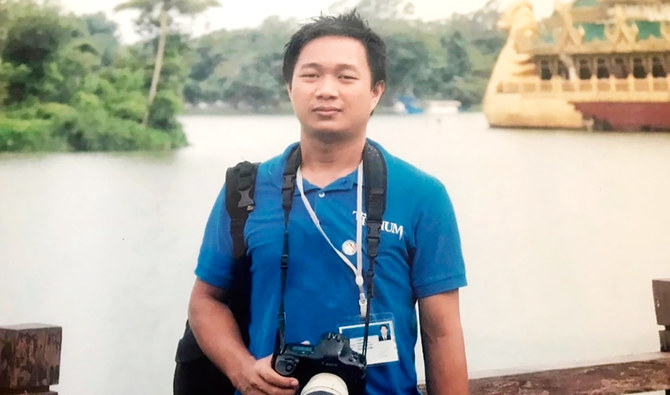
This undated family file photo shows Associated Press journalist Thein Zaw in Yangon, Myanmar. (AP)
2 / 2
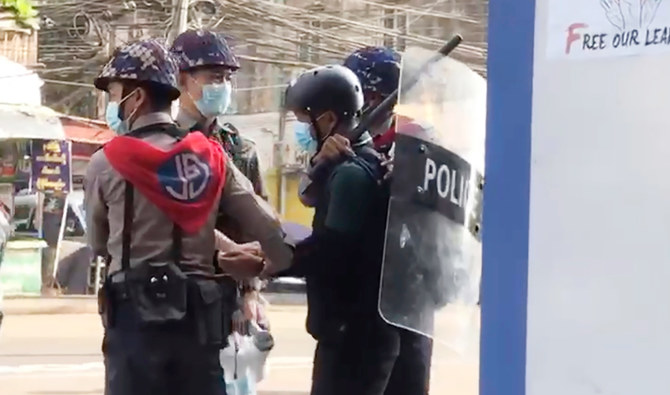
In this file image made from video taken on Feb. 27, 2021, Associated Press journalist Thein Zaw is arrested by police in Yangon, Myanmar. (AP)
Short Url
Updated 12 March 2021
Follow

Myanmar cracks down on journalists documenting anti-coup protests

  • Crackdown comes as security forces have escalated deadly violence against protesters
  • At least 38 journalists have been imprisoned for covering anti-coup protests

YANGON: Myanmar’s junta is cracking down on journalists covering mass protests, with dozens, including foreigners, being detained since the Feb. 1 coup.

The crackdown comes as security forces escalate deadly violence against protesters, who have been coming to the streets in their hundreds of thousands to demand the release of elected government leaders, including Aung San Suu Kyi, who were overthrown in the coup.

At least 12 people were killed on Thursday, when police fired live rounds at demonstrators, according to the Assistance Association for Political Prisoners (AAPP Burma), which has recorded 69 protester deaths since the beginning of the coup. AAPP estimates that 2,000 people have been detained, with at least 38 of them journalists covering the protests.

Five independent news outlets were banned from broadcasting earlier this week. Some of their premises were raided by authorities, and had their editors detained.

“The junta might (want) to block the flow of information like North Korea does. But as long as we have internet access, their crimes will be reported anyway,” an editor from Myanmar Now, one of the outlets whose offices were raided, told Arab News on Friday.

“We will continue our work to keep providing information online and defy the junta that wants to see us stop working ... It is also a revolution to stay alive when someone wants your death," he said on condition of anonymity.

On Thursday, Robert Bociaga, a Polish freelance photojournalist working with CNN and Deutsche Welle, was detained in Taunggyi, Shan State, while covering an anti-junta protest, local media reported.

While authorities refused to comment on whether the Polish reporter had been released, a court on Friday extended the pre-trial detention of six other journalists, including Associated Press photojournalist Thein Zaw who was arrested while photographing security forces charging at protesters in Yangon on Feb. 27.

Protests continued across the country on Friday, fueled by the junta’s move to bring new charges against Suu Kyi, accusing her of corruption.

“The junta is trying to portray her as a criminal. It is ridiculous,” Sandar Min, a senior member of the former ruling party National League for Democracy, told Arab News over the phone on Friday.

In Yangon’s Hlaing Thar Yar township, demonstrators raised barricades to protect tens of thousands of protestors from violence.

“We would not tolerate (it) if they attempted to disperse us violently,” protest leader Thar Zay told Arab News.

“We have prepared how to respond to them if we see such violence against protesters here.”


Gabon cuts off Facebook, TikTok after protests

Updated 18 February 2026
Follow

Gabon cuts off Facebook, TikTok after protests

Libreville, Gabon: Facebook and TikTok were no longer available in Gabon on Wednesday, AFP journalists said, after regulators said they were suspending social media over national security concerns amid anti-government protests.
Gabon’s media regulator on Tuesday announced the suspension of social media platforms until further notice, saying that online posts were stoking conflict.
The High Authority for Communication imposed “the immediate suspension of social media platforms in Gabon,” its spokesman Jean-Claude Mendome said in a televised statement.
He said “inappropriate, defamatory, hateful, and insulting content” was undermining “human dignity, public morality, the honor of citizens, social cohesion, the stability of the Republic’s institutions, and national security.”
The communications body spokesman also cited the “spread of false information,” “cyberbullying” and “unauthorized disclosure of personal data” as reasons for the decision.
“These actions are likely, in the case of Gabon, to generate social conflict, destabilize the institutions of the Republic, and seriously jeopardize national unity, democratic progress, and achievements,” he added.
The regulator did not specify any social media platforms that would be included in the ban.
But it said “freedom of expression, including freedom of comment and criticism,” remained “a fundamental right enshrined in Gabon.”

‘Climate of fear’

Less than a year after being elected, Gabonese President Brice Oligui Nguema has faced his first wave of social unrest, with teachers on strike and other civil servants threatening to do the same.
School teachers began striking over pay and conditions in December and protests over similar demands have since spread to other public sectors — health, higher education and broadcasting.
Opposition leader Alain-Claude Billie-By-Nze said the social media crackdown imposed “a climate of fear and repression” in the central African state.
In an overnight post on Facebook, he called on civil groups “and all Gabonese people dedicated to freedom to mobilize and block this liberty-destroying excess.”
The last action by teachers took place in 2022 under then president Ali Bongo, whose family ruled the small central African country for 55 years.
Oligui overthrew Bongo in a military coup a few months later and acted on some of the teachers’ concerns, buying calm during the two-year transition period that led up to the presidential election in April 2025.
He won that election with a huge majority, generating high expectations with promises that he would turn the country around and improve living standards.
A wage freeze decided a decade ago by the Bongo government has left teachers struggling to cope with the rising cost of living.
Authorities last month arrested two prominent figures from the teachers’ protest movement, leaving teachers and parents afraid to discuss the strike in public.