

Amid pandemic, Pakistani cities gear up for year’s largest women’s rights event

Activists of Pakistan trade unions attend a rally, ahead of International Women's Day in Lahore, Pakistan on March 7, 2021. (EPA)
Short Url
Updated 08 March 2021
Follow

Amid pandemic, Pakistani cities gear up for year’s largest women’s rights event

  • Human Rights Commission of Pakistan urges govt. to protect and empower participants during peaceful marches on International Women’s Day
  • Aurat March has attracted thousands and made headlines around the world since its inception three years ago

KARACHI: As thousands of Pakistanis prepared to partake in the country’s largest women’s rights event to mark International Women’s Day on Monday, the Human Rights Commission of Pakistan (HRCP) urged the government to “uphold” the public’s right to peaceful marches and “safe” spaces.
“Commission expects the state to uphold women’s constitutional right to freedom of peaceful assembly and to ensure that women’s marches across Pakistan on 8 March are provided security and safe public spaces,” Hina Jilani, Chairperson HRCP, said in a statement.
She added that women’s rights “do not exist in a vacuum” and were “tied intrinsically to the vigor and wellbeing of a civilized society.”
The nationwide event known as Aurat March, using the Urdu word for women, will see protests being held in different cities on Monday, with organizers saying they were expecting a low turnout due to the COVID-19 pandemic.
“The march will be held with strict health guidelines...we are expecting 3,000 to 5,000 participants this year,” Qurat Mirza, an organizer of the Karachi leg of the event, told Arab News.
It’s a comparatively low number compared to last year when “10,000 participated in the protest in Karachi,” the largest of Aurat March events in the country.
“Last year, 10,000 participated in the march in Karachi, which is the largest of Aurat marches in the country whereas the participation across Pakistan was estimated to be 50,000 including in major urban units like Karachi, Lahore, Islamabad, Quetta and Peshawar and small cities like Hyderabad, Faisalabad, Multan,” Mirza said.
Since its inception three years ago, Aurat March has made headlines worldwide when slogans and posters raised by Pakistani women and minorities became the subject of intense national debate, leading to countless reports of online harassment, including murder and rape threats.

Mirza said that this year, too, participants were willing to brave the pandemic to highlight the rising incidents of abuse against women.
“Violence against women has increased during COVID-19, and if women’s oppression hasn’t ended in the pandemic, then why should we suspend our resistance? We remind the state that our protection is our constitutional right, providing which is the duty and responsibility of the state,” Mirza said.
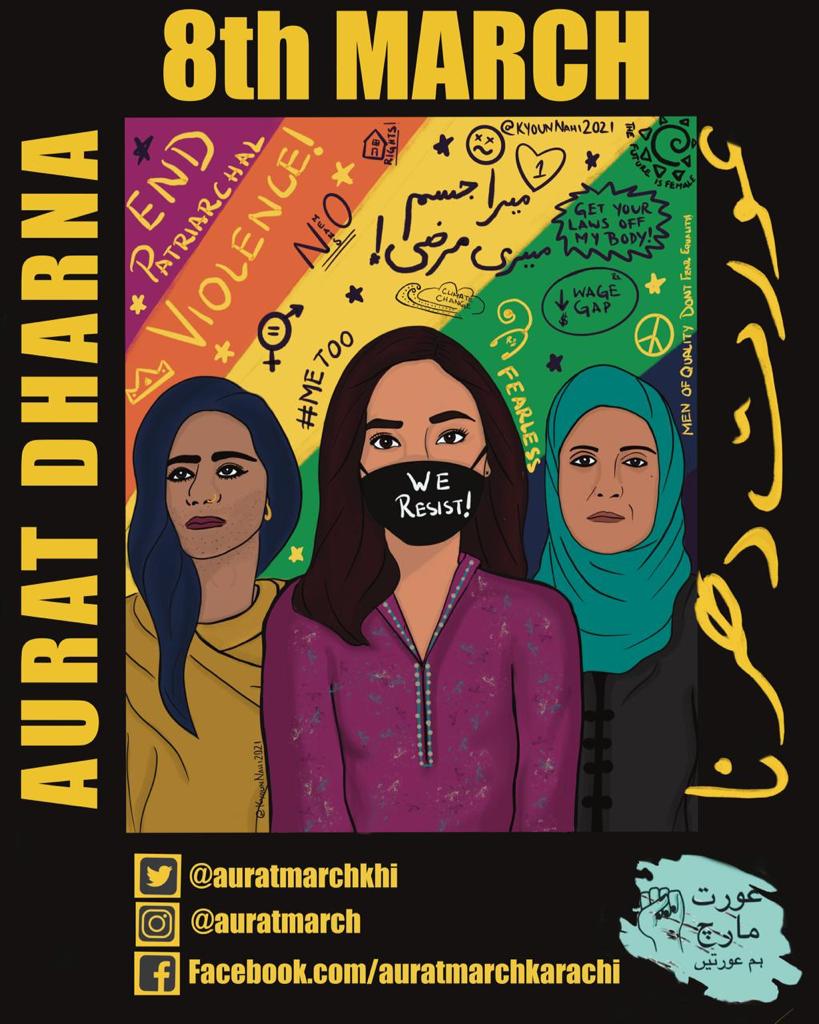
On Sunday evening, Aurat March organizers from Karachi, Pakistan’s largest city, said on Twitter that in light of the pandemic, there would be an Aurat Dharna (sit-in).
“6 foot ki doori, Magar inqilab zaruri [Please ensure 6-feet distance but the revolution is crucial],” they said on their official Twitter page. 
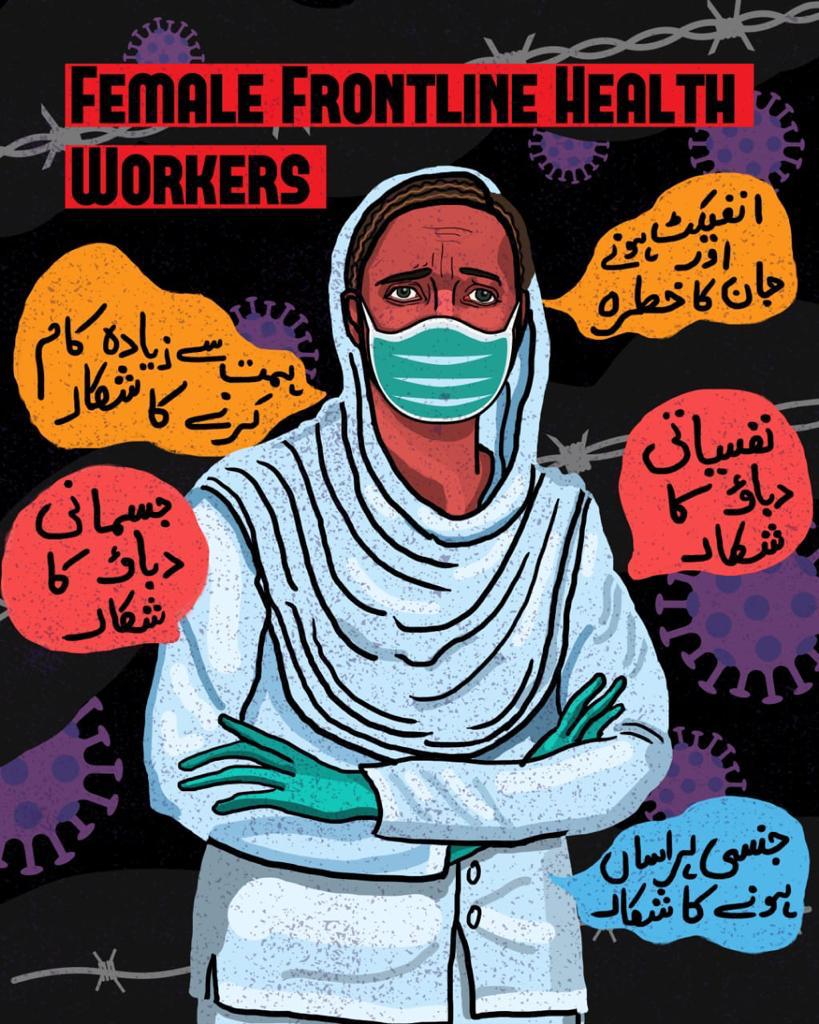
Broadly, the theme for this year’s march is women’s health care struggles and is further divided into 15 demands, which highlight patriarchal violence and discrimination faced by women and sexual minority groups when accessing health care in Pakistan.

“We have added a sit-in to the march to press for our demands. We will come out on the roads again for our rights if they are not fulfilled by authorities,” Sheema Kermani, one of the Aurat March pioneers, told Arab News on Sunday.
Last year, a court in Lahore was petitioned to place restrictions on the event, which the complainant said had an agenda of spreading ‘anarchy, vulgarity, blasphemy and hatred’ against Islam, but the march was given a conditional go-ahead.
In the past, there has been an uproar in conservative circles over slogans used, including, “My body, my choice.”
Global watchdogs have expressed concern in recent years over what they see as a growing clampdown on rights campaigns in Pakistan, and in 2020, local police submitted a report to the court stating that the event faced a threat from militant groups including Pakistani Taliban militants.


Pakistan launches digital tools to trace life insurance claims, tighten motor insurance enforcement

Updated 6 sec ago
Follow

Pakistan launches digital tools to trace life insurance claims, tighten motor insurance enforcement

  • SECP rolls out SMS-based Life Insurance Policy Finder, orders insurers to join Motor Insurance Repository
  • The regulator says centralized data will help authorities verify coverage, reduce long-unclaimed benefits

KARACHI: Pakistan’s securities regulator on Monday announced two digital initiatives aimed at overhauling how insurance data is stored and accessed, in a push to strengthen enforcement, improve transparency and make it easier for citizens to trace insurance coverage.

The Securities and Exchange Commission of Pakistan (SECP) announced in two separate statements it had introduced a nationwide Life Insurance Policy Finder to help families identify policies held by deceased relatives. It also directed all non-life insurers to join a centralized Motor Insurance Repository (MIR).

Both systems, developed with the Central Depository Company (CDC), seek to address longstanding gaps in a sector where weak records, low compliance and limited data-sharing have left motorists, policyholders and beneficiaries without reliable recourse.

“The Securities and Exchange Commission of Pakistan (SECP), in collaboration with the Central Depository Company of Pakistan Limited (CDC) and the Insurance Association of Pakistan (IAP), has introduced the Life Insurance Policy Finder Service,” it said in one of the statements. “This initiative is designed to facilitate the general public in locating life insurance policies of deceased loved ones.”

“The service addresses a long-standing challenge faced by families who remain unaware of life insurance policies held by their deceased relatives,” it added. “This lack of awareness often results in legitimate claims and benefits remaining unclaimed for years.”

The SECP said the initiative aims to strengthen consumer protection, promote transparency and provide structured and secure access to insurance benefits for rightful heirs and beneficiaries.

Under the new policy-finder service, which goes live on Dec. 15, individuals can send the CNIC number of the deceased via SMS to 99833.

If a policy exists, the relevant insurer will contact the beneficiary to verify details and guide them through the claims process. Life insurers and family takaful operators have also been instructed to participate fully and respond to queries within set turnaround times.

Separately, on the motor insurance side, all non-life insurers underwriting vehicle policies are required to sign a service-level agreement with the CDC within 60 days and begin uploading complete and validated policy data to the MIR.

The repository will allow provincial and federal authorities to verify third-party insurance coverage, a requirement that exists on paper but remains loosely enforced nationwide.

The SECP said the measures form part of its broader effort to promote digital transformation, improve compliance and safeguard consumer interest.

“A centralized and validated data repository will allow authorities to verify insurance coverage efficiently, addressing significant gaps in compliance,” it added.