

Amid pandemic, Pakistani cities gear up for year’s largest women’s rights event

Activists of Pakistan trade unions attend a rally, ahead of International Women's Day in Lahore, Pakistan on March 7, 2021. (EPA)
Short Url
Updated 08 March 2021
Follow

Amid pandemic, Pakistani cities gear up for year’s largest women’s rights event

  • Human Rights Commission of Pakistan urges govt. to protect and empower participants during peaceful marches on International Women’s Day
  • Aurat March has attracted thousands and made headlines around the world since its inception three years ago

KARACHI: As thousands of Pakistanis prepared to partake in the country’s largest women’s rights event to mark International Women’s Day on Monday, the Human Rights Commission of Pakistan (HRCP) urged the government to “uphold” the public’s right to peaceful marches and “safe” spaces.
“Commission expects the state to uphold women’s constitutional right to freedom of peaceful assembly and to ensure that women’s marches across Pakistan on 8 March are provided security and safe public spaces,” Hina Jilani, Chairperson HRCP, said in a statement.
She added that women’s rights “do not exist in a vacuum” and were “tied intrinsically to the vigor and wellbeing of a civilized society.”
The nationwide event known as Aurat March, using the Urdu word for women, will see protests being held in different cities on Monday, with organizers saying they were expecting a low turnout due to the COVID-19 pandemic.
“The march will be held with strict health guidelines...we are expecting 3,000 to 5,000 participants this year,” Qurat Mirza, an organizer of the Karachi leg of the event, told Arab News.
It’s a comparatively low number compared to last year when “10,000 participated in the protest in Karachi,” the largest of Aurat March events in the country.
“Last year, 10,000 participated in the march in Karachi, which is the largest of Aurat marches in the country whereas the participation across Pakistan was estimated to be 50,000 including in major urban units like Karachi, Lahore, Islamabad, Quetta and Peshawar and small cities like Hyderabad, Faisalabad, Multan,” Mirza said.
Since its inception three years ago, Aurat March has made headlines worldwide when slogans and posters raised by Pakistani women and minorities became the subject of intense national debate, leading to countless reports of online harassment, including murder and rape threats.
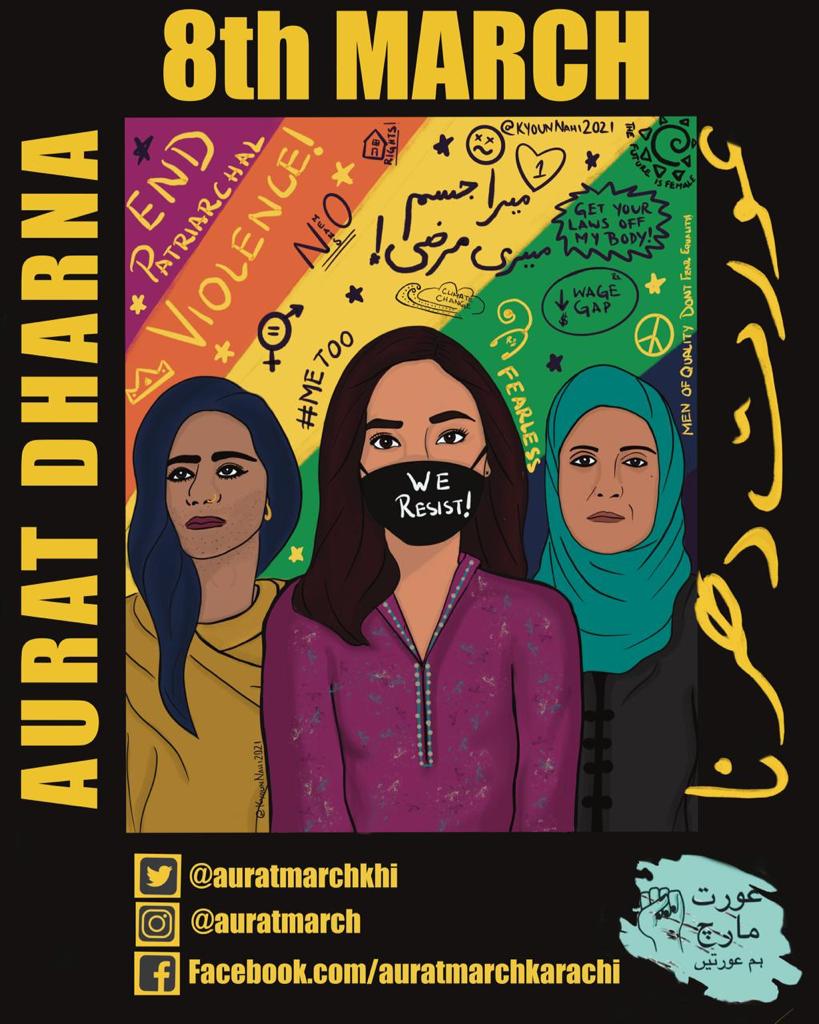

Mirza said that this year, too, participants were willing to brave the pandemic to highlight the rising incidents of abuse against women.
“Violence against women has increased during COVID-19, and if women’s oppression hasn’t ended in the pandemic, then why should we suspend our resistance? We remind the state that our protection is our constitutional right, providing which is the duty and responsibility of the state,” Mirza said.
On Sunday evening, Aurat March organizers from Karachi, Pakistan’s largest city, said on Twitter that in light of the pandemic, there would be an Aurat Dharna (sit-in).
“6 foot ki doori, Magar inqilab zaruri [Please ensure 6-feet distance but the revolution is crucial],” they said on their official Twitter page. 
Broadly, the theme for this year’s march is women’s health care struggles and is further divided into 15 demands, which highlight patriarchal violence and discrimination faced by women and sexual minority groups when accessing health care in Pakistan.
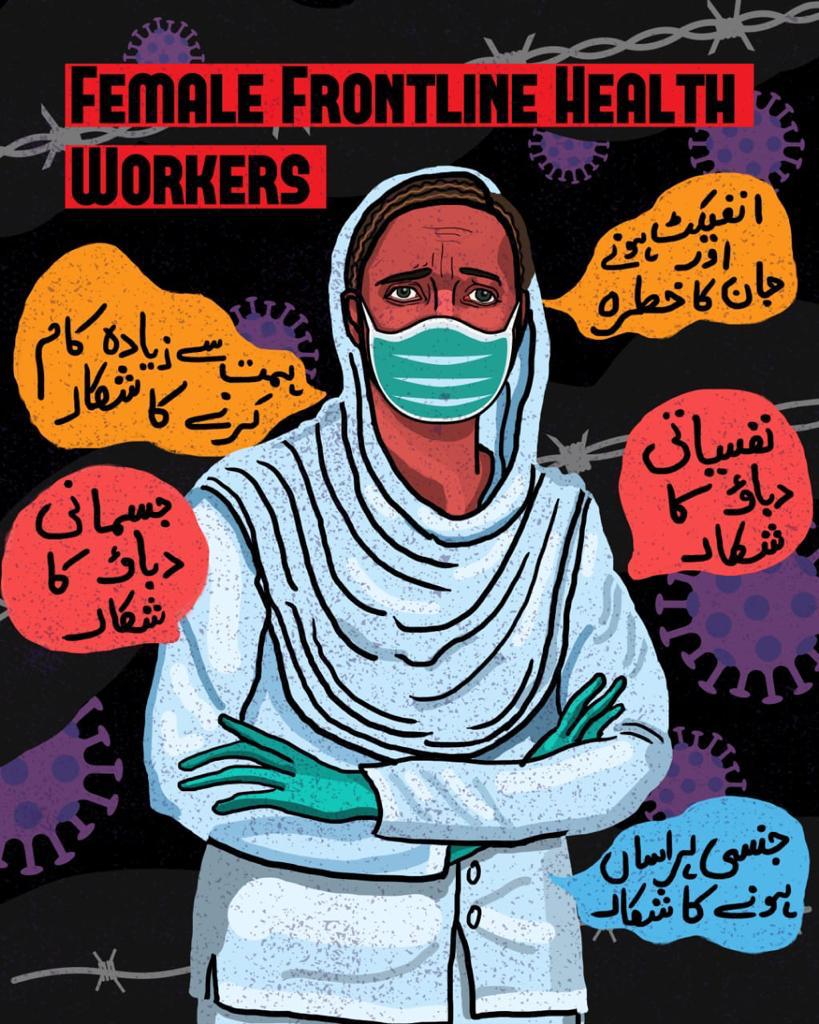

“We have added a sit-in to the march to press for our demands. We will come out on the roads again for our rights if they are not fulfilled by authorities,” Sheema Kermani, one of the Aurat March pioneers, told Arab News on Sunday.
Last year, a court in Lahore was petitioned to place restrictions on the event, which the complainant said had an agenda of spreading ‘anarchy, vulgarity, blasphemy and hatred’ against Islam, but the march was given a conditional go-ahead.
In the past, there has been an uproar in conservative circles over slogans used, including, “My body, my choice.”
Global watchdogs have expressed concern in recent years over what they see as a growing clampdown on rights campaigns in Pakistan, and in 2020, local police submitted a report to the court stating that the event faced a threat from militant groups including Pakistani Taliban militants.


Pakistan opposition rallies in Khyber Pakhtunkhwa to demand release of Imran Khan

Updated 07 December 2025
Follow

Pakistan opposition rallies in Khyber Pakhtunkhwa to demand release of Imran Khan

  • PTI-led gathering calls the former PM a national hero and demands the release of all political prisoners
  • Government says the opposition failed to draw a large crowd and accuses PTI of damaging its own politics

ISLAMABAD: Pakistan’s opposition led by the Pakistan Tehreek-e-Insaf (PTI) party demanded the release of jailed former prime minister Imran Khan at a rally in the northwestern Khyber Pakhtunkhwa province on Sunday, describing him as a national hero who continues to command public support.

The gathering came days after a rare and strongly worded briefing by the military’s media chief, Lt. Gen. Ahmed Sharif Chaudhry, who dismissed Khan as “narcissistic” and “mentally ill” on Friday while responding to the former premier’s allegations that Pakistan’s chief of defense forces was responsible for undermining the constitution and rule of law.

He said that Khan was promoting an anti-state narrative which had become a national security threat.

The participants of the rally called for “civilian supremacy” and said elected representatives should be treated with respect.

“We, the people of Pakistan, regard Imran Khan as a national hero and the country’s genuinely elected prime minister, chosen by the public in the February 8, 2024 vote,” said a resolution presented at the rally in Peshawar. “We categorically reject and strongly condemn the notion that he or his colleagues pose any kind of threat to national security.”

“We demand immediate justice for Imran Khan, Bushra Bibi and all political prisoners, and call for their prompt release,” it added, referring to Khan’s wife who is also in prison. “No restrictions should be placed on Imran Khan’s meetings with his family, lawyers or political associates.”

Addressing the gathering, Sohail Afridi, the chief minister of Khyber Pakhtunkhwa, denied his administration was not serious about security issues amid increased militant activity. However, he maintained the people of his province had endured the worst of Pakistan’s conflict with militancy and urged a rethinking of long-running security policies.

The resolution asked the federal government to restore bilateral trade and diplomatic channels with Afghanistan, saying improved cross-border ties were essential for the economic stability of the region.

The trade between the two neighbors has suffered as Pakistan accuses the Taliban administration in Kabul of sheltering and facilitating armed groups that it says launch cross-border attacks to target its civilians and security forces. Afghan officials deny the claim.

The two countries have also had deadly border clashes in recent months that have killed dozens of people on both sides.

Some participants of the rally emphasized the restoration of democratic freedoms, judicial independence and space for political reconciliation, calling them necessary to stabilize the country after years of political confrontation.

Reacting to the opposition rally, Information Minister Attaullah Tarrar said the PTI and its allies could not gather enough people.

“In trying to build an anti-army narrative, they have ruined their own politics,” he said, adding that the rally’s reaction to the military’s media chief’s statement reflected “how deeply it had stung.”

“There was neither any argument nor any real response,” he added, referring to what was said by the participants of the rally.