

Pakistan, Sri Lanka military agree to enhance defense cooperation

Pakistan Air Chief Marshal Mujahid Anwar Khan meets with Sri Lankan Prime Minister Mahinda Rajapaksa in Colombo on March 4, 2021. (Photo courtesy: PAF)
Short Url
Updated 07 March 2021
Follow

Pakistan, Sri Lanka military agree to enhance defense cooperation

  • Chief Marshal Mujahid Anwar Khan earlier this week met Sri Lankan PM Mahinda Rajapaksa and top military officials in Colombo
  • Pakistan last month offered a $50 million credit line to Sri Lanka for cooperation in the field of defense and security  

ISLAMABAD: The Pakistan Air Force (PAF) chief and Sri Lanka's defense secretary have agreed to strengthen defense cooperation, PAF said on Saturday.

Air Chief Marshal Mujahid Anwar Khan arrived in Colombo on Thursday, where he met with Sri Lankan Prime Minister Mahinda Rajapaksa and top military officials.

As Marshal Khan lauded the efforts of Sri Lankan Armed Forces in their fight against terrorism during a meeting with Defense Secretary Gen. Kamal Gunaratne, he offered Pakistan's support and cooperation, PAF said in a statement.
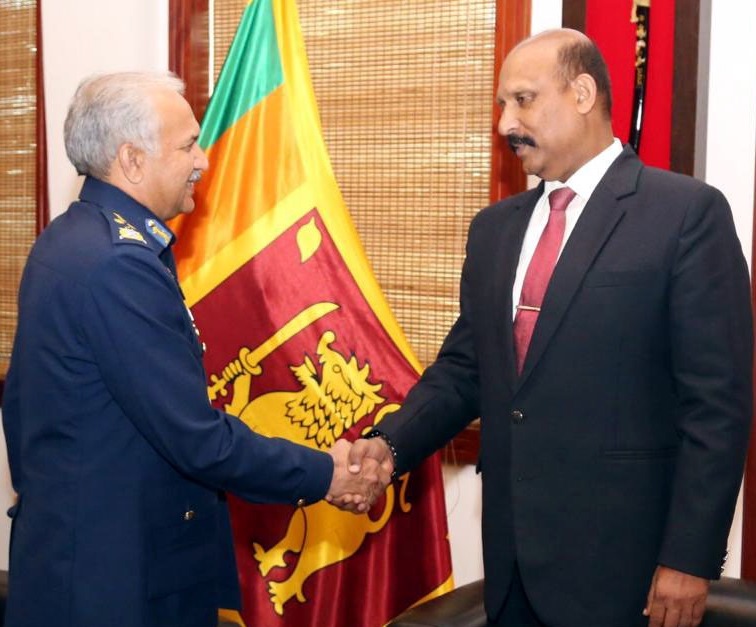


In this photo released by Pakistan Air Force (PAF) on March 6, 2021, Pakistan Air Chief Marshal Mujahid Anwar Khan meets Sri Lanka Defense Secretary Gen. Kamal Gunaratne in Colombo. (Photo courtesy: PAF)

"The leaders agreed to further enhance bilateral cooperation especially in training and professional enhancement programs," PAF said, adding that Gen. Gunaratne welcomed the Pakistani air chief's visit as "manifestation of the strong bond between the Armed Forces of both the countries, especially the two Air Forces."

The Pakistani air chief's visit follows Prime Minister Imran Khan's official visit in late February, during which Pakistan offered a $50 million new credit line to Sri Lanka for cooperation in the field of defense and security.


Pakistan to launch first national anti-polio drive of 2026 today to vaccinate millions

Updated 16 sec ago
Follow

Pakistan to launch first national anti-polio drive of 2026 today to vaccinate millions

  • Pakistani health volunteers will aim to vaccinate over 45 million children from Feb. 2-8, reports state media 
  • Pakistan reported 31 polio cases last year, which were significantly lower than the 74 cases it reported in 2024 

ISLAMABAD: Pakistani health authorities will launch the year’s first national anti-polio drive today, Monday, to vaccinate over 45 million children against the virus, state media reported as Islamabad aims to eliminate the disease. 

Eliminating poliovirus remains a critical health initiative of Pakistan, which along with Afghanistan, is one of only two countries worldwide where the virus is endemic. Pakistan reported 31 cases of polio in 2025, which authorities say is a significant decline from the alarming 74 cases of the disease it reported in 2024. 

Prime Minister’s Focal Person for Polio Eradication Ayesha Raza Farooq announced last month that the anti-polio vaccination campaign will be conducted across the country from Feb. 2 to 8, during which over 45 million children under the age of five will be targeted. She said a total of 400,000 trained health volunteers will go door-to-door to administer polio drops to children. 

“A varied duration anti-polio campaign in Punjab, Sindh and Khyber Pakhtunkhwa will begin from tomorrow [Monday],” state broadcaster Radio Pakistan reported on Sunday. 

The National Emergency Operations Center (NEOC), in an earlier statement, said six national polio campaigns were conducted across the country in 2025. The NEOC urged parents to fully cooperate with polio teams and ensure their children receive polio drops. 
Polio workers and their security escorts have repeatedly been targeted in militant attacks, particularly in parts of Pakistan’s northwestern Khyber Pakhtunkhwa (KP) and Balochistan provinces, complicating efforts to vaccinate children in remote areas. 
A gun attack targeting a polio vaccination team in Pakistan’s northwestern Bajaur district in December 2025 left one police constable and a civilian dead.

Natural disasters, such as floods, have also disrupted vaccination campaigns in recent years.