‘Revolutionary’ new cancer treatment builds on COVID-19 jab tech

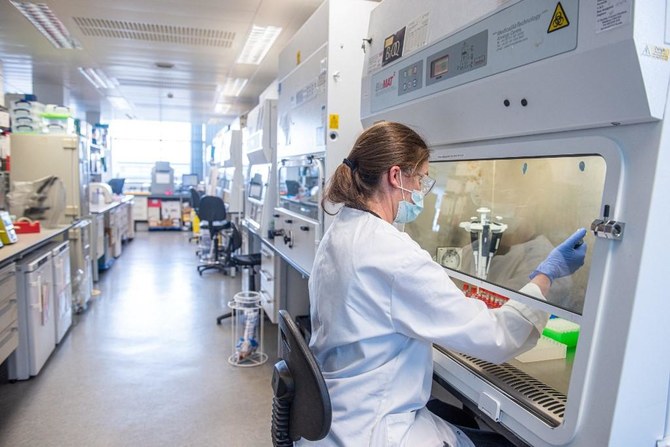
Vaccitech is deploying anti-coronavirus technology to revolutionize conventional cancer treatments. (File/AFP)
Short Url
Updated 06 March 2021
Follow

‘Revolutionary’ new cancer treatment builds on COVID-19 jab tech

  • Biotech company launched by leaders of Oxford University vaccine team
  • It is using vaccine technology pioneered during the pandemic to treat non-small cell lung cancer

LONDON: Vaccitech, a biotechnology company launched by two leaders of the Oxford University COVID-19 vaccine team, is deploying anti-coronavirus technology to revolutionize conventional cancer treatments.
The company, founded by professors Sarah Gilbert and Adrian Hill, is financed by the venture capital wing of tech giant Google.
It is using vaccine technology pioneered during the pandemic to treat non-small cell lung cancer. Clinical trials will begin this summer.
The technology’s application on prostate cancer treatment is already underway, with “very promising” results seen in an initial study.
Vaccitech is also developing “therapeutic vaccines” to treat rather than prevent diseases resulting from chronic viral infections such as hepatitis B.
Hill said: “This technology has the potential to make therapeutic vaccination a standard and very cost-effective part of most cancer treatments.”
Gilbert said: “For some cancers, vaccination to induce T cells could enable the body to destroy malignant cells in a very targeted way.”
Vaccitech CEO Bill Enright said the company will know whether the technology is successful within two years.
“It’s pretty revolutionary. If we can show proof of concept on the oncology side, it should have a huge impact,” he added.


Bangladesh sends record 750,000 workers to Saudi Arabia in 2025

Updated 56 min 35 sec ago
Follow

Bangladesh sends record 750,000 workers to Saudi Arabia in 2025

  • Latest data shows 16% surge of Bangladeshis going to the Kingdom compared to 2024
  • Bangladesh authorities are working on sending more skilled workers to Saudi Arabia

DHAKA: Bangladesh sent over 750,000 workers to Saudi Arabia in 2025, marking the highest overseas deployment to a single country on record, its labor bureau said on Friday.

Around 3.5 million Bangladeshis live and work in Saudi Arabia, sending home more than $5 billion every year. They have been joining the Saudi labor market since the 1970s and are the largest expatriate group in the Kingdom.

Last year, Saudi Arabia retained its spot as the top destination for Bangladeshi workers, with more than two-thirds of over 1.1 million who went abroad in 2025 choosing the Kingdom.

“More than 750,000 Bangladeshi migrants went to Saudi Arabia last year,” Ashraf Hossain, additional director-general at the Bureau of Manpower, Employment and Training, told Arab News.

“So far, it’s the highest number for Bangladesh, in terms of sending migrants to Saudi Arabia or any other particular country in a single year.”

The latest data also showed a 16 percent increase from 2024, when about 628,000 went to the Kingdom for work, adding to the largest diaspora community outside Bangladesh.

Authorities have focused on sending more skilled workers to Saudi Arabia in recent years, after the Kingdom launched in 2023 its Skill Verification Program in Bangladesh, which aims to advance the professional competence of employees in the Saudi labor market.

Bangladesh has also increased the number of certification centers, allowing more candidates to be verified by Saudi authorities.

“Our focus is now on increasing safe, skilled and regular migration. Skilled manpower export to Saudi Arabia has increased in the last year … more than one-third of the migrants who went to Saudi Arabia did so under the Skill Verification Program by the Saudi agency Takamol,” Hossain said.

“Just three to four months ago, we had only been to certify 1,000 skilled workers per month. But now, we can conduct tests with 28 (Saudi-approved) centers across the country, which can certify around 60,000 skilled workforces (monthly) for the Kingdom’s labor market.”

On Thursday, the BMET began to provide training in mining, as Bangladesh aims to also start sending skilled workers for the sector in Saudi Arabia.

“There are huge demands for skilled mining workers in Saudi Arabia as it’s an oil-rich country,” Hossain said.

“We are … trying to produce truly skilled workers for the Saudi labor market.”

In October, Saudi Arabia and Bangladesh signed a new employment agreement, which enhances worker protection, wage payments, as well as welfare and health services.

It also opens more opportunities in construction and major Vision 2030 projects, which may create up to 300,000 new jobs for Bangladeshi workers in 2026.