


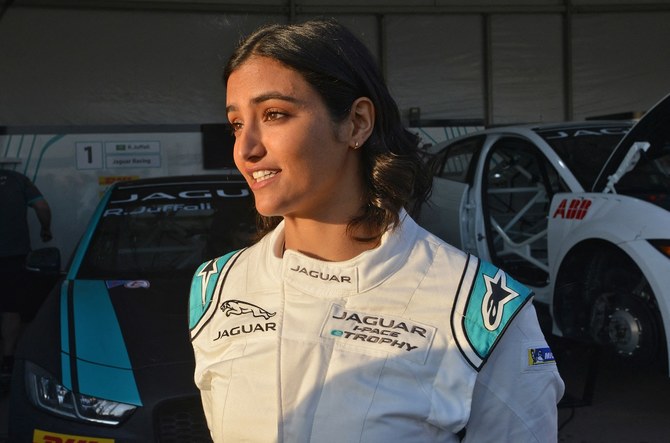

RIYADH: Within moments of meeting Reema Juffali, you will get the feeling she was always meant for a career in motorsports. Watch her drive, and those feeling are immediately confirmed.
For Saudi Arabia’s first-ever female Formula racer, the high-velocity, adrenaline-packed action has become a way of life.
“It’s a privilege to be able to do what I’m doing, racing, and racing under the Saudi flag,” the Jeddah-born motorist said. “It’s a humbling experience representing my country by being the first, and alhamdulillah (praise God), I’m pursuing my passion and doing what I love.”
It has been a momentous couple of weeks for Juffali.
Ahead of the Formula E double-header last weekend at Diriyah, Juffali announced that she will be making the move from Formula 4 to Douglas Motorsport in the BRDC British Formula 3 Championship this year.
“It’s going to be a big step for me driving a faster car, a better car, so that’s really exciting,” she told Arab News. “In terms of the future, I’m open to any opportunity that comes my way. I definitely want to race at the top level of motorsports, whether it’s in a Le Mans race or Formula E — it’s all on the cards.”
Douglas Motorsport has been taking part in the series since 2016, with 14 wins and over 60 podiums to its name. This is a major step up for Juffali, but surpassing expectations is what she does.
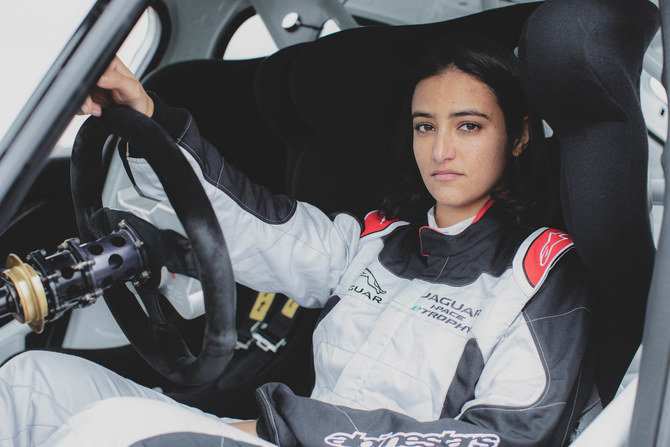
As a child, Reema Juffali defied gender stereotypes and social norms in Saudi Arabia, preferring sports while other girls chose ballet. (Supplied)
As a child, Juffali defied gender stereotypes and social norms in Saudi Arabia, preferring sports while other girls chose ballet. Her passion for cars came early, and she could name different car manufacturers from a young age. After moving to Boston to study, she began driving — still illegal at the time in Saudi Arabia — and she fell in love with Formula 1.
When it became legal for women to drive in the Kingdom in 2018, she would be the first one out there on the circuit.
“I got approval from the federation to get my license in the UK, and it turned out to be a very simple process,” she told Arab News. “One only needed to receive a medical check-up, to understand the safety regulations and what the flags and signals meant, as well as to pass a one to two-lap test demonstrating this knowledge.
“It felt like I had just graduated from university,” she added. And when the time came, she converted that license into a Saudi one to race under the Kingdom’s banner.
Juffali stressed the importance of her family’s support in pursuing her dreams, despite their initial concerns for her safety.
“My mother and father both really supported me and encouraged me. In a sport like this, there’s quite a lot happening; you really do need a good support system,” she said.
“In the beginning, my friends and family were a bit apprehensive. ‘Is this safe?’ they asked. And I explained that I had done my research, that I had received as much experience as I could before getting into the car and that it was my passion, my dream. I think that was important for them to hear,” she added.
Whatever early doubts there may have been, Juffali pressed ahead with what she believed was her true calling — a professional career in motorsports.
“It’s amazing to be able to compete in a sport where the gender barriers are still evident, but when you’re on track it doesn’t really matter,” she said.
“And for me, at the end of the day, it’s all the same: Whether I’m racing against a male or a female, I just want to get ahead of them, and I want to win.”
A pivotal moment in Juffali’s career was meeting Susie Wolff, former professional racing driver and current Team Principal of Venturi Racing, while attending the Abu Dhabi Grand Prix. The Scottish driver would become a mentor for the young Saudi.
“I saw it as a sign that I needed to start. I needed to go after my dream,” Juffali said. “When I did, I reached out to her again and told her ‘I’m racing, I did it,’ and she honestly was super happy for me.”
Prior to Juffali’s first race, she had only trained for six weeks with her coach in England. She said it was like being “thrown into the deep end.”
Juffali ignored the noise around her and focused on improving herself by getting out on the track as much as possible and putting herself in different scenarios, such as racing under different weather conditions, particularly the rain, and driving different cars.
She quickly learned from her mistakes and became the proficient driver she is today.
Juffali fondly recalled achieving her first purple, or quickest, lap.
“I was like, ‘Really? Are you sure? Is it me?’,” she said excitedly. It was one of the first moments she believed she was the real deal.
Juffali admitted that in the early days she would suffer from overdriving, in which a rookie driver will often depend on what they are learning rather than what they are feeling.
“I still battle with that sometimes, when a scenario appears that I haven’t been in before,” she said. “I do sometimes overthink and overdrive and when that happens, you make mistakes. I’m now more exposed to these scenarios and I have more experience, so I think less and I just do more. I feel more, let’s say. I go with my instinct and gut rather than what I think I need to do.”
Juffali said the most important aspects of racing are consistency, precision and keeping a calm head. Those qualities quickly led to success on the track.
The now 29-year-old driver was in complete disbelief after her first win at the TRD 86 Cup in Dubai.
“A high point was definitely my first win,” she said. “That came as a shock to me because of the way the race was set up. It was a two-part race, and I didn’t realize that I was first. I finished the race thinking ‘Am I actually first?’ and I kept asking people: ‘Is it real? Is it happening?’”
On top of racing, Juffali sees the track as a form of therapy and encourages people to take their stresses and anxieties out on the tarmac, where one is permitted to put the pedal to the metal. “I get that all out on the track, so when I’m in the car on normal roads I’m quite relaxed,” she said.
Juffali stressed the importance of adhering to traffic laws and road safety, explaining that the best way to do so was to be mindful of those around you.
“Think about each other,” she said. “When you’re on the road, it’s not just yourself; you’re putting other people in harm’s way if you’re driving recklessly.”
For those wishing to follow in her footsteps, Juffali broke down the differences in the varying single-seater Formula categories.
“Formula 4 is the introductory level. It’s the one that has the least power. It’s the slowest and least aerodynamic,” she said. “With Formula 3, you get more power and become more aerodynamic, which means the downforce increases, so it becomes physically harder to drive. Formula 2 is closest to Formula 1. At this level, there is more power and the cars are bigger. Formula 1 is a completely different ballgame.”
The societal changes that have empowered women in the Kingdom over recent years have paved the road for Juffali to achieve her dreams. And she has a word of advice for others looking to do the same.
“I think the most important thing, and the thing that I would’ve liked to hear myself, is that it doesn’t hurt to try, to put yourself in different situations, to experience different things, to try everything,” she said. “That’s how you’re going to find your passion. That’s how you’re going to find your calling.”


