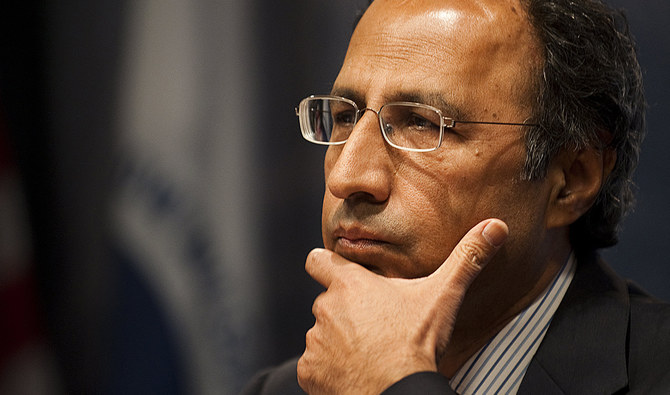
KARACHI: Following the ruling Pakistan Tehreek-e-Insaf party’s loss of a key senate seat in Islamabad on Wednesday, experts say Finance Minister Dr. Abdul Hafeez Shaikh, who lost to joint opposition candidate Syed Yousaf Raza Gilani, has limited options to secure his political future.
Shaikh took oath as a federal minister under a presidential ordinance in December 2020 and is required to win a parliamentary seat until June this year to continue in his post.
“The government can retain him as special adviser, a position he held earlier, but he will not be able to enjoy the privileges of a cabinet minister under that arrangement,” vice chairman of the Islamabad Bar Council Zulfiqar Ali Abbasi told Arab News on Thursday. “Otherwise, there are no alternative options available to him and he will have to go.”
The presidential ordinance to elevate Shaikh as the federal finance minister was issued following a verdict by the Islamabad High Court (IHC) on including advisers and special assistants in cabinet meetings and committees.
The country’s constitution stops unelected individuals to work as ministers beyond six months, stipulating that such individuals cannot be appointed as ministers at the end of the six-month term unless they become members of parliament within that period.
However, some experts believe that the government can still get him elected before June and such a precedent exists.
“The government can retain him either as an adviser or make someone resign from a senate or national assembly seat where it is hundred percent confident of its victory,” Dr. Ikram ul Haq, a Lahore-based legal and financial expert, told Arab News. “Musharraf got Shaukat Aziz elected from Tharparkar in the past.”
Shaikh spearheaded the Pakistani team of economic managers dealing with the International Monetary Fund (IMF), but analysts say his departure will have little impact on the fund’s $6 billion loan program.
“The IMF program will remain on track because [Governor State Bank] Dr. Reza Baqir can assume a key role as he did during the staff level agreement with the fund,” Dr. Vaqar Ahmed, joint executive director at the Sustainable Development Policy Institute, told Arab News.
However, he said there was no doubt the government was in a tough spot.
After Shaikh’s defeat in the Senate election, the Pakistan Stock Exchange plummeted by 2.2 percent on Thursday morning, its highest fall in the last three months, though it recovered some of its losses during the day.
“The decline was caused by a perception that the government’s political alliance was weakening, and the country could witness an uncertain environment in the coming days,” Mohammed Sohail, chief executive officer at Karachi’s Topline Securities, told Arab News. “The market can stabilize once again if Prime Minister Imran Khan manages to win the vote of confidence.”
A report by Arif Habib Limited on Thursday said Asad Umar and Hammad Azhar could be two potential candidates for the post of finance minister, if Shaikh did not make it. Umar is currently serving as planning minister and Azhar as minister of industrial production.


![]()

Pakistan’s finance minister has limited political options after senate defeat — experts
Short Url
https://arab.news/gzvfx
Pakistan’s finance minister has limited political options after senate defeat — experts
- Abdul Hafeez Shaikh was defeated by a joint opposition candidate in a major senate contest in Islamabad on Wednesday
- Appointed under a presidential ordinance, Shaikh is required to win a parliamentary seat until June to continue as finance minister
Latest updates


© 2026 SAUDI RESEARCH & PUBLISHING COMPANY, All Rights Reserved And subject to Terms of Use Agreement.