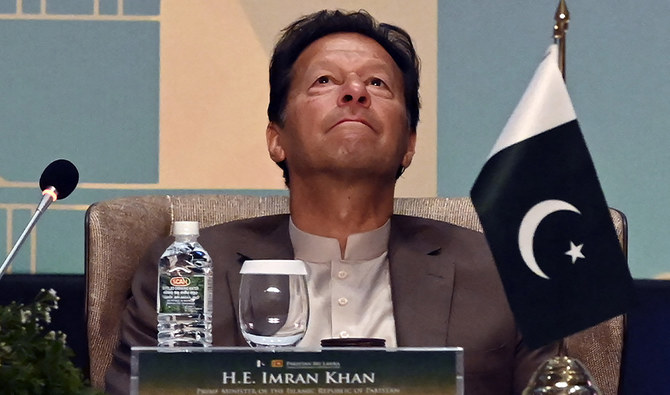
ISLAMABAD: All eyes are on Prime Minister Imran Khan after his Pakistan Tehreek-e-Insaf party announced he would seek a vote of confidence from parliament following a major setback to the government in a landmark senate poll on Wednesday.
Opposition politician Yousuf Raza Gillani defeated finance minister and key Khan aide Hafeez Sheikh, receiving 169 votes to Sheikh’s 164. Gillani’s success suggested some ruling party lawmakers had revolted and didn’t vote for Shaikh for the key seat reserved for the capital Islamabad, analysts said.
“PM Khan will take a vote of confidence from Parliament,” the ruling party said in a tweet, quoting Foreign Minister Shah Mahmood Qureshi.
The announcement came after Pakistan Peoples Party chairman Bilawal Bhutto Zardari urged Khan to accept defeat and resign as the opposition would seek a motion of no confidence against him.
“We will choose our timing when to use the option of no-confidence against the prime minister,” Bilawal said while addressing a press conference along with Gillani after the announcement of results by the Election Commission of Pakistan. “He should morally resign now, but we know he neither did it before nor will do it now … We will now get Yousuf Raza Gillani elected as Chairman Senate.”
Speaking on the occasion, Gillani said credit for his victory goes to “all the democratic forces” in the country.
“It’s a victory of democracy and it’s a victory of the parliament,” he said.
Despite winning the 2018 general election, Khan’s coalition does not have the majority in the upper house of parliament needed to pass key legislation.
The electoral college for the senate elections, which are held every three years on half of the chamber’s strength, comprises Pakistan’s four provincial assemblies and the lower house of parliament. With opposition parties controlling the senate, the government has had to pass interim legislation through presidential ordinances, which expire in 120 days.
The government’s legislators and allies in the lower house of parliament voted to make Khan’s finance minister Shaikh a senator.
At the end of polling, Khan’s ruling party had bagged 18 new seats, the opposition Pakistan Peoples Party got eight new senators elected and the Pakistan Muslim League-Nawaz only won five seats. The Balochistan Awami Party — an ally of the ruling PTI — secured six more seats.
In Pakistan, a senator serves a term of six years, barring resignation, disqualification, or other extraordinary circumstances. Half of the senators are elected at one time, and the other half three years later.
This year, 52 senators elected in 2015 are set to retire; the other 52 will retire in 2024. However, elections are being held only for 48 seats after Pakistan’s northwestern Federally Administered Tribal Areas (FATA) were merged with the Khyber Pakhtunkhwa province in 2018. The senate thus now comprises 100 lawmakers: 23 each from all the provinces and four from Islamabad. The remaining four senators from FATA will retire in 2024.
The Pakistani Supreme Court ruled this Monday that senate elections would continue to be held through a secret ballot as per the constitution but directed the election commission to use technology to check against corrupt practices in the polls.
The court’s 4:1 verdict came in response to a presidential reference filed in December, seeking the court’s opinion on whether voting in senate elections could be held through an open ballot.
The government of PM Khan has argued that open balloting would introduce transparency into a voting process that has long been plagued by irregularities, with national and provincial lawmakers accused of selling their votes.
Leaders of the opposition alliance, the Pakistan Democratic Movement (PDM), have opposed the government’s move to try to hold senate elections through an open ballot.
On Tuesday, the election commission said senate elections this year would be held as “per past practices,” saying it was setting up a monitoring mechanism to identify corrupt practices in the elections.
On Tuesday night, a video surfaced showing the son of Gillani explaining to lawmakers how they can waste their vote during the election. The government has since demanded the election commission declare Gillani ineligible and has filed a reference with the commission seeking his disqualification for being involved in “corrupt practices.”


![]()
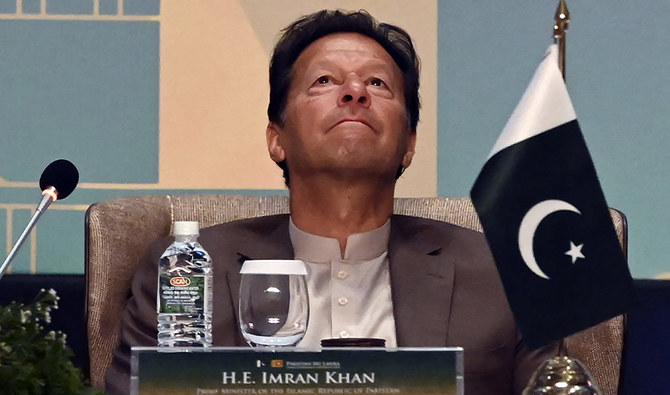
All eyes on Pakistani prime minister after senate election setback
Short Url
https://arab.news/5kd2u
All eyes on Pakistani prime minister after senate election setback
- Yousaf Raza Gillani’s success in senate poll suggests some ruling party lawmakers revolted and didn’t vote for Sheikh for key seat reserved for Islamabad
- Foreign Minister Qureshi says Khan will seek a vote of confidence from National Assembly to prove he still enjoys a majority in parliament
Latest updates


© 2026 SAUDI RESEARCH & PUBLISHING COMPANY, All Rights Reserved And subject to Terms of Use Agreement.