



UMERKOT, Sindh: For generations now, members of the ancient Jogi community in Pakistan’s vast Thar Desert have thrived on catching venomous snakes and making them dance to their music.
Today, the nomadic snake charmers of Pakistan’s southern Sindh province are vanishing due to a lack of government patronage and as younger generations attend school and opt for professions with more reliable incomes.
But Misri Jogi, a famous chieftain of the community, says he is resolved to keep the dying art of snake charming alive.
A teacher and leader of the profession, Misri has received various awards for his skills, including the ‘Award of Excellence’ from the president of Pakistan. He is also the last snake charmer in Sindh who can make the murli, or special flute used for snake charming.
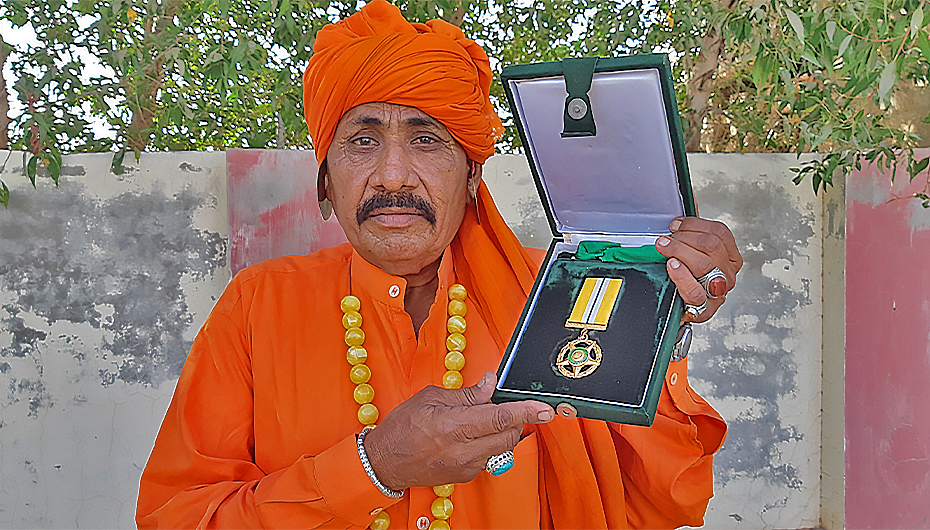
Chief of the snake charmers' community, Misri Jogi showcases the “Tamgha-e-Imtiaz” medal, conferred to him in 2013, in Umerkot, in the Thar desert region of Pakistan, on February 28, 2021. (AN photo by Zulfiqar Kunbhar)
“In the past, one out of every household could make the murli in my generation,” Misri said in an interview at the Misri Jogi colony in Sindh’s Umerkot district. “Today there is hardly any need for a murli-maker as snake charming as an art has collapsed. I am the only murli-maker left in the Thar region.”
The colony is home to an estimated 5,000 households of Jogis, Misri said, saying there were around 100,000 snake charmers in Sindh, and 30,000 just in Umerkot.
“I am trying to pass on my generation’s art to the world as well as my future generations knowing they will not use it,” Misri lamented as he sat on the ground making a murli out of a dry hollowed gourd and two bamboo attachments. A crowd encircled him, watching intently. “But at least they will remember it,” he added, touching a hand to his high, gracefully folded orange turban.
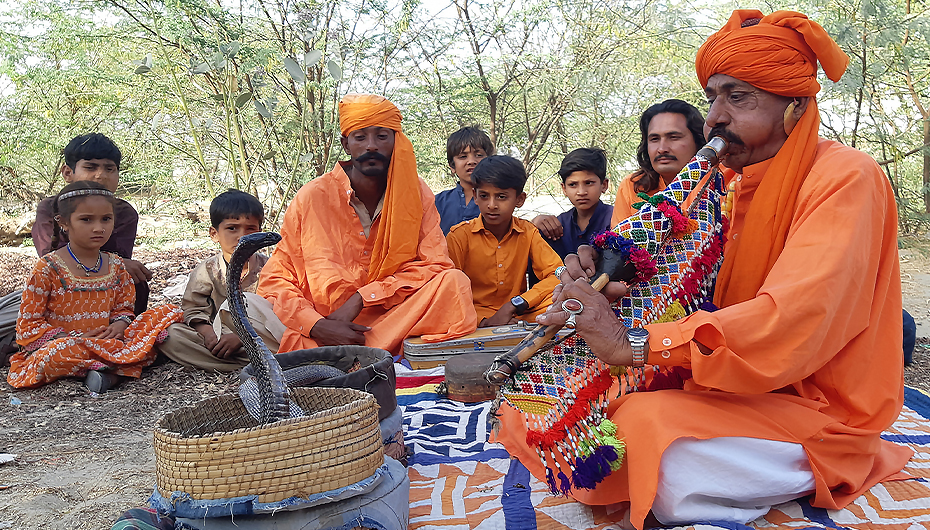
Chief of the snake charmers' community, Misri Jogi, charms a cobra with his murli, a wind instrument, in Umerkot in the Thar desert region of Pakistan, on February 28, 2021. (AN photo by Zulfiqar Kunbhar)
Misri’s Girnari tribe is one of the many groups that has historically practiced snake charming in the Thar desert. The tribes, including Misri’s own, are followers of the late saint Goga Pir. According to their beliefs, the Jogis make a sacred pact with a snake in the name of their saint, promising to release it into the wild anywhere between a period of two months to a year. The snake charmers promise the snake milk and water and in return it promises not to hurt them and guards them against evil. Many charmers will even let the cobras sleep in their beds during winter nights.
But even finding snakes was becoming a challenge now, Misri said, due to increased loss of habitats as agriculture grew and became more mechanized. And it did not help that many people increasingly now linked the art with “beggary.”
“Snake charming has been our sole bread and butter,” he said. “Since there is no government support, artists were helpless and were forced to beg in return for showcasing the art.”
He said if the government wished to preserve the art, it must set up a vocational training center in the Thar Desert. Otherwise more and more within the younger generation would abandon the profession, especially as opportunities for formal schooling opened up, Misri said.
Unlike his father, 22-year-old Prem Jogi said he did not learn snake charming but apprenticed instead at a mechanic’s shop. Today, he owns a motorbike repair shop in Umerkot town.

Prem Jogi poses for a picture as he repairs a motorbike in his shop in Umerkot in the Thar desert region of Pakistan, on February 28, 2021. (AN photo by Zulfiqar Kunbhar)
“Begging that comes because of snake charming is an insult; you cannot bear it for long,” Prem told Arab News. “The new generation is getting away from snake charming in order to preserve their self respect.”


