

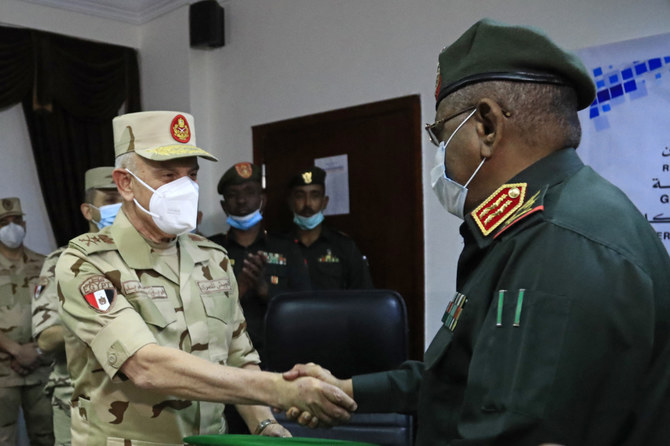
Egypt, Sudan to strengthen military pact

Egypt and Sudan have extended their joint relations on security since Lt. Gen. Abdel Fattah Al-Burhan became president of the transitional Sovereignty Council of Sudan following the ouster of former President Omar Bashir. (AFP)
Short Url
Updated 02 March 2021
Follow

Egypt, Sudan to strengthen military pact

CAIRO: Mohamed Othman Al-Hussein, Sudan’s military chief of staff, and his Egyptian counterpart, Lt. Gen. Mohammed Farid, signed a bilateral agreement at a meeting of the Egyptian-Sudanese military committee in Khartoum on Tuesday.

An Egyptian military delegation is visiting Sudan to hold key meetings as part of joint military cooperation.

Farid led a high-level military delegation to Khartoum to take part in the seventh meeting of the joint Egyptian-Sudanese military committee, headed by the chiefs of staff of both countries.

He will hold talks as part of military cooperation and strategic partnership between the two countries.

Egypt and Sudan have extended their joint relations on security since Lt. Gen. Abdel Fattah Al-Burhan became president of the transitional Sovereignty Council of Sudan following the ouster of former President Omar Bashir.

Last November, Sudanese air force units and Egyptian commando teams conducted a joint Egyptian-Sudanese air drill, Nile Eagles1, the first of its kind.

During a visit by Farid to Khartoum in November, Egyptian and Sudanese military leaders agreed to accelerate joint security and military cooperation.

They also agreed to carry out more drills for all armed forces branches, and step up cooperation in training, border security and combating terrorism, as well as technical insurance and military industries.


Iran unrest persists, top judge warns protesters

Updated 08 January 2026
Follow

Iran unrest persists, top judge warns protesters

  • Demonstrations sparked by soaring inflation
  • Western provinces worst affected

DUBAI: Iran’s top judge warned protesters on Wednesday there would be “no ​leniency for those who help the enemy against the Islamic Republic,” while accusing Israel and the US of pursuing hybrid methods to disrupt the country.
The current protests, the biggest wave of dissent in three years, began last month in Tehran’s Grand Bazaar by shopkeepers condemning the currency’s free fall. 
Unrest has since spread nationwide amid deepening distress over economic hardships, including rocketing inflation driven by mismanagement and Western sanctions, and curbs on political and ‌social freedoms.
“Following announcements ‌by Israel and the US president, there is no excuse for those coming ‌to the ​streets for ‌riots and unrest, chief justice Gholamhossein Mohseni Ejei, the head of Iran’s judiciary, was quoted as saying by state media.
“From now on, there will be no leniency for whoever helps the enemy against the Islamic Republic and the calm of the people,” Ejei said.
Iranian authorities have not given ‌a death toll for protesters, but have said at least two members of the security services have died and more than a dozen have been injured.
Iran’s western provinces have witnessed the most violent protests.
“During the funeral of two people ​in Malekshahi on Tuesday, a number of attendees began chanting harsh, anti-system slogans,” said Iran’s Fars, news agency.
After the funeral, Fars said, “about 100 mourners went into the city and trashed three banks ... Some started shooting at the police trying to disperse them.”
The semi-official Mehr news agency said protesters stormed a food store and emptied bags of rice, which has been affected by galloping inflation that has made ordinary staples increasingly unaffordable for many Iranians.