

Global markets rebound as rate hike worries fade

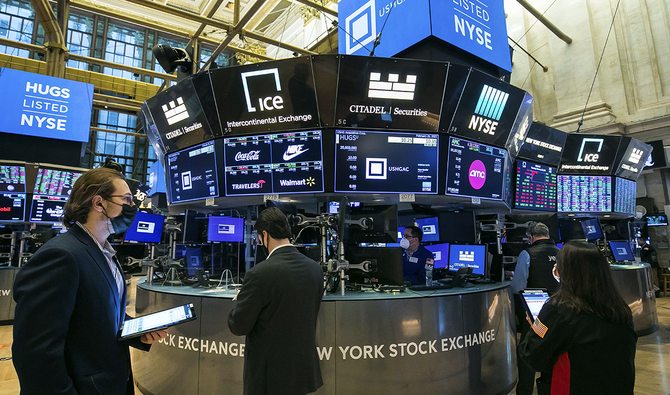
Global shares rose Monday, lifted by hopes President Joe Biden’s stimulus package will be enacted and by bargain-hunting after sell offs last week. (AP)
Short Url
Updated 02 March 2021
Follow

Global markets rebound as rate hike worries fade

  • Wall Street stocks snapped higher at the open and kept pushing up further

LONDON: World stock markets shot higher on Monday, bouncing back from last week’s heavy selloff as worries about early interest rate hikes faded and US Treasury yields dropped, dealers said.

Wall Street stocks snapped higher at the open and kept pushing up further, recovering much of the ground they lost at the end of last week.

The blue-chip Dow was up 2.1 percent in late morning trading, with the broader S&P 500 and tech-heavy Nasdaq Composite also gaining more than 2 percent.

In Europe, London, Frankfurt and Paris all closed the day 1.6 percent higher.

Asian stocks rose strongly on bargain-buying as the passage of President Joe Biden’s $1.9-trillion Covid relief stimulus through the US House of Representatives provided additional cheer.

While many Democrats are disappointed a $15 minimum wage can’t be included in the package in the US Senate, “it does have the short term benefit of making the path to passing the American Rescue Plan that bit easier,” noted Spreadex analyst Connor Campbell.

Oil prices climbed before this week’s output meeting of the OPEC group of oil producers and their allies, while the dollar advanced versus the euro and yen.

“Equity markets have shaken off the negative sentiment that was doing the rounds last week as the pullback in government bond yields has seen buyers step into the fold,” said analyst David Madden at online trading firm CMC Markets UK.

Stocks took a beating last week as government bond yields spiked higher, with investors worried that too much stimulus will spark inflation and push central banks into raising interest rates earlier than expected.

In a bid to calm markets, several central banks — including in Japan, South Korea and the European Union — sought over the weekend to reiterate their pledges to maintain their ultra-loose monetary policies for as long as needed.

Australia’s led the way by ramping up its asset purchases to keep rates low.

“Traders feel more confident about snapping up relatively cheap stocks as they are less fearful that central banks will look to tighten their policy anytime soon,” said Madden.

News that Johnson & Johnson’s one-shot vaccine had been given the green light by US regulators — paving the way for a quicker rollout of vaccinations — added to the positive sentiment on Monday.

“Now that the US has three highly effective Covid vaccines, expectations for herd immunity at some point in the summer should release a lot of pent up buying power from the US consumer,” said Oanda analyst Edward Moya.

He said this is renewing interest in stocks in smaller companies with investors betting that an early drop in restrictions will boost their fortunes.

Oil prices also rebounded with focus on the key meeting of the OPEC+ group of major producers on Thursday, when they will discuss the huge output cuts that have provided much-needed support to prices.

Russia is said to be keen to turn on the taps again but Saudi Arabia prefers to keep the status quo.

Record $14.4bn rise in Saudi holdings of US Treasuries

Updated 19 January 2026
Follow

Record $14.4bn rise in Saudi holdings of US Treasuries

RIYADH: Saudi Arabia increased its holdings of US Treasuries by 10.71 percent in November in what was the largest increase since data tracking began in 1974, according to the latest official data,

The Kingdom’s US Treasury portfolio stood at $148.8 billion in the month, up $14.4 billion from October.

Following the increase, Saudi Arabia moved up one place to 17th place among the largest foreign holders of US Treasuries.

Countries including Saudi Arabia invest in US Treasuries for their perceived safety, liquidity, diversification benefits, and alignment with economic ties to the US. 

The Kingdom’s holdings were 17.25 percent higher in November compared with January 2025.

The allocation highlights Saudi Arabia’s preference for longer-dated US government debt as part of its foreign reserve strategy, focused on capital preservation, liquidity, and diversification amid global market volatility. 

Saudi Arabia’s holdings included $106.8 billion in long-term securities, accounting for 72 percent of the total, while short-term holdings stood at $42 billion, or 28 percent. 

Globally, Japan remained the largest foreign holder of US Treasury securities at $1.2 trillion, followed by the UK at $888.5 billion, mainland China at $682.6 billion, and Belgium at $481 billion. 

Canada ranked fifth with holdings of $472.2 billion, followed by the Cayman Islands and Luxembourg in sixth and seventh positions, with portfolios valued at $427.4 billion and $425.6 billion, respectively. 

France placed eighth with $376.1 billion, followed by Ireland at $340.3 billion and Taiwan at $312.5 billion. 

Other countries included in the top 20 list include Switzerland, Singapore, Hong Kong, and Norway, as well as India and Brazil. 

The trade relationship between Saudi Arabia and the US remains strong, with the Kingdom exporting SR5.20 billion ($1.39 billion) worth of non-oil goods in October, data from the General Authority of Statistics showed.

Speaking to Arab News in October, Nasser Saidi, founder and president of economic and financial advisory services firm Nasser Saidi & Associates and a former minister of economy and trade in Lebanon, said US Treasuries are a critical pillar of stability.

“Holding treasuries allows Saudi Arabia to meet its international payment obligations — finance imports, service external debt, portfolio, and capital flows — provide a buffer against oil revenue shocks, while also generating a steady, low-risk stream of income,” he said.