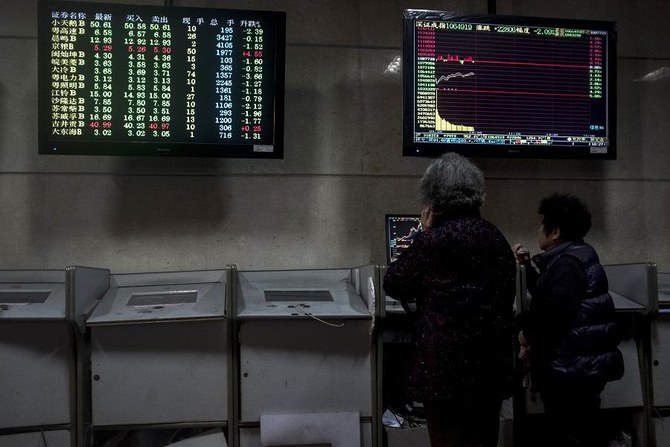
GLOBAL MARKETS: Silver jumps, stocks slide as social trading roils market

New variants of the novel coronavirus have prolonged lockdowns and delayed expectations of an economic rebound. (File/AFP)
Short Url
Updated 30 January 2021
Follow

GLOBAL MARKETS: Silver jumps, stocks slide as social trading roils market

  • Silver rallied and was up 2 percent at $26.90 an ounce

NEW YORK/LONDON: Silver prices jumped and global equity markets sank on Friday amid a growing battle on Wall Street between hedge funds and retail investors, while a dispute over COVID-19 vaccine supply in Europe cooled risk appetite.
Disappointing vaccine data from Johnson & Johnson also hurt sentiment but the assault of retail traders using online forums to force hedge funds to reverse short positions — bets that stocks will fall — kept the market on edge.
Shares of GameStop Corp. and AMC Entertainment Holdings Inc. surged again after Robinhood and Interactive Brokers said they planned to ease restrictions after imposing buying halts on Thursday.
GameStop soared 67.9 percent to $325 a share, five times its closing price a week ago Friday, and AMC gained 53.7 percent, both in heavy trade. AMC was one of the most active stocks on the New York Stock Exchange. Volume on US exchanges was 16.83 billion shares, up from the 10.6 billion average in the fourth quarter.
Silver rallied and was up 2 percent at $26.90 an ounce, taking gains to almost 10 percent since messages began to circulate on Reddit early Thursday urging retail investors to pile into the market and drive up prices.
Anxiety has grown as investors ask whether hedge funds will need to liquidate other positions to address losses in stocks they have shorted, said Michael Arone, chief investment strategist at State Street Global Advisers in Boston.
“Once this short squeeze inevitably ends and there aren’t any more greater fools to bid up these stocks, will retail investors get stuck holding the bag?” Arone asked.
“The unintended consequences of this potential volatility have markets on edge as we end the week,” Arone said.
Arone added that investors need to take a giant step back as earnings are strong, the economy is improving, fiscal and monetary policy is supportive and vaccines are rolling out.

MSCI’s benchmark for global equity markets fell 1.82 percent to 642.57, while Europe’s broad FTSEurofirst 300 index closed down 1.95 percent at 1,524.1 to post its worst weekly loss, at 3.3%, since October.
On Wall Street, the Dow Jones Industrial Average fell 2.03 percent, the S&P 500 lost 1.93 percent and the Nasdaq Composite dropped 2 percent. The three indexes suffered their biggest weekly fall since the end of October.
MSCI’s broadest index of Asia-Pacific shares outside Japan fell 1.1 percent to post a weekly loss of 4.4 percent. Japan’s Nikkei fell 1.9 percent, recording its first weekly loss of the year.
Vaccine dispute
Delays in COVID-19 vaccine production have snowballed into a spat between Britain, the European Union and drugmakers over how best to direct limited supplies.
AstraZeneca Plc offered eight million more doses of its COVID-19 vaccine to the European Union after it unexpectedly announced supply cuts last week. But the bloc said that was far short of what was originally promised, an EU official told Reuters on Friday.
New variants of the novel coronavirus have prolonged lockdowns and delayed expectations of an economic rebound.
The US dollar retreated from its highest level since mid-November against the Japanese yen as investors rebalanced portfolios for month-end. The greenback slid 0.48 percent against the yen and traded little changed against an index of currencies, falling 0.002 percent.
Bitcoin jumped as much as 14 percent to a two-week high after Tesla Inc. chief Elon Musk tagged the cryptocurrency in his Twitter biography.
French 10-year government bond yields, which move inversely to price, rose four basis points after France’s gross domestic product contracted less than expected in the fourth quarter of 2020.
US Treasury yields rose, in line with those in Europe, after data showed inflation perked up last month, while employment costs rose, suggesting the world’s largest economy is on the mend from the devastating effects of the pandemic.
The US yield curve steepened as long yields increased, with the spread between 2-year and 10-year notes hitting 98.20 basis points, the widest in about a week.
The 10-year US Treasury note rose 2.1 basis points to yield 1.0757 percent.
Oil prices traded mixed as demand concerns caused by new coronavirus variants and slow vaccine rollouts offset a cut in Saudi Arabian oil supply and falling US oil inventories.
Brent crude futures settled up 35 cents at $55.88 a barrel. US crude futures fell 14 cents to settle at $52.20 a barrel.
Spot gold prices rose 0.16 percent to $1,843.31 an ounce. US gold futures settled up 0.5 percent to $1,850.30 an ounce.



AI’s shift toward proactive healthcare

Updated 05 February 2026
Follow

AI’s shift toward proactive healthcare

  • Experts reveal how AI is reducing burnout and streamlining workflows

JEDDAH: Artificial intelligence is increasingly moving from the margins of healthcare innovation into its operational core. Rather than replacing clinicians, AI is being deployed to address persistent challenges across health systems, from administrative overload and staff burnout to fragmented data and inefficient patient flow.

Speaking to Arab News, Abbes Seqqat, chief executive officer of Rain Stella Technologies, and Eric Turkington, chief product officer, discussed how AI is already transforming healthcare delivery — and why its impact is most meaningful when embedded directly into clinical workflows rather than treated as a standalone tool.

Seqqat describes AI’s role as accelerating a structural shift in healthcare delivery. “AI is accelerating the shift in healthcare from reactive to proactive care, because AI fundamentally helps detect, analyze and predict,” he said, noting that many health systems lack the resources to perform these tasks at scale.

Abbes Seqqat, chief executive officer of Rain Stella Technologies. (RST photo)

While AI use cases in healthcare are broad, Seqqat emphasized that the most effective applications today focus on operational and clinical fundamentals, including reducing administrative burden, identifying patient risks earlier, and capturing clinical data more reliably and in real time.

RST’s portfolio reflects this approach, spanning surgical data capture and workflow automation, cloud-based electronic medical records, and health information exchange. Across these systems, the common goal is improving data quality and usability so clinicians can spend less time managing information and more time delivering care.

According to Turkington, RST’s systems rely on a mix of established and emerging AI technologies.

RST's Equinox offers a streamlined workflow, minimizing redundant data entry, and also allows for seamless integration with other systems. (RST images)

“Across the portfolio, we are using a wide range of AI and predictive technologies, from voice technology to reliably capture clinician inputs, to large language models that analyze and act on collected data,” he said.

A key focus has been adapting AI to regional and clinical realities. Voice models, for example, have been trained on UAE and GCC accents and grounded in medical terminology to improve accuracy in real-world settings. RST also uses retrieval-augmented generation and multi-agent AI architectures, allowing different AI components to perform specialized tasks such as classifying surgical notes, identifying unusual events, or assisting with billing and coding, Turkington explained.

DID YOU KNOW?

• AI can detect, analyze, and predict patient risks faster than traditional methods.

• Systems like Equinox use voice input and predictive analytics to actively support clinical decisions.

• AI assistants provide real-time updates, automate documentation, and improve coordination in operating theaters.

One of the central concerns around AI adoption is whether it adds complexity to already demanding clinical roles. Seqqat argues the opposite should be the goal.
“For nurses and frontline staff, AI’s greatest contribution is removing the invisible administrative friction that leads to burnout,” Seqqat said.

In operating theaters, AI systems can replace manual coordination methods such as phone calls and whiteboards by providing real-time situational awareness. By automating updates, anticipating delays, and serving as an on-demand clinical notepad, AI reduces cognitive load and allows staff to remain focused on patient care, he explained.

RST’s voice-enabled assistant, Orva, is designed specifically for perioperative environments.

Orva captures live updates through voice input, enabling it to surface delays, flag bottlenecks, and prompt coordination between departments. (RST photo)

Turkington said it enables hands-free documentation and coordination, helping surgical teams manage schedules and resources more effectively.

By capturing live updates through voice input, Orva can surface delays, flag bottlenecks, and prompt coordination between departments. It also assists with documentation and coding, reducing errors and supporting more accurate reimbursement— an area where incomplete records often create downstream challenges.

Electronic medical records remain central to healthcare delivery, but Turkington noted that AI can move them beyond passive data repositories.

Eric Turkington, chief product officer of Rain Stella Technologies. (RST photo)

“We designed Equinox as an EMR that enables you to spend less time with the software and more time with patients,” Turkington said.

Through voice input, automated documentation from visual annotations, and AI-generated pre-visit summaries, the system can actively support clinicians rather than slow them down. Predictive analytics, such as identifying no-show risks or highlighting care gaps, further shift EMRs toward decision-support tools rather than administrative obligations.

Both executives stressed that AI’s effectiveness depends heavily on data access and quality. Seqqat pointed to interoperability as a prerequisite rather than an afterthought.
“AI is only as powerful as the data it can access,” he said, adding that fragmented records limit both clinical insight and system-wide learning.

Health information exchanges, such as RST’s Constellation platform, enable patient data to be viewed longitudinally across providers. AI can then assist with patient identity matching and population-level analysis, allowing trends and risks to be identified across large datasets.

Turkington shared an example from an operating theatre where AI helped prevent cascading delays. When a surgical case ran late, a nurse verbally updated Orva that the patient was ready to exit. The system alerted the recovery unit, analyzed schedule conflicts, and prompted management to reassign staff before delays affected subsequent procedures.

Opinion

This section contains relevant reference points, placed in (Opinion field)

By tagging the cause of the delay and feeding that data into predictive models, the system helped prevent similar issues in the future — without additional manual coordination.

According to Seqqat, the primary returns from AI adoption come from combining efficiency with financial accuracy. Streamlined workflows allow providers to treat more patients without compromising care, while improved documentation reduces revenue leakage.

Looking ahead, Seqqat sees AI becoming central to Saudi Arabia’s healthcare transformation. He described its role as advancing smart hospitals, predictive patient flow, and precision medicine aligned with Vision 2030 goals.
“The role of AI in Saudi Arabia’s healthcare sector is evolving from a supporting technology to a foundational pillar of the Kingdom’s Vision 2030 transformation. Over the next few years, we expect to see AI move into the realm of smart hospitals, where predictive analytics optimize patient flow and AI-driven precision medicine leverages the Saudi Genome Program to provide hyper-personalized care. By unifying national health data and automating complex administrative workflows, AI will enable a more proactive, value-based healthcare model that improves patient outcomes and operational efficiency across the country.”