

Saudia signs new flight deal to help boost e-commerce

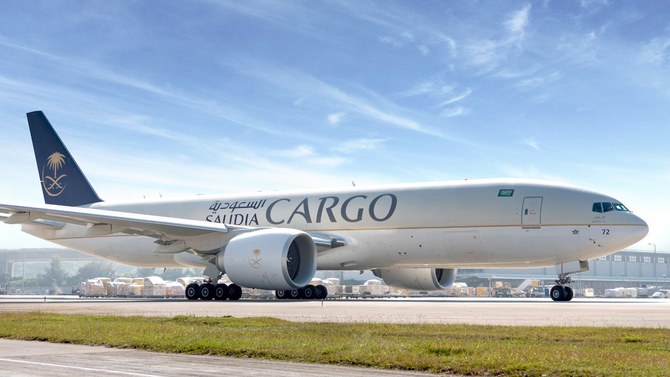
The new flights are as a result of the signing of a cargo agreement with IT and logistics operator Cainiao Network, the logistic arm of Alibaba Group.. (Supplied)
Short Url
Updated 03 March 2021
Follow

Saudia signs new flight deal to help boost e-commerce

RIYADH: Saudi Arabian air freight flag carrier Saudia Cargo is to operate five weekly flights from Hong Kong to Liege in Belgium, with Riyadh as a connection point, in a bid to help boost e-commerce links between Europe and China.

The new flights are as a result of the signing of a cargo agreement with IT and logistics operator Cainiao Network, the logistic arm of Alibaba Group.

Cainiao logistic services cover more than 200 countries, while Alibaba Group is one of the largest e-commerce brands in the world. Its total revenue for the last three months of 2020 was up 37 percent to $34.2 billion.

Saudia Cargo CEO Omar Hariri said: “We are excited for this strategic agreement (with Cainiao) which will enhance logistic services between the two continents through the famous Alibaba’s e-commerce platform and its high traffic of online shoppers.

“This agreement is part of our framework to transform the Kingdom into an open gate for world trade and a bridge connecting East and West by leveraging its strategic location in the center of the world. Other promising partnerships will be coming up in the near future to reinforce logistic operations of Alibaba in both continents,” he added.

William Xiong, Cainiao’s chief strategist and general manager of export logistics, said: “We are happy to launch a collaboration with Saudia Cargo. Both our sellers and customers from China, Saudi Arabia, and Europe will benefit from the new flights that will decrease delivery time for their parcels.

“Expanding our logistics network into new regions will also help us in building efficient global exports networks. This new route will be one of the key elements to create seamless logistics and increase synergy between different regions.”


Saudi Arabia’s debt capital market to hit $600bn by end-2026, up 15% Fitch says 

Updated 7 sec ago
Follow

Saudi Arabia’s debt capital market to hit $600bn by end-2026, up 15% Fitch says 

RIYADH: Saudi Arabia’s debt capital market is expected to reach $600 billion in outstanding issuance by the end of 2026, cementing its position as the largest US dollar debt and sukuk issuer among emerging markets. 

In a report published this week, Fitch Ratings said outstanding Saudi debt surpassed $520 billion in 2025, an annual increase of 21 percent, with sukuk — Shariah-compliant financial instruments — accounting for roughly 62 percent of the total.

The steady momentum in Saudi Arabia’s sukuk market highlights the broader expansion of the Kingdom’s debt markets, as domestic and international investors seek diversification and stable returns. 

Bashar Al-Natoor, global head of Islamic finance at Fitch Ratings, said: “Driven by cross-sector financing needs, fiscal deficits, regulatory initiatives, and expected lower oil prices and interest rates, Saudi Arabia’s DCM is likely to reach $600 billion outstanding in 2026.” 

He added: “Almost all Fitch-rated Saudi sukuk are investment grade, with issuers on Stable Outlooks and no defaults. Following reforms, foreign investors now contribute more than 10 percent of the government’s outstanding direct domestic issuance in primary local markets at end-2025.”

In 2025, the Kingdom’s dollar debt issuance surged by 49 percent to around $100 billion, with sukuk growth outpacing bonds. 

In emerging markets excluding China, Saudi Arabia was both the largest dollar-debt issuer in 2025, with an 18 percent share, and the largest environmental, social and governance dollar-debt issuer, with more than a 26 percent share. 

“Subordinated sukuk issuances by banks are rising. Access to the Saudi riyal and dollar markets is bringing benefits amid tighter riyal liquidity. This is supported by no additional currency risk, and established access to foreign investors,” said Fitch. 

It added that Saudi Arabia’s annual borrowing plan, approved by the National Debt Management Center, aims to source up to 50 percent of sovereign funding needs from private markets, 25 percent to 30 percent from international debt capital markets, and 20 percent to 30 percent from domestic debt capital markets. 

The report further noted that private funding channels, syndicated financing and certificates of deposit for banks are expected to remain among the prominent alternative funding sources in Saudi Arabia. 

Fitch, however, cautioned that Saudi Arabia’s DCM is exposed to oil price sensitivity, interest rate volatility, evolving Shariah requirements for sukuk, and geopolitical risks, which could affect fiscal balances, funding costs and investor sentiment. 

Earlier this month, a separate report by Fitch Ratings revealed that global sukuk issuances reached $300 billion in 2025, representing a 25 percent increase compared to the previous year, driven by steady offerings in Gulf Cooperation Council countries. 

The report added that this growth momentum is likely to continue in 2026, supported by funding diversification efforts, upcoming maturities and refinancing activity across sovereigns, banks and corporates.