

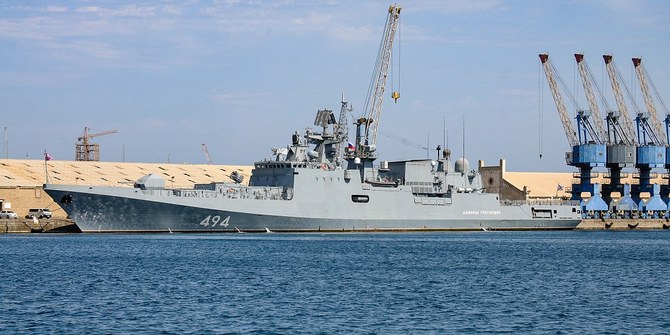
Russian warship enters Sudan port in new military deal
The Admiral Grigorovich is the first Russian warship to enter Port Sudan
Under the deal Russia will also be given the right to transport weapons, ammunition and equipment via Sudan’s ports and airports
Updated 01 March 2021
Arab News
DUBAI: A Russian warship has entered a Sudanese port where Moscow plans to build a naval base on Sudan’s Red Sea coast.
The Admiral Grigorovich is the first Russian warship to enter Port Sudan, state news agency Interfax reported citing the Russian fleet on Sunday.
Russia previously announced a deal in November which outlined the creation of a logistical support center in Sudan where repairs and resupply operations would take place, as well as providing rest for crew members.
The facility’s capacity will be capped at 300 military and civilian personnel, as well as four ships – including nuclear-powered vessels and the deal will stand for 25 years.
Under the deal Russia will also be given the right to transport weapons, ammunition and equipment via Sudan’s ports and airports.
Moscow has been exploring Africa for this purpose as it enhances its geopolitical standing.
Russia signed a deal in May, 2019, with Sudan, outlining military and civilian nuclear cooperation, which is set to last seven years.
Desert Storm: 30 years on
The end of the Gulf War on Feb. 28, 1991 saw the eviction of Iraq from Kuwait but paved the way for decades of conflict
What the lifting of the RSF’s Kadugli siege means for Sudanese civilians
Sudanese Armed Forces advance raises hopes for aid access as famine and displacement grip South Kordofan
Analysts warn humanitarian relief remains fragile amid continued fighting, stalled talks, and volatile front lines
Updated 7 sec ago
Arab News
RIYADH: As Sudan’s devastating conflict approaches its third anniversary, the army announced on Tuesday that it has broken the years-long siege on Kadugli, the famine-stricken capital of South Kordofan, in what analysts say could signal a shift in the war’s momentum.
The army’s breakthrough, announced days after a similar advance in nearby Dilling, offered South Kordofan residents a reprieve from a deepening humanitarian crisis that had triggered mass displacement and widespread hunger, sparking hopes that aid could finally resume.
The oil-rich Kordofan region has become the latest front line in Sudan’s conflict, toward which the paramilitary Rapid Support Forces shifted their focus after seizing El-Fasher, one of the army’s last strongholds in Darfur, last October.
Tens of thousands of Sudanese refugees are living in makeshift shelters at spontaneous refugee resettlements near the border town of Adré, Chad, with limited access to basic services. (UNHCR photo)
Joining forces with the Sudan People’s Liberation Movement-North, which controls stretches of territory in Kordofan and beyond, the Abu Dhabi-backed RSF tightened a blockade that had intermittently isolated Kadugli and Dilling since the war began.
The siege deepened the already dire famine conditions, later confirmed by the UN-backed Integrated Food Security Phase Classification in November, in the city and in El-Fasher.
Although the army’s recent operation has reopened the road between Kadugli and Dilling, aid organizations say sustained humanitarian access is still vulnerable to renewed fighting and insecurity in surrounding areas.
Mathilde Vu, the advocacy manager for the Norwegian Refugee Council in Sudan, said aid trucks have started arriving in Dilling, which is a “good sign.”
Infographic showing the location of Kadugli and Sudan's provinces affected by the ongoing civil war. (AFP/File)
“We hope this means more supplies into Kadugli soon,” she told Arab News, but warning that famine in the city will not be reversed overnight.
“Humanitarian access needs to be guaranteed immediately and permanently,” she said, calling for global pressure to ensure the warring parties abide by international law and not attack nor block entry of aid.
On Thursday, Mohanad El-Balal, co-founder of Khartoum Aid Kitchen, posted photos on X showing trucks of aid from Sudan’s Humanitarian Aid Commission heading to Kadugli.
However, humanitarian organizations and global hunger monitors warned that without a sustainable peace, the lifting of the siege on Kadugli and Dilling will offer only a temporary relief for civilians.
The Famine Early Warning Systems Network says famine conditions will probably persist until May even though some commercial supplies have started reaching South Kordofan.
“Access is likely to be volatile as the area remains heavily contested, and joint RSF-SPLM-N forces are expected to seek to regain control,” the monitor said.
It noted that the arrival of large numbers of displaced people in rural areas around the Western Nuba Mountains near Dilling, combined with a troop buildup, insecurity, depleted harvests and restricted trade, could push conditions beyond famine thresholds by May.
Continued fighting in the area, even after the lifting of the siege, is expected to further impede aid efforts, warned humanitarian organizations.
Hours after the army entered Kadugli, the RSF launched a drone attack that hit a medical center in Kadugli, killing 15 people including seven children, according to Sudan Doctors Network, which tracks the war.
The next day, local media reported that a similar drone strike on a military hospital, attributed to the RSF-SPLM-N alliance, killed one and injured eight.
The fighting had already pushed more than 88,000 people to flee the Kordofan region since October, according to UN figures.
Aid agencies expect that figure to grow to 100,000 based on new reports of large-scale displacements in Al-Quoz, Habila, and Ar-Reif Ash Shargi in South Kordofan, as well as continued near-daily displacement out of Kadugli and Dilling.
On Thursday, the IPC issued an alert, confirming that famine has now spread to two cities in North Darfur — Um Baru and Kernoi. It projects that acute malnutrition will continue to spread in 2026, with nearly 4.2 million estimated cases compared with 3.7 million in 2025.
“Prolonged displacement, conflict, and erosion of health, water and food systems are expected to increase acute malnutrition and food insecurity,” the IPC said.
Although supply lines and access to the people of Kadugli and Dilling are expected to improve, it said the “conflict continues to drive displacement, looting, and severe disruptions to livelihoods, trade, access to services, and mutual and humanitarian aid.”
Regular shelling and drone strikes on civilian sites and infrastructure have caused conditions to deteriorate in both towns, the monitor added.
Against this backdrop, the US and UN co-hosted a fundraising event in Washington on Wednesday to appeal for aid for Sudan, launching a new Sudan Humanitarian Fund with $700 million.
However, this figure is a long way from meeting the $2.9 billion requested by the UN’s 2026 Humanitarian Needs and Response Plan, which was only 5.5 percent funded as of Feb. 3. The 2025 plan received just 38.7 percent of what was needed.
While the military breakthrough in Kordofan is a significant development, observers cautioned that peace remains a distant prospect as mediation efforts stall and the warring parties continue to vie for control over different parts of the country.
The UN estimates more than 40,000 people have been killed since the war began and 14 million displaced, triggering the world’s worst humanitarian crisis. Both sides are accused of war crimes. In Darfur, the RSF has even been accused of genocide — and Abu Dhabi has been accused of backing the RSF.
Last year, a detailed report produced by Amnesty International provides evidence for the presence of UAE armored personnel carriers and infantry fighting vehicles in Sudan being used by the RSF in particular. Amnesty also accuses the RSF of war crimes.
The army now controls the capital Khartoum along with the northern, central and eastern regions, and the strategic Red Sea city Port Sudan. The army’s next objective is Darfur — the last region under RSF control.
Speaking to Reuters on Tuesday, Jan Egeland, head of the Norwegian Refugee Council, said that advances on the battlefield had not alleviated civilian suffering.
“Every day we see new overloaded trucks with women and children fleeing fighting and starvation in South Kordofan to South Sudan, which is also in a deep economic crisis,” Egeland posted on X. “It is the worst crisis in the largest humanitarian catastrophe in the world.”
Last month, the US and Saudi Arabia presented the Sudanese Armed Forces with the latest truce proposal. Speaking to reporters after the breakthrough on Tuesday, Sudan’s army chief Abdel Fattah Al-Burhan said there would be no truce as long as the RSF occupies cities.
“We respond to all calls for peace and we respond to any call to end the war, but ending the war will not be at the expense of Sudanese blood,” he said. “There must be no truce that strengthens the enemy, no ceasefire should allow this militia to regain its strength.”
Analysts believe the army’s latest breakthroughs in Kadugli and Dilling are a sign that momentum is beginning to shift against the RSF.
Mariam Wahba, research analyst at the Foundation for Defense of Democracies, wrote on Thursday that the army’s victory has “weakened the RSF’s control over strategic population centers in South Kordofan by disrupting the rebel group’s supply lines.”
Another political analyst told Arab News that Kadugli’s liberation was “a strategic surprise by all measures,” overturning the balance of power and redrawing the map of control in western Sudan.
During Wednesday’s fundraiser in Washington, Massad Boulos, US senior adviser for Arab and African affairs, confirmed that the US has put forward a “comprehensive proposal” for a humanitarian truce that could be agreed on in the next few weeks.
He said that the plan had already gained the support of members of the Quad — comprising the US, Egypt, Saudi Arabia, and the UAE — which has been coordinating diplomatic efforts to end the war in Sudan.
However, for peace to succeed, Wahba said Washington must go beyond its current focus on humanitarian aid and ceasefire diplomacy by adopting a dual strategy of pressure and alignment.
She said the US should act to disrupt the RSF’s financial networks and arms supply chains to weaken its capacity to wage war, while applying pressure on the army, through sanctions or diplomatic isolation, to exclude hardline Islamists from its ranks.
Washington, she said, should leverage its ties in aligning efforts with regional powers — Egypt, Saudi Arabia, Turkiye, and the UAE — around shared objectives such as preventing Sudan from becoming a safe haven for militias and transnational criminal networks.
“Coordinated pressure would provide Washington with greater leverage to shape ceasefire terms, marginalize spoilers, and influence Sudan’s postwar trajectory without direct US military involvement,” she said.
On Tuesday, Burhan vowed that he would liberate all Sudanese territory.
“I want to assure our people everywhere — in Al-Geneina, in Al-Tina, and in all other places — the army will reach them. The armed forces will reach them.”
To the people of Al-Fasher he said: “We are coming.”