

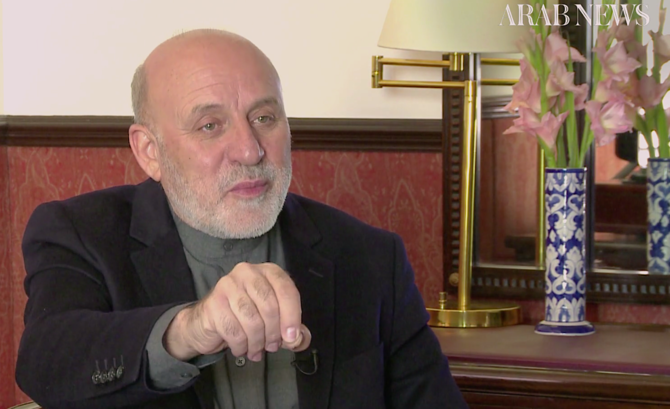

ISLAMABAD: Afghanistan’s special envoy has welcomed the Pakistani military’s announcement that it would oppose the return of the Taliban to power in Afghanistan.
The Afghan president’s special envoy for Pakistan, Mohammad Umer Daudzai, was on a three-day visit to Islamabad last week as peace talks between the Taliban and the Afghan government have resumed in Qatar to yield a power-sharing arrangement in the country torn by a decades-long conflict.
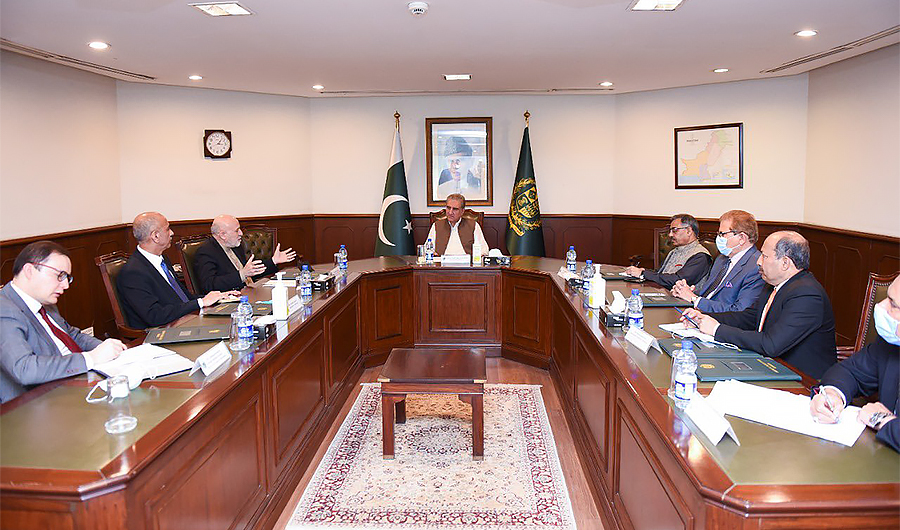
Afghan president's special envoy for Pakistan, Mohammad Umer Daudzai (first in the left row) meets Pakistan's Foreign Minister, Shah Mahmood Qureshi (center) in Islamabad, Pakistan, on February 26, 2021. (Photo courtesy: Mohammad Umer Daudzai/Twitter)
During the peace talks, which started in September and have been suspended several times since, Afghan government negotiators have been pushing for a permanent cease-fire and are expected to protect the existing system of governance — in place since the ouster of the Taliban by a US-led invasion of Afghanistan in 2001.
As Daudzai was visiting Islamabad, which has been seen as critical to getting the Taliban back to the negotiating table and pushing them to reduce violence in Afghanistan, Pakistan Army spokesperson Maj. Gen. Babar Iftikhar told reporters on Wednesday that “Taliban control of Kabul again is not possible, and Pakistan will not support any such move.”
Daudzai welcomed the statement as a “very positive development” and one that is not accidental.
“The statement by the Pakistan’s army spokesman is new, which is not by chance. Armies take assessment of the environment in their neighborhood and the Pakistan army has realized that Afghan army, police and the system are strong, and the Taliban cannot topple the system,” he told Arab News in an interview on Friday.
He said that during his trip that wrapped on Friday, Pakistani leaders had told him they would openly call for a cease-fire in Afghanistan instead of the “ambiguous and useless words ‘reduction in violence’” that had been used by international representatives in official talks.
Daudzai told Arab News that ahead of December’s visit of Taliban delegates to Islamabad, Pakistani Prime Minister Imran Khan had assured Afghan President Ashraf Ghani that he would take up the cease-fire issue with the group.
“But later we realized that the Taliban did not show flexibility on the issue,” Daudzai said.
The Taliban have been rejecting cease-fire since the beginning of intra-Afghan negotiations.
“If Pakistan says that it does not have control over the Taliban but has some influence, we request Pakistan to take advantage of its influence and convince the Taliban to hold fruitful negotiations,” the Afghan envoy said, as he expressed hope for progress before Ghani’s planned visit before the beginning of the fasting month of Ramadan in mid-April.
“We want major progress before the president’s visit to Pakistan so both sides make any important announcement,” he said.


