

Academics back UK professor accused of anti-Semitism

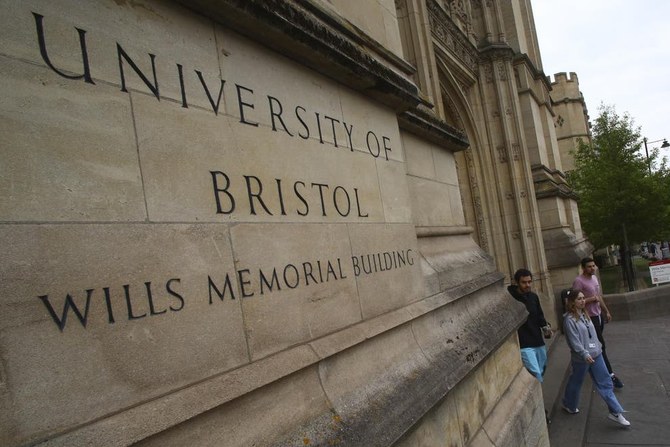
Bristol University said: “We do not endorse the comments made by Prof. Miller about our Jewish students.” (AFP/Getty/File Photo)
Short Url
Updated 27 February 2021
Follow

Academics back UK professor accused of anti-Semitism

  • Letter says David Miller ‘responded honestly’ to Israel-Palestine query

LONDON: Academics at the University of Bristol have urged it to abide by academic freedom and resist firing one of its lecturers, David Miller, who has been accused of anti-Semitism.

A professor of political sociology, Miller said Israel wants to “impose its will all over the world,” and it is “fundamental to Zionism to encourage Islamophobia and anti-Arab racism.”

He claimed that members of the British university’s Jewish Society who had submitted complaints regarding his comments are being used as “political pawns by a violent, racist foreign regime engaged in ethnic cleansing.”

A letter of support for Miller has been signed by several academics who said he was “approached to provide a statement on Israel and Palestine” and “simply responded honestly to the query.”

They warned that “well-orchestrated efforts” have been made to misrepresent his response as proof of anti-Semitism, and that sacking him would “crush academic freedom.” The letter was sent to Prof. Hugh Brady, president and vice chancellor of the university.

Miller has said his aim is to end “settler colonialism in Palestine” and “end Zionism as a functioning ideology of the world.”

Jewish Society President Edward Isaacs said the university is giving Miller’s views “legitimacy and power” by refusing to take action.“Jewish students have been actively seeking to ensure they are not taught by David Miller, and when they are, they are fearful of him finding out they are Jewish or associated with the Jewish Society,” Isaacs said.

“These are dangerous conspiracy theories about dual loyalty, dishonesty and Jewish students being operatives of a foreign state.”

Miller told The Times newspaper that he takes student safety “very seriously,” and that universities are governed by laws protecting the right to espouse research “that some may find discomfiting.”

Bristol University said: “We do not endorse the comments made by Prof. Miller about our Jewish students.”

The university said it is speaking to student organizations, including the Jewish Society, and the UCU, an academic union, “about how we can address student concerns swiftly, ensuring that we also protect the rights of our staff.”


India plans AI ‘data city’ on staggering scale

Updated 15 February 2026
Follow

India plans AI ‘data city’ on staggering scale

  • ‘The data city is going to come in one ecosystem ... with a 100 kilometer radius’

NEW DELHI: As India races to narrow the artificial intelligence gap with the United States and China, it is planning a vast new “data city” to power digital growth on a staggering scale, the man spearheading the project says.

“The AI revolution is here, no second thoughts about it,” said Nara Lokesh, information technology minister for Andhra Pradesh state, which is positioning the city of Visakhapatnam as a cornerstone of India’s AI push.

“And as a nation ... we have taken a stand that we’ve got to embrace it,” he said ahead of an international AI summit next week in New Delhi.

Lokesh boasts the state has secured investment agreements of $175 billion involving 760 projects, including a $15 billion investment by Google for its largest AI infrastructure hub outside the United States.

And a joint venture between India’s Reliance Industries, Canada’s Brookfield and US firm Digital Realty is investing $11 billion to develop an AI data center in the same city.

Visakhapatnam — home to around two million people and popularly known as “Vizag” — is better known for its cricket ground that hosts international matches than cutting-edge technology.

But the southeastern port city is now being pitched as a landing point for submarine internet cables linking India to Singapore.

“The data city is going to come in one ecosystem ... with a 100 kilometer radius,” Lokesh said. For comparison, Taiwan is roughly 100 kilometers wide.

Lokesh said the plan goes far beyond data connectivity, adding that his state had “received close to 25 percent of all foreign direct investments” to India in 2025.

“It’s not just about the data centers,” he explained while outlining a sweeping vision of change, with Andhra Pradesh offering land at one US cent per acre for major investors.