Pakistan, India can live in peace, downed Indian pilot says in newly released footage

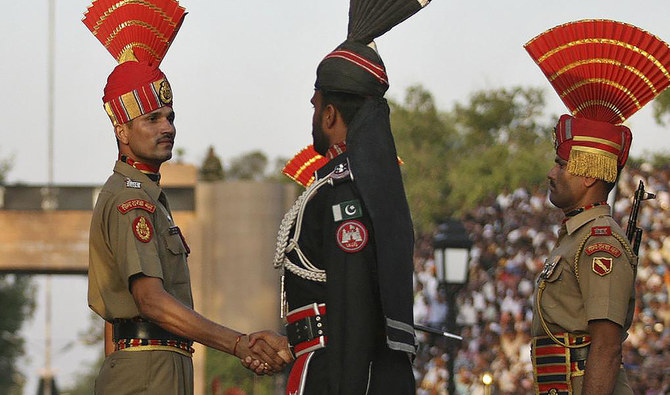
A Pakistani Ranger, center, and an Indian Border Security Force (BSF) officer, left, shake hands during the daily parade at the Pakistan-India joint check-post at Wagah border, Pakistan, on May 11, 2010. (REUTERS/File)
Short Url
Updated 28 February 2021
Follow

Pakistan, India can live in peace, downed Indian pilot says in newly released footage

  • Newly released footage comes days after a ceasefire on Kashmir border was settled by the Indian and Pakistani military
  • Wing Commander Abhinandan Varthaman was captured on Feb. 27, 2019 when his jet entered Pakistani airspace

ISLAMABAD: India and Pakistan can live in peace, an Indian Air Force pilot who was briefly in Pakistani custody in 2019 said in footage circulated by local media organizations on Saturday.  
Wing Commander Abhinandan Varthaman was captured on Feb. 27, 2019 when Pakistan shot down his jet when it crossed the Line of Control (LoC) — the de facto border in Kashmir. A day earlier, Indian warplanes also crossed the border and dropped bombs near Balakot in Khyber Pakhtunkhwa province.
No casualties were caused by the attack and Pakistan soon released the Indian pilot in a goodwill gesture.
Parts of the video recorded by the Pakistani Army, including Varthaman's famous praise of the "fantastic" tea he was served by Pakistani officers, were aired already in 2019, but some lines in the footage shared on Saturday, including the pilot's call for peace, are new.
"I want that peace should prevail, and we (India and Pakistan) can live in peace," Varthaman said in the video.
"Wars happen when there is no peace. I don't know what needs to be done to bring about peace, but I do know that there should be peace. And I see no reason for us to continue with any kind of hostilities."
He added: "What is happening to Kashmiris? Neither you nor I know about it ... We should think with a calm mind."
The newly released footage comes after the military operations heads of Pakistan and India said in a joint statement on Thursday that they had agreed to discuss each other’s concerns that could disturb peace and lead to violence along the Line of Control (LoC).
The announcement has been seen as restoring a ceasefire agreement from 2003, which has been fraying in recent years.
Kashmir has long been a flashpoint between Pakistan and India as both claim the region in full but rule it in part. Tensions increased in August 2019, after New Delhi withdrew the region's autonomy and split it into federally administered territories. In recent months, cross border firing has become frequent, often killing or maiming people living in the area.


Pakistan to unveil austerity plan on Monday as Middle East conflict drives oil price surge

Updated 08 March 2026
Follow

Pakistan to unveil austerity plan on Monday as Middle East conflict drives oil price surge

  • The development follows an increase of Rs55 ($0.20) per liter in prices of petrol and diesel in Pakistan this week
  • PM Shehbaz Sharif promises ‘maximum relief’ to people as soon as ‘this difficult phase passes’ and economy stabilizes

ISLAMABAD: Pakistan is set to unveil an austerity plan tomorrow, Monday, as surging global oil prices, driven by United States and Israeli strikes on Iran, mount pressure on Prime Minister Shehbaz Sharif’s government to curb spending and stabilize the economy, the PM’s office said on Sunday.

The development follows an increase of Rs55 ($0.20) per liter in the prices of petrol and diesel in Pakistan this week as the Strait of Hormuz, which supplies a fifth of the global oil consumption, faces disruptions due to US-Israeli strikes on Iran and Tehran’s counter attacks on US interests in the Gulf region.

Pakistan’s Petroleum Division was directed to submit daily stock reports, while the country’s Oil and Gas Regulatory Authority (OGRA) was tasked with maintaining strict market oversight, officials said this week, as oil rose above $90 a barrel globally, the highest in years.

Sharif on Sunday presided over a meeting to review measures to stabilize the economy amid the Middle East conflict, with officials saying global supply disruptions and price fluctuations may have an impact on Pakistan, according to the prime minister’s office.

“In view of the recent international situation, timely implementation of measures is essential for the country’s economic stability,” Sharif was quoted as saying at the meeting. “The government is constantly monitoring the situation and all necessary decisions will be taken to provide all possible stability to the national economy.”

Earlier in the day, Pakistan’s Finance Minister said that Islamabad was preparing alternative plans to manage the financial impact of rising oil prices.

Speaking at the meeting, Sharif said the austerity measures must protect the interest of the people.

“All government employees and ministers will have to adopt austerity,” he said. “In the current difficult times, it is important to ensure wise use of national resources and as soon as this difficult phase passes and the economy becomes more stable, the government will provide maximum relief to the people.”

Instructions regarding austerity and simplicity will not be applicable to the industry and agriculture sectors so that the country’s production, exports and food security are not affected, according to Sharif’s office.

Several suggestions and recommendations based on austerity and simplicity were presented at the meeting, which were reviewed in detail by participants.

“The briefing was informed that the country has adequate reserves of diesel, petrol and other petroleum products and the government has made advance arrangements to deal with any emergency,” Sharif’s office said.