

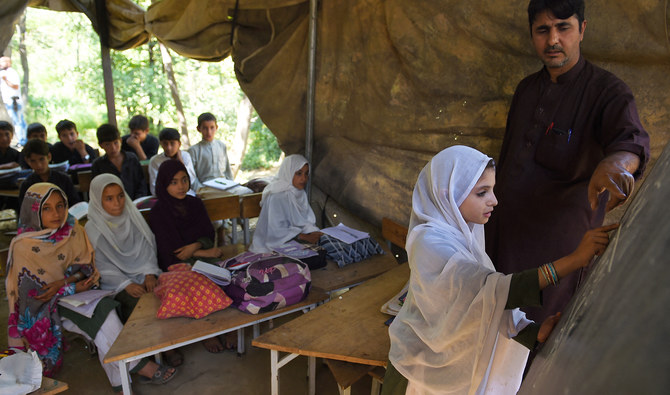

ISLAMABAD: Pakistani parliamentarians and rights activists on Friday hailed the passage of the ICT Prohibition of Corporal Punishment Bill from the National Assembly earlier this week, urging the government to enact accompanying rules of business and launch a nationwide awareness campaign to change popular mindset on the issue.
The bill which was passed on Tuesday prohibits all forms of corporal punishment in all types of education institutes, including religious seminaries, childcare centers and rehabilitation facilities. The new law intends to penalize individuals for assault and hurt inflicted on children under any circumstances.
"It's a significant development for us since we were campaigning to get the practice banned since 2013," said Shehzad Roy, a popular musician who also runs a non-profit advocacy firm called Zindagi Trust.
"Protecting our children, however, requires more than just the passage of this bill," he continued. "The rules of business have to be clarified and the mindset that legitimizes corporal punishment needs to be changed by launching informative awareness campaigns."
Roy urged the government to strengthen social welfare departments and child protection units everywhere since he claimed they were not very functional.
He argued that physical punishment left a permanent scar on a child's personality, adding that the new law would not just protect children but also help build "a safer, kinder and more peaceful Pakistan."
According to a 2014 survey by the Society for the Advancement of Education (SAHE) and Alif Ailaan, more than 70 percent of Pakistani teachers consider corporal punishment useful to discipline students.
Mehnaz Akbar Aziz of the Pakistan Muslim League-Nawaz party, who tabled the bill in the National Assembly, said the state had finally recognized its responsibility toward its young citizens by making this legislation.
"Under the bill, the state has for the first time decided to intervene when a child's dignity is taken away by those who are responsible to develop and protect it," Aziz told Arab News. "It took two years of constant effort to push it through the National Assembly and we are now working to get it endorsed by the Senate without further delay."
She welcomed an announcement by the provincial administration of Balochistan to start working on a similar law to prohibit corporal punishment.
"It is commendable but this law is applicable only to Islamabad," said Anees Jilani, a lawyer and children's rights activist. "It is needed across the whole country."
"Such punishments were also prohibited in the capital territory under the Islamabad Child Protection Act," Jilani continued. "The real issue is the effective implementation of law."
Roy told Arab News that Sindh, Khyber Pakhtunkhwa and Gilgit Baltistan had their own laws against corporal punishment, but Punjab and Balochistan did not offer any legal protection to schoolgoing children.
"We are trying to get such laws passed by the Punjab and Balochistan assemblies as well," he said.


