

Pope’s visit to Iraqi Ziggurat to bring together several faiths — and hopefully lure more visitors

1 / 5
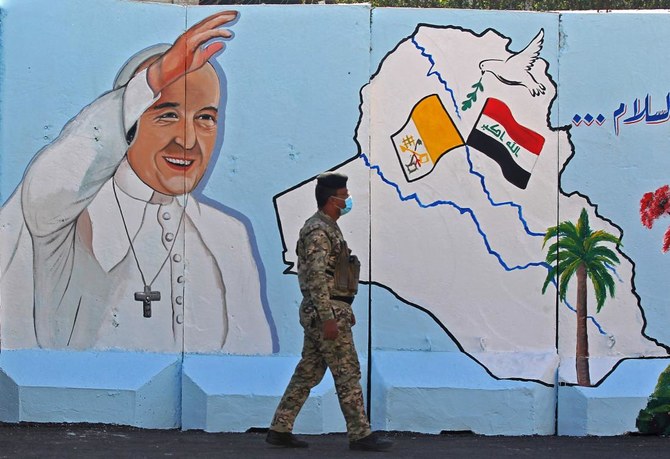
An Iraqi policeman walks past a mural depicting Pope Francis on the outer walls of Our Lady of Salvation (Sayidat al-Najat) Church, in Baghdad on February 22, 2021. (AFP)
2 / 5
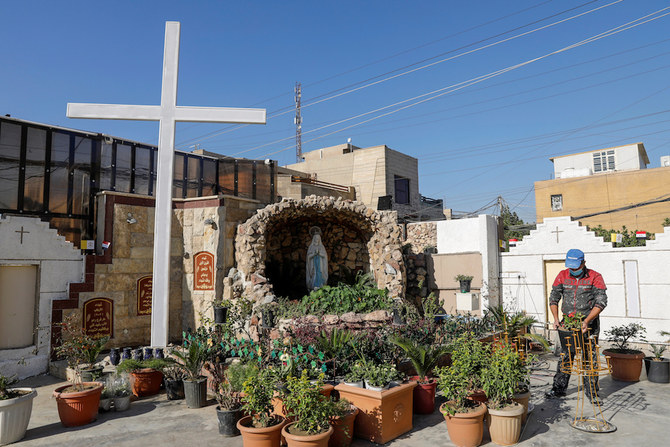
A christian volunteer decorates streets with the pictures of Pope Francis, ahead of his planned visit to to Iraq, in Qaraqosh, Iraq February 22, 2021. Picture taken February 22, 2021. (Reuters)
3 / 5
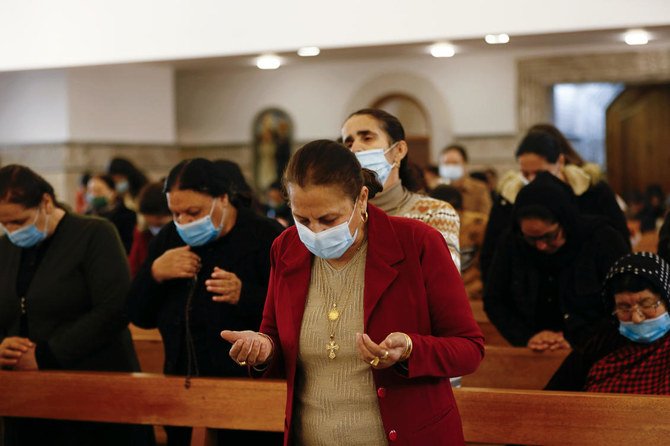
A man is seen outside the St. Joseph Chaldean Cathedral, where Pope Francis will hold a mass, ahead of his planned visit to Iraq, in Baghdad, Iraq February 23, 2021. Picture taken February 23, 2021. (AFP)
4 / 5
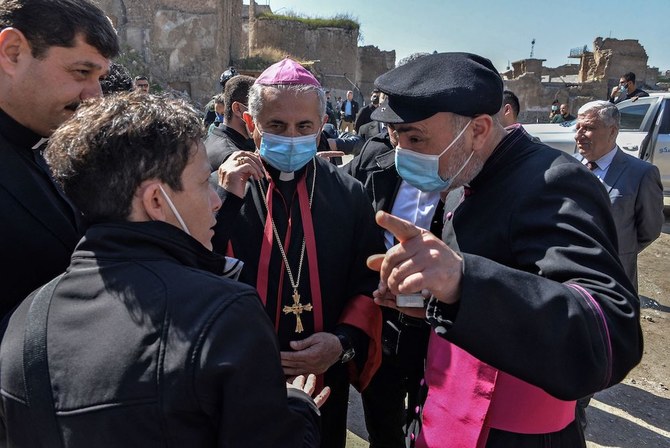
Archbishop of the Archeparchy of Mosul Najib Mikhael Moussa (C) and Father Raed Adel (L) listen to the members of the Papal convoy during their visit to Iraq's northern city of Mosul. (AFP)
5 / 5
Short Url
Updated 25 February 2021
Follow

Pope’s visit to Iraqi Ziggurat to bring together several faiths — and hopefully lure more visitors

  • Roads around the site are being rennovated and powerlines extended ahead of the pope’s visit
  • The inter-religious prayer service will be attended by Christians, Muslims, Mandaean-Sabaean, Yazidi and other religious minorities in Iraq

BAGHDAD: Pope Francis is due to hold an inter-religious prayer service at the ancient Mesopotamian site of Ur when he visits Iraq next week — an event local archaeologists hope will draw renewed attention to the place revered as the birthplace of Abraham.

Popular with Western visitors in the 1970s and 1980s, Ur is scarcely visited today after decades of war and political instability shattered Iraq’s international tourism industry. The coronavirus crisis now also keeps local tourists away.

Located about 300 km (200 miles) south of the capital Baghdad, the site comprises a pyramid-style Ziggurat and an adjacent residential complex as well as temples and palaces.


It was excavated about 100 years ago by Leonard Woolley, a Briton who recovered treasures rivalling those found in Tutankhamen’s tomb in Egypt. But little work has since been done on one of the world’s oldest cities, where urban dwelling, writing and central state power began.

According to the State Board for Antiquities and Heritage director for Ur, Ali Kadhim Ghanim, the complex next to the Ziggurat dates back to about 1900 BC.

The father of Judaism, Christianity and Islam, Abraham is described in the biblical book of Genesis as living in the city before God called upon him to create a new nation in a land he later learned was Canaan.

“This is why it is believed that this building, or house, was the house of the prophet Abraham,” Ghanim said, pointing at the residential complex.

According to Ghanim, the housing settlement was restored in 1999, after Pope Francis’ predecessor, Pope John Paul II, announced a trip to Iraq. But his visit was canceled when negotiations with the government of then-Iraqi leader Saddam Hussein broke down.

This time, Ghanim hopes that Pope Francis’ visit will attract international attention to the site, which he says is badly needed to fund restoration works on its palaces and temples.

“Not only tourism, but we believe that there will be a Christian pilgrimage season,” Ghanim said.

READ MORE

Pope Francis’ visit, his first foreign trip since the coronavirus pandemic and the first ever by a pope to Iraq, is a sign that “You’re not alone,” said Monsignor Segundo Tejado Muñoz. More here.
 

Un Ponte Per, an Italian-based organization, is working with the United Nations Development Programme on infrastructure works such as paths, rest areas and signposts to help visitors.

Roads around the site are being rennovated and powerlines extended ahead of the pope’s visit.

But without adequate funding, Ghanim says his administration has been limited to containing further damage to the site, such as digging trenches to divert rainwater from the ruins.

Basra’s Archbishop Habib Al-Naufaly stressed the symbolic importance of the pope’s March 5-8 visit as Iraq is still recovering from the war against Islamic State that destroyed scores of Christian heritage sites.

The inter-religious prayer service will be attended by Christians, Muslims, Mandaean-Sabaean, Yazidi and other religious minorities present in Iraq.

The focus will be on harmony between religious groups in a service the Vatican has named “Prayer for the sons and daughters of Abraham.”


First Ramadan after truce brings flicker of joy in devastated Gaza

Updated 55 min 51 sec ago
Follow

First Ramadan after truce brings flicker of joy in devastated Gaza

  • Ramadan lanterns and string lights appear on streets lined with collapsed buildings and piles of rubble in Gaza City
  • The first holy month since the October ceasefire brings mixed feelings for the many still living in tents

GAZA CITY: Little Ramadan lanterns and string lights appeared on streets lined with collapsed buildings and piles of rubble in Gaza City, bringing joy and respite as Islam’s holiest month began — the first since October’s ceasefire.
In the Omari mosque, dozens of worshippers performed the first Ramadan morning prayer, fajr, bare feet on the carpet but donning heavy jackets to stave off the winter cold.
“Despite the occupation, the destruction of mosques and schools, and the demolition of our homes... we came in spite of these harsh conditions,” Abu Adam, a resident of Gaza City who came to pray, told AFP.
“Even last night, when the area was targeted, we remained determined to head to the mosque to worship God,” he said.
A security source in Gaza told AFP Wednesday that artillery shelling targeted the eastern parts of Gaza City that morning.
The source added that artillery shelling also targeted a refugee camp in central Gaza.
Israel does not allow international journalists to enter the Gaza Strip, preventing AFP and other news organizations from independently verifying casualty figures.

‘Stifled joy’

In Gaza’s south, tens of thousands of people still live in tents and makeshift shelters as they wait for the territory’s reconstruction after a US-brokered ceasefire took hold in October.
Nivin Ahmed, who lives in a tent in the area known as Al-Mawasi, told AFP this first Ramadan without war brought “mixed and varied feelings.”
“The joy is stifled. We miss people who were martyred, are still missing, detained, or even traveled,” she said.
“The Ramadan table used to be full of the most delicious dishes and bring together all our loved ones,” the 50-year-old said.
“Today, I can barely prepare a main dish and a side dish. Everything is expensive. I can’t invite anyone for Iftar or suhoor,” she said, referring to the meals eaten before and after the daily fast of Ramadan.
Despite the ceasefire, shortages remain in Gaza, whose battered economy and material damage have rendered most residents at least partly dependent on humanitarian aid for their basic needs.
But with all entries into the tiny territory under Israeli control, not enough goods are able to enter to bring prices down, according to the United Nations and aid groups.

‘Still special’

Maha Fathi, 37, was displaced from Gaza City and lives in a tent west of the city.
“Despite all the destruction and suffering in Gaza, Ramadan is still special,” she told AFP.
“People have begun to empathize with each other’s suffering again after everyone was preoccupied with themselves during the war.”
She said that her family and neighbors were able to share moments of joy as they prepared food for suhoor and set up Ramadan decorations.
“Everyone longs for the atmosphere of Ramadan. Seeing the decorations and the activity in the markets fills us with hope for a return to stability,” she added.
On the beach at central Gaza’s Deir el-Balah, Palestinian artist Yazeed Abu Jarad contributed to the holiday spirit with his art.
In the sand near the Mediterranean Sea, he sculpted “Welcome Ramadan” in ornate Arabic calligraphy, under the curious eye of children from a nearby tent camp.
Nearly all of Gaza’s 2.2 million residents were displaced at least once during the more than two years of war between Israel and Hamas, sparked by the latter’s unprecedented October 7 attack on Israel.
Mohammed Al-Madhoun, 43, also lives in a tent west of Gaza City, and hoped for brighter days ahead.
“I hope this is the last Ramadan we spend in tents. I feel helpless in front of my children when they ask me to buy lanterns and dream of an Iftar table with all their favorite foods.”
“We try to find joy despite everything,” he said, describing his first Ramadan night out with the neighbors, eating the pre-fast meal and praying.
“The children were as if they were on a picnic,” he said.