Saudi Arabia working to enhance energy security - cabinet

1 / 3
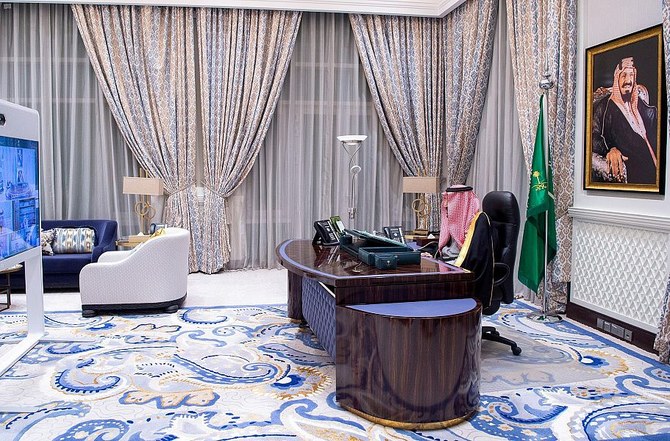
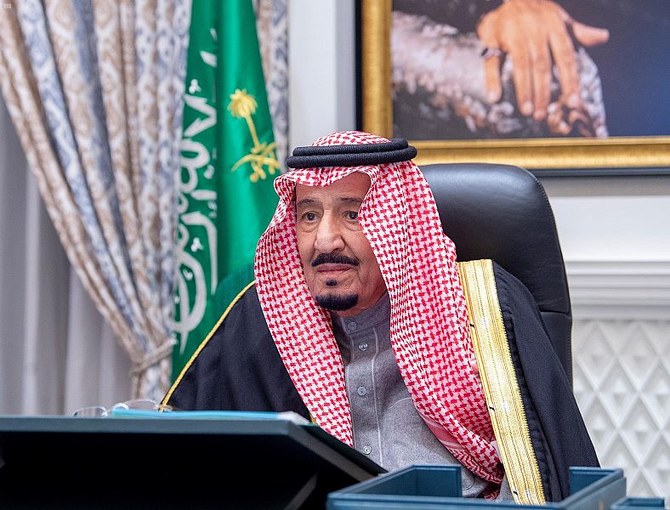
Saudi Arabia’s Council of Mincers held their weekly meeting, virtually chaired by King Salman from NEOM on Tuesday, Feb. 23, 2021. (SPA)
2 / 3
Saudi Arabia’s Council of Mincers held their weekly meeting, virtually chaired by King Salman from NEOM on Tuesday, Feb. 23, 2021. (SPA)
3 / 3
Saudi Arabia’s Council of Mincers held their weekly meeting, virtually chaired by King Salman from NEOM on Tuesday, Feb. 23, 2021. (SPA)
Short Url
Updated 24 February 2021
Follow

Saudi Arabia working to enhance energy security - cabinet

  • Cabinet repeated the Kingdom’s condemnation of cross-border attacks by Yemen's Houthi militia
  • The council said it was hoping for a peaceful resolution to violent protests in Mogadishu

RIYADH: Saudi Arabia is committed to supporting the stability of the oil markets and the sustainability of global supplies, the Kingdom’s cabinet said.
The announcement was made during the cabinet’s weekly meeting, during which the Council of Ministers discussed mitigating the effects of the coronavirus (COVID-19) pandemic, enhancing energy security and the market balance.
Minister of Information Majid Al-Qasabi said the minsters discussed the Kingdom’s statements at the World Energy Forum, the International Energy Agency and OPEC, on the importance of cooperation to face the challenges of the pandemic and limit its impact on global economic growth.
“Saudi Arabia stressed the need to work to overcome the challenges through collective action, dialogue and data transparency in the energy field,” Al-Qasabi said.
The cabinet repeated the Kingdom’s condemnation of cross-border attacks by the Houthi militia in Yemen. Over the past week, the conflict escalated as the Iran-backed group launched missiles and drones toward Saudi Arabia that were intercepted by Arab coalition forces.
The council said it was also hoping for a peaceful resolution to violent protests that erupted in Mogadishu on Friday over delayed elections in Somalia.
On the COVID-19 front, the cabinet was briefed on the latest virus statistics in the Kingdom and progress in the national inoculation campaign. The ministers were also briefed on the resumption of vaccine supplies and the new vaccine centers opened over the past week in the Kingdom.


Saudi FM joins Arab counterparts in talks with Slovenia on Gaza, regional stability

Updated 06 February 2026
Follow

Saudi FM joins Arab counterparts in talks with Slovenia on Gaza, regional stability

  • Prince Faisal and Tanja Fajon later signed general cooperation agreement aimed at enhancing ties between Kingdom and Slovenia

LJUBLJANA: Saudi Foreign Minister Prince Faisal bin Farhan held talks with Slovenia’s Deputy Prime Minister and Minister of Foreign and European Affairs Tanja Fajon in Ljubljana on Friday, as he joined Arab counterparts for an expanded meeting focused on Gaza and wider regional developments.

Prince Faisal met Fajon separately to review Saudi-Slovenian relations and explore ways to strengthen cooperation across various fields, the Saudi Press Agency reported.

The two sides later signed a general cooperation agreement aimed at enhancing ties between the Kingdom and Slovenia and intensifying joint efforts to support further progress and prosperity for both countries, SPA added.

The expanded ministerial meeting also brought together Jordanian Deputy Prime Minister and Foreign Minister Ayman Safadi, Egyptian Foreign Minister Badr Abdelatty, Bahraini Foreign Minister Abdullatif Al-Zayani and Qatar’s Minister of State for Foreign Affairs Sultan Al-Muraikhi.

During the talks, ministers discussed ways to bolster regional and international security and stability, with a focus on the situation in Gaza.

They stressed the need to uphold the ceasefire agreement between Israel and Hamas, ensure its full implementation and deliver sufficient and sustainable humanitarian aid to the enclave.

The officials also reviewed efforts to advance US President Donald Trump’s peace plan and reiterated the importance of achieving a clear political horizon leading to an independent and sovereign Palestinian state along the 1967 borders, with East Jerusalem as its capital, based on the two-state solution.

They addressed developments in the occupied West Bank, calling for an end to illegal, unilateral Israeli measures and violations against Islamic and Christian holy sites in occupied Jerusalem, warning that such actions undermined de-escalation efforts.

The ministers praised Slovenia’s support for Palestinian rights and its recognition of a Palestinian state, and also discussed broader regional developments, ways to reduce escalation through dialogue, and efforts to resolve the Russia-Ukraine crisis.