Qatar targets first place in LNG production for next 2 decades

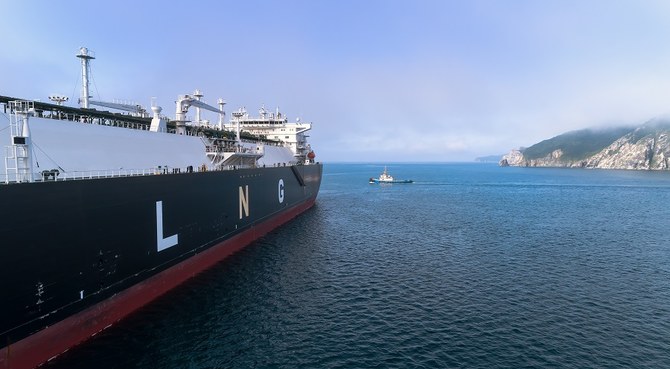
Qatar will spend billions of dollars expanding its LNG capacity more than 50 percent to 126 million tons a year. (Shutterstock)
Short Url
Updated 24 February 2021
Follow

Qatar targets first place in LNG production for next 2 decades

  • State’s energy minister claims expansion project viable even if oil falls to $20 a barrel

RIYADH: Qatar aims to be the world’s biggest producer of liquefied natural gas (LNG) for at least the next two decades, capitalizing on rising demand as the world transitions from oil and coal to cleaner energy, according to Asharq Bloomberg.

Qatar will spend billions of dollars expanding its LNG capacity more than 50 percent to 126 million tons a year, a level other countries would struggle to match, Energy Minister Saad Al-Kaabi told Bloomberg Television.

The Gulf state is already the world’s main supplier of the super-chilled fuel, but new projects elsewhere, especially in Australia and the US, have eroded its dominance.

The nation would be able to produce LNG from the first phase of the expansion so cheaply that it would be viable even if oil prices fell below $20 a barrel, said Al-Kaabi. “This is one of the most competitive, if not the most competitive, projects on the planet,” he added.

Oil prices collapsed last year but have soared more than 60 percent since the start of November to around $64 a barrel with the roll-out of coronavirus disease (COVID-19) vaccines.

State producer Qatar Petroleum (QP) took a final investment decision on the North Field East Project last week. The project is likely to be the only one in the world to pass this milestone in 2021, after just one was sanctioned to move ahead last year, according to Bloomberg NEF.

Al-Kaabi, who is also chief executive officer of QP, said that the lack of new supply from other countries would benefit Qatar. “With less projects coming online, our expansion is very timely,” he added.

Qatar last year supplied 23 percent of the world’s LNG and energy companies looking to produce more renewable energy will still need gas to offset the intermittency of green power, said Al-Kaabi.

“Renewables will definitely happen, we’re doing a lot ourselves, but you need gas to complement that. Gas is sort of in a Catholic marriage with renewables. They would need to stay together for a very long time for you to have the transition successfully,” the minister added.

Qatar is one of world’s richest countries, with a per capita gross domestic product of $53,000 last year, according to the International Monetary Fund.

QP has booked capacity at units that turn LNG back into gas in Belgium, France, and the UK. It is also looking to build on its 70 percent stake in Britain’s largest LNG import terminal by investing in more regasification plants, said Al-Kaabi.


Saudi POS spending rises 4.3% to $3.47bn in late December 

Updated 13 sec ago
Follow

Saudi POS spending rises 4.3% to $3.47bn in late December 

RIYADH: Saudi Arabia’s point-of-sale transactions climbed to SR13.02 billion ($3.47 billion) in the week ended Dec. 27, marking a 4.3 percent increase from the previous seven days, official data showed. 

According to the latest report from the Saudi Central Bank, also known as SAMA, the number of transactions rose 1.1 percent to 220.65 million during the period. 

The sustained momentum in POS spending reflects firm consumer demand and the Kingdom’s ongoing shift toward digital payments under its Vision 2030 agenda. 

Spending in the food and beverages sector remained the largest contributor, totaling SR1.91 billion, up 1.2 percent week on week. 

Restaurants and cafes recorded transactions of SR1.57 billion, a marginal 0.1 percent increase, while spending in the apparel, clothing, and accessories segment rose 1.3 percent to SR1.23 billion. 

Expenditure in the transportation sector climbed 7.7 percent to SR943.18 million, while spending at gas stations slipped 0.1 percent to SR918.88 million. 

In the health sector, POS transactions reached SR776.02 million, up 6.8 percent from the previous week. 

Spending in professional business services stood at SR746.76 million, followed by furniture and home supplies at SR515.88 million. 

SAMA’s data underscore resilient consumer confidence, despite global economic headwinds, offering continued support to Saudi Arabia’s broader economic transformation. 

Earlier this year, the central bank said non-cash retail transactions reached 12.6 billion in 2024, up from 10.8 billion in 2023, highlighting the rapid expansion of electronic payment systems across the Kingdom.  

Electronic payments accounted for 79 percent of total retail transactions in 2024, compared with 70 percent a year earlier. 

On a regional basis, Riyadh recorded POS transactions worth SR4.63 billion, reflecting a 5 percent weekly increase, while the number of transactions rose 1.6 percent to 70.95 million. 

In Jeddah, transaction values totaled SR1.77 billion, up 3 percent from the previous week. Dammam followed with SR659.53 million, an 8.4 percent increase. 

POS spending in Makkah amounted to SR594 million, followed by Madinah at SR559.74 million and Alkhobar at SR386.06 million.