

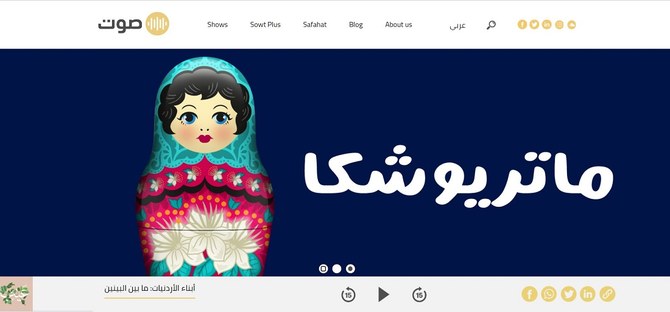

DUBAI: A Jordanian podcasting startup that launched in 2016 with three shows is now producing 25 offerings for its on-demand and digital audiences.
Sowt (voice, in Arabic) Podcasts was established with the aim of producing high-quality Arabic audio content and one of the network’s latest shows, “Manbet,” is the brainchild of Bisher Najjar.
The content creator has his own YouTube show, “Arab Dystopia,” and covers the topics of social sciences and humanities. Launched in last year’s fall, “Manbet” looks to present these subjects in a simplified manner, said Tala El-Issa, managing producer at Sowt.
“We found it very interesting because we think that it (social sciences and humanities) is becoming more relevant to our current times; social sciences can actually explain a lot of things that we are witnessing right now,” she added.

Tala El-Issa (Supplied)
The first season of “Manbet” did not have an overarching theme and was produced in a more anthological style, covering subjects such as Arab feminism and poets, and the Belgian Congo.
The second season, that was released on Monday, tells the story of enslaved African Muslim Omar ibn Said over four episodes. The series is based on his autobiographical manuscript written in Arabic in 1831 but lost until the 1990s.
Following last summer’s Black Lives Matter movement rallies, black activists and influencers in the Arab world took the opportunity to highlight racism in Arab countries, said El-Issa, by deconstructing myths and talking about day-to-day experiences of people in their personal and working lives.
“There was a huge interest in the intersection of being Arab, Muslim, and black all at once,” she added.
Ibn Said’s story was reflective of just that.
Mahmoud Al-Khawaja, writer and researcher of the series, said: “Delving into the story of Omar ibn Said was also an opportunity to compare what was written or concluded by white researchers with the ones done by researchers from diverse ethnic backgrounds or ones who do not adopt a white perception in their reading of the story.
“This becomes clear when examining certain controversial chapters in Ibn Said’s life, such as his conversion from Islam to Christianity, the humanity of his white owner, and the real importance of his educational level and the social level of his family before captivity and slavery,” he added.
Sowt’s production of the story mirrors the growth of the podcast industry with more companies producing original content. Sowt witnessed a 300 percent increase in listenership last year with the majority tuning in from Saudi Arabia, followed by Egypt and Jordan.
A separate report found that listeners in the Middle East and North Africa region preferred entertainment-related (50 percent) and self-help/inspirational (36 percent) content to business (4 percent) and coronavirus disease (COVID-19) pandemic-related (2 percent) content, indicating the demand for original material.
Brands and publishers are beginning to take note too, with more brands producing their own podcasts and traditional publishers outputting audio-led offerings as well.
El-Issa said: “I have been working with Sowt ever since it started, and at a certain point I used to think that podcasting could be a bubble, and I was worried that it would pop. But to be honest, I don’t think it’s a bubble at all. I think it will keep on growing and growing.”


