

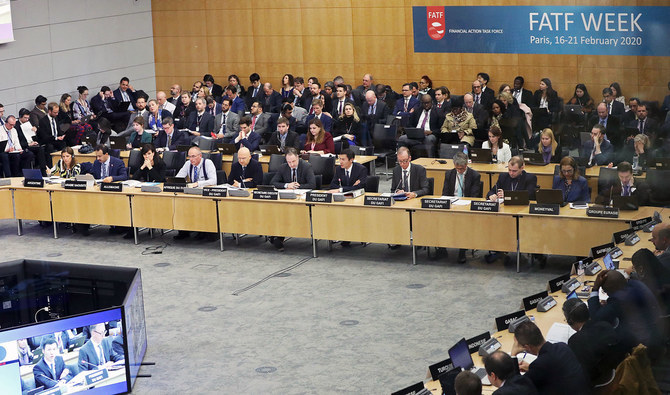

ISLAMABAD: A global money laundering and terror financing watchdog began its three-day virtual plenary session this week to evaluate steps taken by Pakistan to strengthen oversight of its largely undocumented financial sector and decide if the South Asian nation would be removed from a ‘grey list.’
The Financial Action Task Force (FATF) sets standards and promotes effective implementation of legal, regulatory and operational measures for combating money laundering, terror financing and other related threats to the integrity of the international financial system.
In 2018 the FATF placed Pakistan on its “grey list” of countries with inadequate controls over terror financing, and gave it a 27-step action plan to implement, which includes passing new legislation. Pakistan says it has met most of the requirements to be removed from the grey list.
“Stop money laundering, save lives. The FATF is holding a three day Plenary to discuss key issues in the fight against money laundering and terrorist financing,” the watchdog wrote on its Twitter page.
Stop money laundering, save lives. The FATF is holding a three day Plenary to discuss key issues in the fight against money laundering and terrorist financing. See more about why it's importanthttps://t.co/B8Wu8vdJGK #FollowTheMoney pic.twitter.com/bQBdBXzlA9
— FATF (@FATFNews) February 22, 2021
“We hope the FATF plenary will acknowledge and appreciate our actions,” Pakistan’s foreign office spokesperson Zahid Hafeez Chaudhri told Arab News on Sunday. “FATF is a technical body, and we expect it to take a decision based on the merits of our case.”
The global financial watchdog had already acknowledged that Pakistan had completed 21 of the 27 action items, and Chaudhri said his country was “painstakingly” working to make progress on “the remaining six partially addressed items.”
Pakistani officials also say the forum has been used by various international powers to unjustly target their country.
Prime Minister Imran Khan’s adviser on national security, Dr. Moeed Yusuf, recently told a conference in Islamabad that FATF’s decision to keep Pakistan on its grey list was more “political” than “technical.”
The outcomes of the FATF plenary will be published on Thursday 25 February, at the close of the meeting.
“The issue isn’t whether it’ll [Pakistan] be blacklisted (it won’t), but more so if it comes off the grey list,” Michael Kugelman at the Wilson Center in Washington wrote on Twitter. “A good chance it’ll stay, given member views that some Action Plan items not complete.”
Today marks the start of the latest FATF plenary, which will weigh in on Pakistan's status. The issue isn't whether it'll be blacklisted (it won't), but more so if it comes off the "gray list." A good chance it'll stay, given member views that some Action Plan items not complete.
— Michael Kugelman (@MichaelKugelman) February 22, 2021
Pakistan has long been accused of supporting militant groups for use as proxies to project power in the South Asian region particularly toward its arch-rival India and in Afghanistan. Islamabad vociferously denies such accusations.
But with a minimum of three votes by FATF members needed to avoid the organization’s blacklist, Pakistan has been able to avoid being black listed so far thanks to support from major ally China and other friendly countries including Malaysia and Turkey.
Islamabad and counter-terrorism officials say Pakistan has taken extraordinary steps, including an unprecedented conviction for terrorism financing of Hafiz Saeed, chief of the Pakistani Lashkar-e-Taiba (LeT) group.
The most crucial aspect of compliance with FATF in Pakistan’s case is steps to effectively prevent militant groups from openly operating and raising funds.
The FATF has pushed Pakistan to adequately identify, assess and understand risks associated with militants groups present in the country such as Lashkar-e-Taiba, Daesh, Al-Qaeda, Jamat-ud-Dawa and Jaish-e-Mohammad.


