

Japan battling virus threat ahead of delayed Olympics

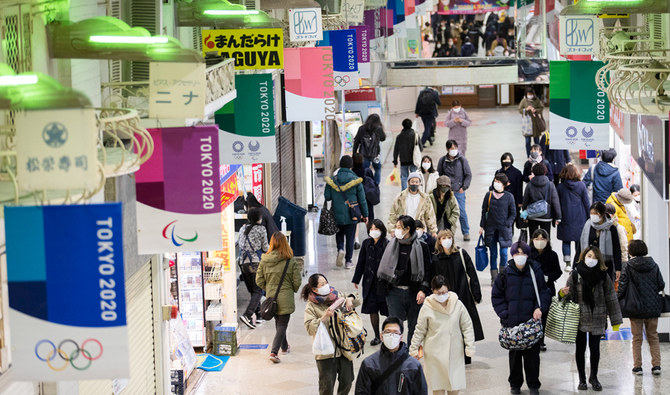
People walk through a shopping street decorated with banners of Tokyo's postponed Olympics and Paralympics in Tokyo on Thursday, Feb. 18, 2021. (AP)
Short Url
Updated 23 February 2021
Follow

Japan battling virus threat ahead of delayed Olympics

  • It was the first time that the New Year greetings had been canceled since 1990 following the death of Emperor Hirohito, posthumously named Emperor Showa, in 1989

TOKYO: Japan has managed to fight the coronavirus pandemic through quarantine, social distancing and states of emergency since the global outbreak of the virus began early last year.
The Japanese health ministry, under the directive of Japan’s minister overseeing vaccinations Taro Kono, began administering vaccines to medical staff on Feb. 17.
The country has so far approved only the Pfizer/BioNTech vaccine, and started administering the first shots in a Tokyo hospital.
The uphill battle Japan and the rest of the world faced during this pandemic was no easy feat.
On Jan. 16 last year, the Japanese health ministry confirmed the first coronavirus case in the country.
A week later, the foreign ministry issued a level two travel warning for the city of Wuhan in China, the epicenter of the outbreak.
By the end of January, more cases were detected that were either asymptomatic or showed mild symptoms. By February and March, the outbreak had reached most parts of the world, with talks of lockdowns, quarantine and social distancing measures.
Japan’s former prime minister Shinzo Abe announced in March a 270 billion yen ($2.5 billion) emergency economic package to help fight the pandemic as he sought public support for his government’s fight against the outbreak.
Travel restrictions were also put in place and a state of emergency was discussed in Tokyo as cases continued to rise in and out of Japan.
The country opened back up around June and by August cases began to rise again. By November, Japan’s Imperial Household Agency had decided to cancel the 2021 New Year greetings by the Imperial Family to visitors at the Imperial Palace in central Tokyo due to the threat of the virus.



Hopes remain that the Olympics will go ahead despite coronavirus challenges. (Supplied)

It was the first time that the New Year greetings had been canceled since 1990 following the death of Emperor Hirohito, posthumously named Emperor Showa, in 1989.
On Jan. 2, members of the Imperial Family appear on the balcony of the palace to offer New Year’s greetings to crowds of visitors.
Since the start of the Heisei era in 1989, at least 50,000 people visit to receive royal greetings.
The Imperial Family also greets the public at the palace on the Emperor’s birthday. But visits this year and last year were canceled due to concerns over crowding.
As December rolled around, Christmas and New Year’s celebrations were kept to a minimum, as coronavirus cases began to reach an all-time high. In Jan. 7 of this year, Japan’s Prime Minister Yoshihide Suga declared a new state of emergency in Tokyo.
With vaccines being administered and quarantine measures still in place for travelers, many hope that the situation will subside in time for the upcoming Tokyo Olympics and Paralympics Summer Games, despite the obstacles.


Rubio warns Iraq on Iran ties as Al-Maliki sets return

Updated 7 sec ago
Follow

Rubio warns Iraq on Iran ties as Al-Maliki sets return

WASHINGTON: US Secretary of State Marco Rubio warned Iraq on Sunday against a pro-Iranian government as the expected return of Nouri Al-Maliki as prime minister stirs Washington’s concern.
Maliki, who left power in 2014 following heated pressure from the United States, has been chosen by Iraq’s largest Shiite bloc, which would put him in line to be nominated prime minister.
Rubio, in a telephone call with incumbent Prime Minister Mohammed Shia Al-Sudani, voiced hope the next government will work to make Iraq “a force for stability, prosperity and security in the Middle East.”
“The secretary emphasized that a government controlled by Iran cannot successfully put Iraq’s own interests first, keep Iraq out of regional conflicts or advance the mutually beneficial partnership between the United States and Iraq,” Rubio said, according to State Department spokesman Tommy Pigott.
A pro-Iranian government in Iraq would be a rare boon for Tehran’s clerical state after it suffered major setbacks at home and in the region.
The Islamic republic has killed thousands of Iranians since mass protests erupted in late December.
Since the October 7, 2023 attacks, Israel has hit Iran both with strikes inside the country and heavy blows against Tehran’s Lebanese ally Hezbollah, while Iran lost its main Arab ally with the fall of Bashar Assad in Syria.
An Iraqi political source told AFP that the United States had conveyed that it “holds a negative view of previous governments led by former prime minister Maliki.”
In a letter, US representatives said that while the selection of the prime minister is an Iraqi decision, “the United States will make its own sovereign decisions regarding the next government in line with American interests.”
The United States wields key leverage over Iraq as the country’s oil export revenue is largely held at the Federal Reserve Bank in New York, in an arrangement reached after the 2003 US invasion that toppled Saddam Hussein.
Chief among US demands is that Iraq prevent a resurgence of Shiite armed groups backed by Iran. Sudani, who took office in 2022, has won US confidence through his delicate efforts to curb violence by the groups.
Maliki initially took office in 2006 with support of the United States as he strongly backed US military efforts against Al-Qaeda in Iraq and other Sunni militants.
But the United States eventually soured on Maliki, believing he pushed an excessively sectarian agenda that helped give rise to the Islamic State extremist movement.
Iraq’s parliament meets Tuesday to elect a new president, who holds a largely ceremonial role but will appoint a prime minister.