

UN calls for urgent action to rescue Rohingya refugees missing at sea

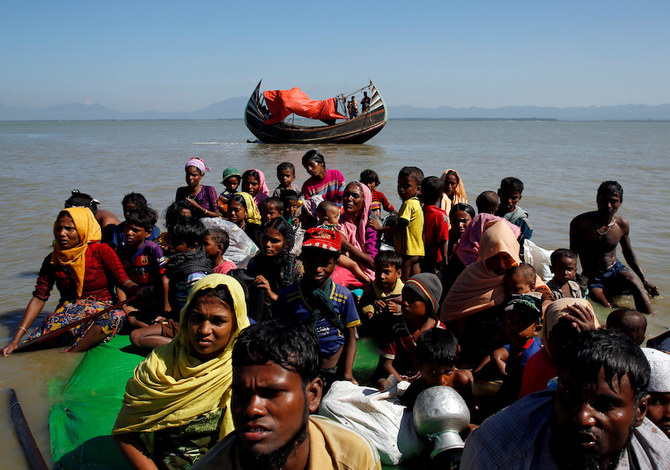
The UN Refugee Agency (UNHCR) on Monday called for urgent efforts to locate a missing vessel carrying Rohingya refugees that has been adrift on the Andaman Sea for more than a week. (Reuters/File Photo)
Short Url
Updated 23 February 2021
Follow

UN calls for urgent action to rescue Rohingya refugees missing at sea

  • Food and water reportedly ran out days ago; it is feared a number of those on board have already died
  • Last contact with vessel was on Saturday; current whereabouts and the number of passengers are unknown

NEW YORK: The UN Refugee Agency (UNHCR) on Monday called for urgent efforts to locate a missing vessel carrying Rohingya refugees that has been adrift on the Andaman Sea for more than a week.

The number of people on board is uncertain, as is the ship’s current location. The last contact with it was a distress call received on Saturday night, local time. This indicated that food and water ran out several days ago and many people are seriously ill. It is feared that a number have already died.

Indrika Ratwatte, director of the UNHCR’s Bureau for Asia and the Pacific, said he has alerted local maritime authorities that the vessel might be in their waters and appealed for their immediate assistance to save lives.

“Many (of those on board) are in a highly vulnerable condition and are apparently suffering from extreme dehydration,” he added. “We understand (that) fatalities have risen over the past 24 hours.”

The Andaman Sea is part of the northeastern Indian Ocean, bounded by the coastlines of Myanmar and Thailand. It lies to the southeast of the Bay of Bengal and east of India’s Andaman and Nicobar Islands.

Ratwatte called on countries in the area to immediately deploy search and rescue vessels and to prioritize efforts to save the lives of the refugees. 

“In line with international obligations under the law of the sea, and longstanding maritime traditions, the duty to rescue persons in distress at sea should be upheld, irrespective of nationality or legal status”, he said. He also reiterated UNHCR’s readiness to provide humanitarian aid and assistance with quarantine procedures.

According to UNHCR, refugees attempting to cross the seas of Southeast Asia are three times more likely to die than those in the Mediterranean, due largely to mistreatment by smugglers and the risk of disease on the boats.

“The fact that refugees and migrants continue to undertake fatal journeys accentuates the need for an immediate and collective regional response to search, rescue and disembarkation,” Ratwatte said.

The Rohingya, an ethnic minority, have endured decades of abuse in Myanmar, beginning in the 1970s when hundreds of thousands sought refuge in neighboring Bangladesh. An additional 250,000 fled after the uprising in Myanmar 1989 and the resulting military crackdown.

Thousands of them returned to Rakhine State in 1992 when Bangladesh and Myanmar agreed a repatriation deal. The latest Rohingya exodus to Bangladesh began in August 2017 following systematic attacks by Myanmar’s military, which senior UN officials have said amount to ethnic cleansing.


Carney says Canada has no plans to pursue free trade agreement with China as Trump threatens tariffs

Updated 26 January 2026
Follow

Carney says Canada has no plans to pursue free trade agreement with China as Trump threatens tariffs

TORONTO: Canadian Prime Minister Mark Carney said Sunday his country has no intention of pursuing a free trade deal with China. He was responding to US President Donald Trump’s threat to impose a 100 percent tariff on goods imported from Canada if America’s northern neighbor went ahead with a trade deal with Beijing.
Carney said his recent agreement with China merely cuts tariffs on a few sectors that were recently hit with tariffs.
Trump claims otherwise, posting that “China is successfully and completely taking over the once Great Country of Canada. So sad to see it happen. I only hope they leave Ice Hockey alone! President DJT”
The prime minister said under the free trade agreement with the US and Mexico there are commitments not to pursue free trade agreements with nonmarket economies without prior notification.
“We have no intention of doing that with China or any other nonmarket economy,” Carney said. “What we have done with China is to rectify some issues that developed in the last couple of years.”
In 2024, Canada mirrored the United States by putting a 100 percent tariff on electric vehicles from Beijing and a 25 percent tariff on steel and aluminum. China had responded by imposing 100 percent import taxes on Canadian canola oil and meal and 25 percent on pork and seafood.
Breaking with the United States this month during a visit to China, Carney cut its 100 percent tariff on Chinese electric cars in return for lower tariffs on those Canadian products.
Carney has said there would be an initial annual cap of 49,000 vehicles on Chinese EV exports coming into Canada at a tariff rate of 6.1 percent, growing to about 70,000 over five years. He noted there was no cap before 2024. He also has said the initial cap on Chinese EV imports was about 3 percent of the 1.8 million vehicles sold in Canada annually and that, in exchange, China is expected to begin investing in the Canadian auto industry within three years.
Trump posted a video Sunday in which the chief executive of the Canadian Vehicle Manufacturers’ Association warns there will be no Canadian auto industry without US access, while noting the Canadian market alone is too small to justify large scale manufacturing from China.
“A MUST WATCH. Canada is systematically destroying itself. The China deal is a disaster for them. Will go down as one of the worst deals, of any kind, in history. All their businesses are moving to the USA. I want to see Canada SURVIVE AND THRIVE! President DJT,” Trump posted on social media.
Trump’s post on Saturday said that if Carney “thinks he is going to make Canada a ‘Drop Off Port’ for China to send goods and products into the United States, he is sorely mistaken.”
“We can’t let Canada become an opening that the Chinese pour their cheap goods into the U.S,” US Treasury Secretary Scott Bessent said on ABC’s “This Week.”
“We have a , but based off — based on that, which is going to be renegotiated this summer, and I’m not sure what Prime Minister Carney is doing here, other than trying to virtue-signal to his globalist friends at Davos.”
Trump’s threat came amid an escalating war of words with Carney as the Republican president’s push to acquire Greenland strained the NATO alliance.
Carney has emerged as a leader of a movement for countries to find ways to link up and counter the US under Trump. Speaking in Davos before Trump, Carney said, “Middle powers must act together because if you are not at the table, you are on the menu” and he warned about coercion by great powers — without mentioning Trump’s name. The prime minister received widespread praise and attention for his remarks, upstaging Trump at the World Economic Forum.
Trump’s push to acquire Greenland has come after he has repeatedly needled Canada over its sovereignty and suggested it also be absorbed into the United States as a 51st state. He posted an altered image on social media this week showing a map of the United States that included Canada, Venezuela, Greenland and Cuba as part of its territory.