Pakistan plans billion-dollar fund to push digital transformation

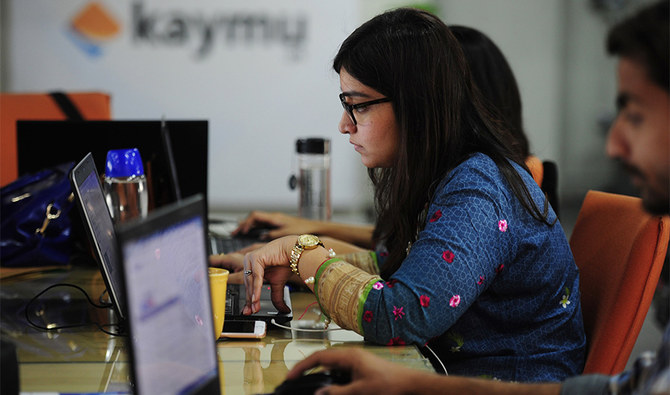
This photograph taken on November 19, 2015 shows Pakistani employees of online marketplace company Kaymu at work in Karachi. (AFP/File)
Short Url
Updated 22 February 2021
Follow

Pakistan plans billion-dollar fund to push digital transformation

  • Ten venture capital funds ready to invest in the country’s special technology zones, chairman Special Technology Zones Authority says
  • Telecom operators say pandemic opportunity not adequately captured in Pakistan due to suboptimal government support and industry preparedness

ISLAMABAD: The Pakistan government has changed foreign exchange regulations to facilitate investors and protect their capital with tax incentives for ten years in special technology zones that aim to boost digital transformation in the next two years, a top government official said on Monday, saying a billion-dollar fund was in the works. 

“We have gotten ten venture capital funds now finally ready to come to Pakistan,” Amer Hashmi, chairman Special Technology Zones Authority, told Arab News on the sidelines of a policy roundtable -“Connecting Pakistan: Covid-19 Lessons for Digital Policy” - organized by policy think tank Tabadlabb in Islamabad. “The state may think about going fifty-fifty with them, and create the first billion dollar fund.”

Talking about the importance of digital transformation and special technology zones, Hashmi said the government was pushing it to create job opportunities and boost revenue.

“The government doesn’t have cash; we will have to do this to generate more revenue and employment,” he said, adding that digital initiatives would be accelerated in the next two years as Prime Minister Imran Khan was himself supervising the digital transformation process. 

While Covid-19 has been a catalyst in accelerating Pakistan’s digital transformation, there is a critical need for strategic reforms and a change in the mindset of the government to sustainably capitalize on the country’s potential, other panelists at Monday’s event said. 

Irfan Wahab, chief executive officer at Telenor, said global demand for digital access during the COVID-19 pandemic and solutions to overcome obstacles had increased manifold, but the opportunity was not adequately captured in Pakistan due to suboptimal government support and industry preparedness.  

He said in many other countries, government regulators had expanded the spectrum during the pandemic emergency to allow smoother access for citizens to high-speed mobile internet.  

“In Pakistan, similar requests were not entertained by the government whose focus remained only on maximizing revenue from spectrum sales,” Wahab said.

Talking about the need for policy interventions, Jazz CEO, Aamir Ibrahim said “we are never going to think about the future" if the government only remained fixated on how to milk telecom companies for taxes.

“This is the inherent disconnect between the three key stakeholders: the investors or operators, the governments, and the end-users, who want the best service for free,” he said.  

High taxes were one of the major obstacles to more rapid adoption of fin-tech and digital payments despite great initiatives such as the government’s instant payment system Raast, Tez Financial’s co-founder Naureen Hayat said. 

“Cash from a customer’s perspective is still cheaper than digital,” she said. “This perception comes as a result of taxes and extra charges.” 


Pakistan, UK sign £35 million Green Compact to strengthen climate resilience

Updated 21 December 2025
Follow

Pakistan, UK sign £35 million Green Compact to strengthen climate resilience

  • Pakistan ranks among nations most vulnerable to climate change and has seen erratic changes in its weather patterns
  • UK will help Pakistan mobilize climate finance, strengthen regulatory frameworks and develop bankable climate projects

ISLAMABAD: Pakistan and the United Kingdom (UK) have formalized a comprehensive climate partnership with the launch of a Green Compact that aims to enhance climate resilience, accelerate clean energy transition and scale up nature-based solutions, including mangrove conservation, Pakistani state media reported on Sunday.

The agreement, signed in Islamabad by Federal Minister for Climate Change and Environmental Coordination Dr. Musadik Malik and UK Minister for International Development Jennifer Chapman, unlocks £35 million in targeted support for green development and long-term climate action, according to Radio Pakistan broadcaster.

Pakistan ranks among nations most vulnerable to climate change and has seen erratic changes in its weather patterns that have led to frequent heatwaves, untimely rains, storms, cyclones, floods and droughts in recent years. In 2022, monsoon floods killed over 1,700 people, displaced another 33 million and caused over $30 billion losses, while another 1,037 people were killed in floods this year.

Mohammad Saleem Shaikh, a spokesperson for Pakistan’s Ministry of Climate Change, described the compact as a “decisive move toward action-oriented climate cooperation,” noting that its implementation over the next decade will be critical for Pakistan which regularly faces floods, heatwaves and water stress.

“The Compact is structured around five core pillars: climate finance and investment, clean energy transition, nature-based solutions, innovation and youth empowerment, and adaptation and resilience,” the report read.

“Under the agreement, the UK will work with Pakistan to mobilize public and private climate finance, strengthen regulatory frameworks for green investment, and develop bankable climate projects.”

Clean energy forms a central component of Pakistan’s transition, with Islamabad planning to expand solar and wind generation to reduce fossil fuel dependence, improve energy security and stabilize power costs, according to Shaikh.

“Renewable energy is now economically competitive, making the transition both environmentally and financially viable,” he was quoted as saying.

“Nature-based solutions, particularly large-scale mangrove restoration, will protect coastal communities from storm surges and erosion while enhancing biodiversity and carbon sequestration.”

Under the Compact, technical support, mentoring and access to investors will be provided to climate-smart startups and young innovators, reflecting Pakistan’s recognition of youth-led initiatives as central to future climate solutions.

On the occasion, Chapman, on her first official visit to Pakistan, underscored the urgency of climate action, highlighting the UK’s support for renewable energy, mangrove and ecosystem restoration, early-warning systems, climate budgeting and international investment flows into Pakistan.

Shaikh described the Green Compact as “a strategic turning point” in Pakistan–UK relations on climate change, saying its effective implementation is essential for Pakistan to meet its national climate targets.