

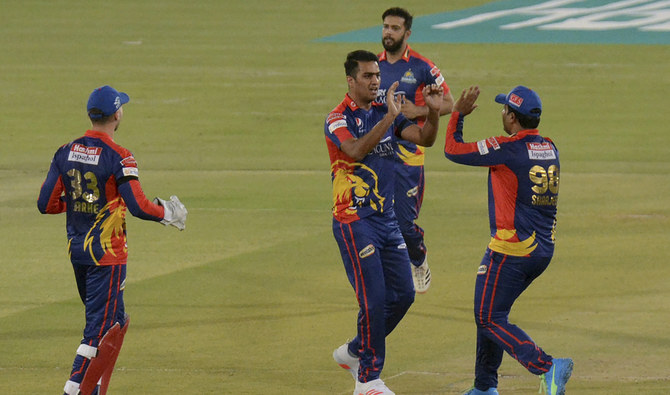
Karachi Kings outclass Quetta Gladiators in Pakistan Super League opening match

Arshad Iqbal of Karachi Kings celebrates with teammates after taking the wicket of Azam Khan during a Pakistan Super League T20 cricket match between Karachi Kings and Quetta Gladiators at National Stadium, in Karachi, Pakistan on February 20, 2021. (AP)
Short Url
Updated 20 February 2021
Follow

Karachi Kings outclass Quetta Gladiators in Pakistan Super League opening match

  • Karachi chased Quetta’s 121 in 13.5 overs with seven wickets in hand
  • The sixth edition of Pakistan Super League was launched with star-studded ceremony on Saturday evening

KARACHI: A blitzing innings of Joe Clarke, who scored 46 of 23 balls, helped the defending Pakistan Super League champions, Karachi Kings, in the opening match of the tournament which they won against Quetta Gladiators by seven wickets at the National Stadium on Saturday. 

Muhammad Nabi, who came to bat at number five, scored 30 of 14 balls and hit the winning stroke of six runs. Babar Azam, who is also the skipper of Pakistan’s national team, scored 24 of 20 balls.

Muhammad Hussain of Quetta Gladiators was a prominent performer who grabbed two wickets in his four overs and only conceded 18 runs. Usmani Shinwari gave away 10 runs and took one wicket. 

Karachi Kings won the toss at the outset and invited Gladiators to bat. 

The Quetta openers were back in the pavilion for 17 runs by the fourth over. Only four Gladiators reached double digits, and West Indian hitter Chris Gayle remained the highest scorer after making 24-ball 39.

An Afghan player, Qais Ahmad, offered some resistance to Karachi by scoring 16 of 13 balls, but the entire team was bowled out in 18.2 overs after putting 121 runs on the board. 

Arshad Iqbal remained the most successful bowler for Karachi and took three wickets while conceding 16 runs in his four overs. 

Earlier, Pakistan’s biggest cricketing event kicked off on Saturday with music and fireworks in Karachi after the edition was suspended last year following the coronavirus outbreak. 

The Pakistan Cricket Board (PCB) said in a statement prior to the opening ceremony that it would allow 20 percent of stadium capacity during games — 7,500 fans in Karachi and 5,500 fans in Lahore — to cheer on their favorite T20 teams for a month of cricket played in two cities. 

Last year, four matches were played in empty stadiums before the league’s suspension. 

Performances by pop stars Atif Aslam, Imran Khan, Humaima Malick and PSL 6 anthem artists, Naseebo Lal, Aima Baig and Young Stunners marked the launch of the sixth edition of the annual cricketing competition at the national stadium in Karachi. They were, however, played on screens as artists did not perform live due to coronavirus health guidelines. 

“Pakistan has opened the doors to the rest of the world and PSL was proud to lead this resurgence of international cricket,” PCB chairman Ehsan Mani said during the ceremony. 

“The best team will lift the trophy on March 22,” he added, as he thanked overseas players who arrived in Pakistan to take part in PSL matches. 

The first 20 matches will be played in the national stadium Karachi between Feb. 20 and March 7. The teams will then depart for Lahore to play the remaining 10 league matches and four playoffs. 

The tournament will conclude with a final match at Lahore’s Qaddafi stadium on March 22.


Islamabad steps up vehicle checks to boost security as 166,000 cars get electronic tags

Updated 18 January 2026
Follow

Islamabad steps up vehicle checks to boost security as 166,000 cars get electronic tags

  • Authorities say over 3,000 vehicles registered in past 24 hours as enforcement intensifies
  • Extended service hours introduced to push full compliance with digital monitoring system

ISLAMABAD: Authorities in the Pakistani capital have intensified enforcement against vehicles without mandatory electronic tags with more than 166,000 cars now registered, according to data released on Sunday evening, as Islamabad moves to strengthen security and digital monitoring at key entry and exit points.

The Islamabad Capital Territory (ICT) administration introduced the electronic tagging system late last year as part of a broader effort to regulate traffic, improve record-keeping and enhance surveillance in a city that hosts the country’s main government institutions, foreign missions and diplomatic enclaves.

Under the system, vehicles are fitted with electronic tags that can be read automatically by scanners installed at checkpoints across the capital, allowing authorities to identify unregistered vehicles without manual inspections. Vehicles already equipped with a motorway tag, or m-tag, are exempt from the requirement.

“A total of 166,888 vehicles have successfully been issued M-Tags so far, including 3,130 vehicles in the last 24 hours,” the ICT administration said, according to the Excise Department.

Officials said readers installed at checkpoints across Islamabad are fully operational and are being used to stop vehicles still without tags, as enforcement teams carry out checks across the city.

To facilitate compliance, authorities have expanded installation facilities and extended operating hours. The Excise Department said m-tag installation is currently available at 17 booth locations, while select centers have begun operating beyond normal working hours.

According to Director General Excise Irfan Memon, m-tag centers at 26 Number Chungi and 18 Meel are providing services round the clock, while counters at Kachnar Park and F-9 Park remain open until midnight to accommodate motorists unable to visit during daytime hours.

Officials said the combination of enforcement and facilitation was aimed at achieving full compliance with minimal disruption, adding that operations would continue until all vehicles operating in the capital are brought into the system.

The enforcement drive builds on a wider push by the federal government to integrate traffic management, emergency response and security monitoring through technology-driven “safe city” initiatives. Last month, Interior Minister Mohsin Naqvi reviewed Islamabad’s surveillance infrastructure and said reforms in monitoring systems and the effective use of technology were the “need of the hour.”

Authorities have urged motorists to obtain electronic tags promptly to avoid delays and penalties at checkpoints as enforcement continues across the capital.