

Amnesty slams ‘inhumanity of Iran’s criminal justice system’

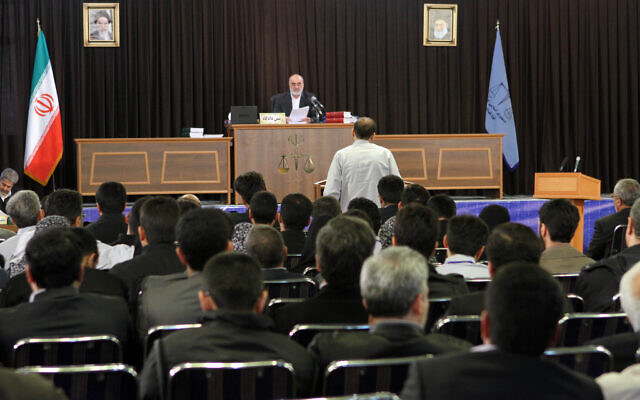
Iran’s criminal justice system is notorious for the number of allegations of cruelty leveled against it. (AP/File Photo)
Short Url
Updated 18 February 2021
Follow

Amnesty slams ‘inhumanity of Iran’s criminal justice system’

  • Iran is renowned for its use of unusual and cruel punishments against prisoners
  • Has been the subject of repeated condemnation by members of international community and human rights campaigners

LONDON: Amnesty International has denounced the “gruesome” treatment of people in Iran’s justice system after an inmate was sentenced to 60 lashes after a peaceful hunger strike, and had a sentence of amputation upheld despite confessing to a crime under torture.

Hadi Rostami, who was convicted of robbery in 2019 after his confession, has attempted suicide twice while in Urumieh prison, according to Amnesty, leading to his sentence being extended by eight months and causing him to receive the lashes.

Despite this, he has not received any access to mental health treatment, and has been held in “inhumane” conditions, the human rights group said, adding that Rostami’s physical health has deteriorated due to the lack of medical attention following his suicide attempts.

“The cruel lashing of an ailing, suicidal prisoner is another reminder of the inhumanity of Iran’s criminal justice system, which legalizes torture and other ill-treatment,” said Diana Eltahawy, Amnesty’s deputy director for the Middle East and North Africa.

“The Iranian authorities are committing torture by leaving Hadi Rostami in constant fear of amputation and deliberately denying him urgently needed medical care for complications resulting from his recent suicide attempts,” she added.

“We call on the Iranian authorities to quash Hadi Rostami’s conviction and amputation sentence immediately and grant him a fair retrial without resorting to corporal punishments. They must also immediately provide him with the specialized physical and mental health care that he requires outside prison.”

Iran is renowned for its use of unusual and cruel punishments against prisoners, and has been the subject of repeated condemnation by members of the international community and human rights campaigners as a result.

In September 2020, Amnesty said the authorities planned to install a guillotine at Urumieh prison to carry out amputations.

It added that as well as Rostami, five other men are awaiting similar fates: Mehdi Sharfian, Mehdi Shahivand, Kasra Karami, Shahab Teimouri Ayeneh and Mehrdad Teimouri Ayeneh.

Iran’s criminal justice system is notorious for the number of allegations of cruelty leveled against it.

As well as torture, Iran is accused of using prisoners to exert political pressure on other governments, including the arbitrary detention of foreign and dual nationals such as British-Iranian Nazanin Zaghari-Ratcliffe and British-Australian academic Kylie Moore-Gilbert, who were both held in solitary confinement in conditions likened to torture by their families.

Iran is also known for executing prisoners in circumstances described as cruel, including political prisoners such as wrestling champion Navid Afkari, who was killed in secret without prior notice to him or his family on Sept. 12, 2020, and the execution of minors such as teenager Shayan Saeedpour in April that year.

Soleimani’s shadow
Qassem Soleimani left a trail of death and destruction in his wake as head of Iran’s Quds Force … until his assassination on Jan. 3, 2020. Yet still, his legacy of murderous interference continues to haunt the region

Enter


keywords

Virtual museum preserves Sudan’s plundered heritage

Updated 6 sec ago
Follow

Virtual museum preserves Sudan’s plundered heritage

CAIRO: Destroyed and looted in the early months of Sudan’s war, the national museum in Khartoum is now welcoming visitors virtually after months of painstaking effort to digitally recreate its collection.
At the museum itself, almost nothing remains of the 100,000 artefacts it had stored since its construction in the 1950s. Only the pieces too heavy for looters to haul off, like the massive granite statue of the Kush Pharaoh Taharqa and frescoes relocated from temples during the building of the Aswan Dam, are still present on site.
“The virtual museum is the only viable option to ensure continuity,” government antiquities official Ikhlass Abdel Latif said during a recent presentation of the project, carried out by the French Archaeological Unit for Sudanese Antiquities (SFDAS) with support from the Louvre and Britain’s Durham University.
When the museum was plundered following the outbreak of the war between the regular army and the paramilitary Rapid Support Forces (RSF) in April 2023, satellite images showed trucks loaded with relics heading toward Darfur, the western region now totally controlled by the RSF.
Since then, searches for the missing artefacts aided by Interpol have only yielded meagre results.
“The Khartoum museum was the cornerstone of Sudanese cultural preservation — the damage is astronomical,” said SFDAS researcher Faiza Drici, but “the virtual version lets us recreate the lost collections and keep a clear record.”
Drici worked for more than a year to reconstruct the lost holdings in a database, working from fragments of official lists, studies published by researchers and photos taken during excavation missions.
Then graphic designer Marcel Perrin created a computer model that mimicked the museum’s atmosphere — its architecture, its lighting and the arrangement of its displays.
Online since January 1, the virtual museum now gives visitors a facsimile of the experience of walking through the institution’s galleries — reconstructed from photographs and the original plans — and viewing more than 1,000 pieces inherited from the ancient Kingdom of Kush.
It will take until the end of 2026, however, for the project to upload its recreation of the museum’s famed “Gold Room,” which had housed solid-gold royal jewelry, figurines and ceremonial objects stolen by looters.
In addition to the virtual museum’s documentary value, the catalogue reconstructed by SFDAS is expected to bolster Interpol’s efforts to thwart the trafficking of Sudan’s stolen heritage.