BEIRUT: Lebanon kicked off Covid-19 vaccinations Sunday with jabs for health care workers and the elderly in an inoculation drive it hopes will keep the outbreak in check amid a deepening economic crisis.
The country has been under lockdown since mid-January, after an unprecedented spike in cases blamed on holiday gatherings forced overwhelmed hospitals to turn away patients.
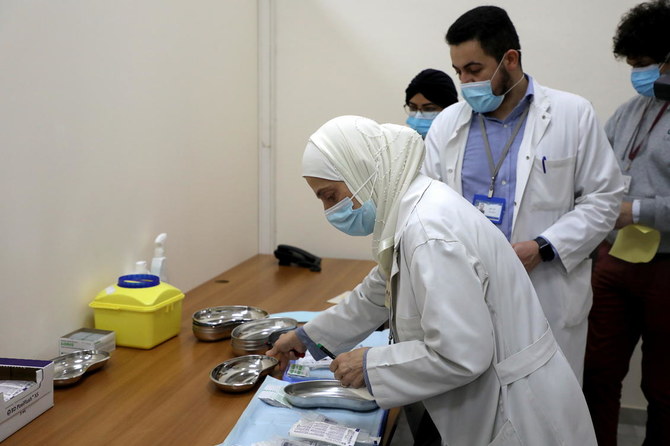
Medical workers and those aged over 75 were the first to receive Pfizer/BioNTech shots at three major Beirut hospitals, a day after a shipment of 28,500 doses arrived at the capital’s airport.
The World Bank has allocated $34 million to inoculate an initial two million of Lebanon’s six million inhabitants.
“Finally there’s a glimpse of hope that things will get back to normal,” said medical student Dana Chatila, who was waiting in her white lab coat and mask outside the American University Medical Center where she works in the emergency department.
“It’s going to take time of course, but the darkness is ending.”
The pandemic has compounded the woes of Lebanese, who are struggling with a dire economic crisis and still reeling from Beirut’s massive port blast last summer that killed more than 200 people and destroyed swathes of the capital.
More than half the population lives in poverty, and rights groups have warned millions will struggle to survive without help if coronavirus restrictions last too long.
Caretaker prime minister Hassan Diab said: “We hope to reach adequate community protection so life can gradually return to normal in Lebanon as soon as possible.”
The first jab was given to Mahmoud Hassoun, head of the intensive care unit at Rafik Hariri Hospital, which has been at the forefront of battling the outbreak.
“Hopefully this will be the beginning of the end of this plague in the country,” he told AFP.
The second to roll up his shirt sleeves in front of the cameras was popular Lebanese comedian Salah Tizani, 93, known by his stage name Abu Salim.
“I’m telling everyone to come and get vaccinated,” he said. “Better to get vaccinated than to be knocked down by this deadly virus.”
Among those vaccinated by early afternoon were more than 100 people over the age of 75, health ministry adviser Mohamad Haidar said. From Monday, another 18 hospitals across Lebanon would join in the vaccination campaign, he said.
Authorities say 336,992 people have caught Covid since February 2020, of whom 3,961 have died.
Lebanon has ordered around six million vaccine doses in total, including two million from Pfizer/BioNTech and another 2.7 million via the international Covax distribution program.
The World Bank and the International Federation of Red Cross and Red Crescent Societies are to monitor the vaccine rollout.
Some 450,000 people have signed up to be vaccinated in Lebanon including 45,000 aged over 75 and 17,500 health sector staff, caretaker health minister Hamad Hassan said.
He has promised all residents would be vaccinated, including Syrian and Palestinian refugees living in the country.
But many in Lebanon are still hesitant to get the jab.
Of 500 people surveyed by private think-tank Information International, 31 percent said they would get vaccinated, 38 percent said they would rather not, and 31 percent were undecided.
Lebanon’s government stepped down after the August 4 port blast but remains in a caretaker capacity as a deeply divided political class has since failed to agree on a new cabinet.
Lebanon desperately needs the new government to start sweeping reforms and unlock billions of dollars in international aid.
Saad Hariri, who returned as premier designate in October almost a year after he stepped down under street pressure, said he wanted a “government of experts not affiliated with political parties.”
“Whoever prevents the government from being formed prevents reforms from being launched, delays stemming the collapse... and prolongs the suffering of Lebanese,” he said after weeks in which he and President Michel Aoun have blamed each other for the deadlock.
He spoke on the 16th anniversary of the assassination in Beirut of his father, former premier Rafik Hariri.


![]()
![]()
![]()

Crisis-hit Lebanon kicks off COVID-19 vaccinations


Short Url
https://arab.news/yntvc
Crisis-hit Lebanon kicks off COVID-19 vaccinations
- Medical workers and those aged over 75 were the first to receive Pfizer/BioNTech shots at three hospitals
- The World Bank has allocated $34 million to inoculate an initial two million of Lebanon’s six million inhabitants


Latest updates




© 2026 SAUDI RESEARCH & PUBLISHING COMPANY, All Rights Reserved And subject to Terms of Use Agreement.