

Chile to Skardu: Families of missing K2 climbers trek thin line between hope and despair

Short Url
Updated 15 February 2021
Follow

Chile to Skardu: Families of missing K2 climbers trek thin line between hope and despair

  • Cousin and best friend of Chile’s JP Mohr arrive in Pakistan "to find answers", say waiting for a miracle
  • Sajid Sadpara, son of missing Pakistani climber Ali Sadpara, says mother broken-hearted, hope almost gone

ISLAMABAD: In the lobby of a small downtown hotel in the Pakistani capital of Islamabad, a stack of odd-shaped luggage lined along a wall on Saturday morning was nothing out of the ordinary at first glance. On closer inspection, the words “JP Mohr” could be seen scrawled in black on a number of blue porter's drums, a familiar part of treks through Pakistan's high mountains.

The 33-year-old Chilean mountaineer Juan Pablo Mohr is one of three climbers who went missing on February 5 during a historic push to summit K2 in winter - one of mountaineering’s last great feats, achieved for only the first time in history this year by a group of Nepali climbers. 

The arrival of Mohr's belongings in the capital over a week after he went missing coincided on Saturday with his two concerned relatives flying into Pakistan from Chile, saying they had been sent by the climber's immediate family to 'bring JP back,' as an arduous helicopter rescue mission continues the search to find him, Pakistan's Ali Sadpara and Iceland's John Snorri. 

"The family told us directly... we must come back with JP," Federico Scheuch, Mohr's manager and cousin, told Arab News in Islamabad.
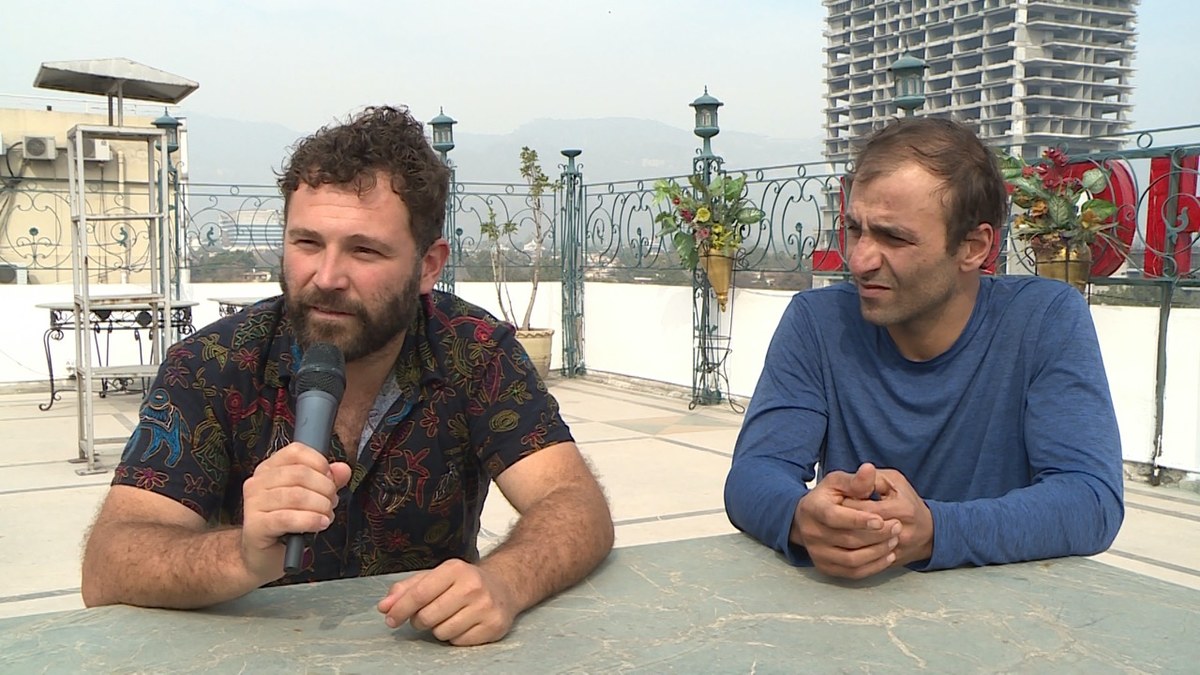


Federico Scheuch (left), manager and cousin of missing K2 climber JP Mohr, and Mohr's childhood best friend Juan Pablo Diban, speak to Arab News in Islamabad, Pakistan on February 13, 2021 (AN Photo)

"The family has a lot of hope and we are waiting for the miracle," he said, adding that he would be flying to the northern town of Skardu the following morning, Sunday, so he could be "closer" to information about ongoing search and rescue attempts.

Back home, Scheuch described a country paralyzed with news of Mohr’s disappearance, with Chileans hoping against hope that one of the pioneer’s of the nation’s mountaineering culture would be found alive on the treacherous K2, the world's second highest mountain. 

"We're here for the Chilean people... for hope," he said.
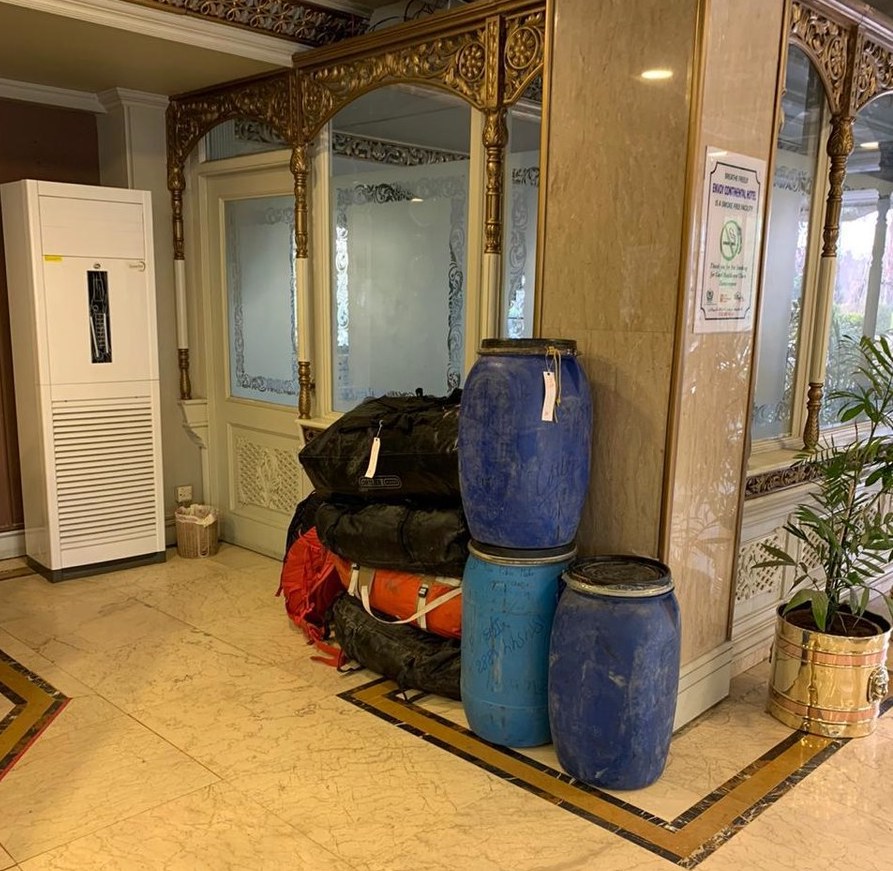


In this photo taken on February 13, 2021, the luggage of Chilean mountaineer Juan Pablo Mohr can be seen in the lobby of a hotel in Islamabad, Pakistan. Mohr is one of three climbers who went missing on February 5 during a historic push to summit K2 in winter (AN photo by Amal Khan)

"The bag just came back from Skardu and I don't want to open it," Scheuch added. "It's scary... it's part of JP... all the things that are in there."

From Skardu, his voice breaking over the phone, Sadpara's son and expedition member Sajid Sadpara told Arab News hope for a positive recovery had all but faded. 

"They're saying the rescue operation is still underway up there... but hope is now close to gone," Sadpara said. "My mother is broken-hearted. She is so sad.”
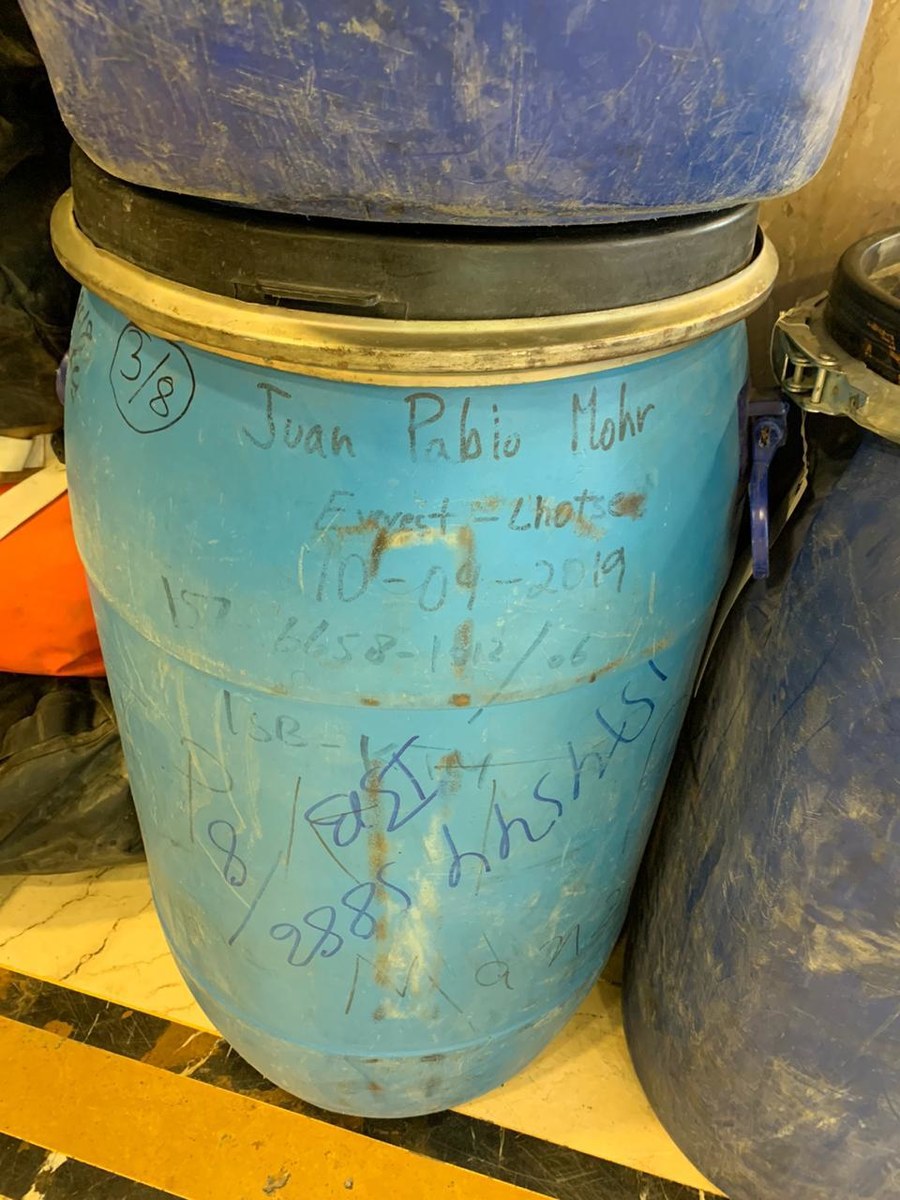


In this photo taken on February 13, 2021, at a hotel in Islamabad, Pakistan, a porter’s drum can be seen with the words “JP Mohr” written on it - part of the recovered luggage of Chilean mountaineer Juan Pablo Mohr. Mohr is one of three climbers who went missing on February 5 during a historic push to summit K2 in winter (AN photo by Amal Khan)

Sajid was the last person to see the three climbers make their final push to the summit on Friday (February 5) morning, at what is considered the most difficult part of the climb: the Bottleneck, a steep and narrow gully just 300 metres shy of the 8,611 metre high K2. 

From there, Sajid, whose oxygen regulator malfunctioned, was asked by his father to climb back down. He made his way to Camp 3 and waited for over 24 hours for the team to descend. They never did.

"We are trying to be the first line of information," Juan Pablo Diban, Mohr's childhood best friend, told Arab News in Islamabad. "We've been watching the news all of last week, talking with anyone who can give us information,” he added, saying him and Scheuch had come to Pakistan "to get more answers."

Diban described Mohr, a father of three, as someone who could never still ever since he was a child and who was always joking and making others around him laugh. He was also hugely respected back home for his social work.

 "The whole of Chile is paralyzed by this news," Diban said. "JP is so much of a giver. He gives happiness to a lot of people."

Speaking about Mohr's decision not to carry supplemental oxygen - the only one in the group not to do so - Diban and Schuech called him a mountaineering purist who just liked doing things the old-fashioned way.

"He preferred to...summit without oxygen. He didn't use sherpas (porters) ... if he can help it, he doesn't use ropes," Schuech said. 

"He just wanted to do it that way for the pureness of the sport," Diban added.

Then he laughed softly: "We also don't want to open his bags... because he is so messy.”


Islamabad puts drivers on notice as smog crisis worsens

Updated 12 sec ago
Follow

Islamabad puts drivers on notice as smog crisis worsens

  • Police checkpoints have issued over 300 fines and impounded 80 vehicles as Islamabad rolls out roadside emissions checks
  • Transport accounts for over half of the capital’s toxic PM2.5, with air quality this month repeatedly breaching WHO safety limits

ISLAMABAD: Truck driver Muhammad Afzal was not expecting to be stopped by police, let alone fined, as he drove into Islamabad this week because of the thick diesel fumes emanating from his exhaust pipe.

“This is unfair,” he said after being told to pay 1,000 rupees ($3.60), with the threat of having his truck impounded if he did not “fix” the problem.

“I was coming from Lahore after getting my vehicle repaired. They pressed the accelerator to make it release smoke. It’s an injustice,” he told AFP.

This picture taken on December 10, 2025, shows residents examining their cars at an emission testing point in Islamabad. (AFP)

Checkpoints set up this month are part of a crackdown by authorities to combat the city’s soaring smog levels, with winter months the worst due to atmospheric inversions that trap pollutants at ground level.

“We have already warned the owners of stern action, and we will stop their entry into the city if they don’t comply with the orders,” said Dr. Zaigham Abbas of Pakistan’s Environmental Protection Agency (EPA), as he surveyed the checkpoint at the southeast edge of the capital.

For Waleed Ahmed, a technician inspecting the vehicles at the site, “just like a human being, a vehicle has a life cycle. Those that cross it release smoke that is dangerous to human health.”

This picture taken on December 10, 2025, shows technician Waleed Ahmed examining a vehicle to test its emissions on road, on the outskirts of Islamabad. (AFP)

‘SELF-INFLICTED CRISIS’

While not yet at the extreme winter levels of Lahore or the megacity Karachi, where heavy industry and brick kilns spew tons of pollutants each year, Islamabad is steadily closing the gap.

So far in December it has already registered seven “very unhealthy” days for PM2.5 particulates of more than 150 micrograms per cubic meter, according to the Swiss-based monitoring firm IQAir.

Intraday PM2.5 levels in Islamabad often exceed those in Karachi and Lahore, and in 2024 the city’s average PM2.5 reading for the year was 52.3 micrograms — surpassing the 46.2 for Lahore.

Those annual readings are far beyond the safe level of five micrograms recommended by the World Health Organization.

An aerial picture shows dense smog in Islamabad on December 12, 2025. (AFP)

Built from scratch as Pakistan’s capital in the 1960s, the city was envisioned as an urban model for the rapidly growing nation, with wide avenues and ample green spaces abutting the Himalayan foothills.

But the expansive layout discourages walking and public transport remains limited, meaning cars — mostly older models — are essential for residents to get around.

“The capital region is choked overwhelmingly by its transport sector,” which produces 53 percent of its toxic PM2.5 particles, the Pakistan Air Quality Initiative, a research group, said in a recent report.

“The haze over Islamabad... is not the smoke of industry, but the exhaust of a million private journeys — a self-inflicted crisis,” it said.

‘HER BASIC RIGHT’

Announcing the crackdown on December 7, EPA chief Nazia Zaib Ali said over 300 fines were issued at checkpoints in the first week, with 80 vehicles impounded.

“We cannot allow non-compliant vehicles at any cost to poison the city’s air and endanger public health,” she said in a statement.

This picture taken on December 10, 2025, shows a technician pasting a certified sticker on a car after it cleared an emission test in Islamabad. (AFP)

The city has also begun setting up stations where drivers can have their emissions inspected, with those passing receiving a green sticker on their windshield.

“We were worried for Lahore, but now it’s Islamabad. And that’s all because of vehicles emitting pollution,” said Iftikhar Sarwar, 51, as he had his car checked on a busy road near an Islamabad park.

“I never needed medicine before but now I get allergies if I don’t take a tablet in the morning. The same is happening with my family,” he added.

Other residents say they worry the government’s measures will not be enough to counter the worsening winter smog.

“This is not the Islamabad I came to 20 years ago,” said Sulaman Ijaz, an anthropologist.

“I feel uneasy when I think about what I will say if my daughter asks for clean air — that is her basic right.”