Mars Hope Probe success strengthens UAE-Japan partnership

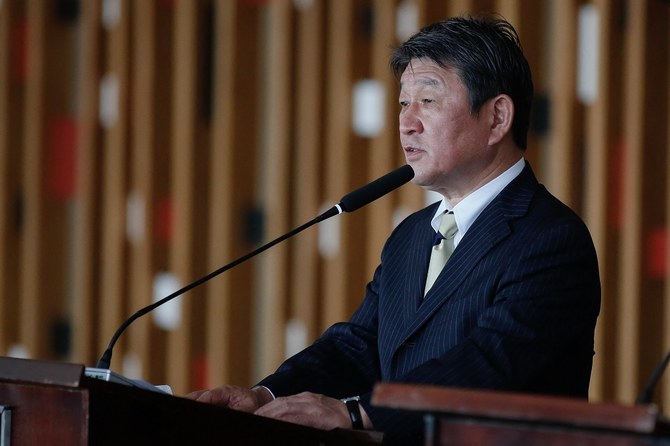
Motegi told a press conference at the ministry on Feb. 12 that this entry was the very first arrival of a probe from the Middle East to Mars. (File/AFP)
Short Url
Updated 12 February 2021
Follow

Mars Hope Probe success strengthens UAE-Japan partnership

  • Motegi told a press conference at the ministry on Feb. 12 that this entry was the very first arrival of a probe from the Middle East to Mars
  • This mission will also aim to carry out an investigation into the transformation of Mars, and its evolution

TOKYO: Japan’s Foreign Minister MOTEGI Toshimitsu praised the successful arrival of the UAE’s Hope Probe to Mars and its entry into orbit. Motegi also extended Japan’s congratulations to the UAE for this achievement, and pledged continued strategic bilateral cooperation in space and other fields.

Motegi told a press conference at the ministry on Feb. 12 that this entry was the very first arrival of a probe from the Middle East to Mars, that was carried on the Japan-made Mitsubishi H2A rocket launched from Tanegashima Space Center in Kagoshima Prefecture in July last year. 

“In Japan, we are very much happy that we have been able to contribute to that success that reflects the comprehensive strategic partnership between Japan and the UAE. Our bilateral relations and cooperation have been proceeding in various fields including the outer space, and (Hope Probe) is the symbol of that,” Motegi said.

On the day of the probe’s entry to Mars’ orbit, Thomas Zurbuchen, NASA’s science mission chief, also congratulated the UAE on its historic achievement: “Your bold endeavor to explore the Red Planet will inspire many others to reach for the stars. We hope to join you at Mars soon with Perseverance.”

The Hope Probe reached the red planet after a seven-month journey, and succeeded despite a 50% chance of failure, according to the UAE’s Vice President Sheikh Mohammed bin Rashid Al Maktoum.

The Hope Probe will play a momentous role in studying the Martian atmosphere over 685 Earth days and will also offer the first-ever planet-wide, 24×7 picture of Mars’ atmospheric dynamics and weather.

This mission will also aim to carry out an investigation into the transformation of Mars, and its evolution, while also inspiring younger students to tap into the field of science.

Throughout, Japan has played an important role in ensuring the missions success and the spacecraft is Japan’s flagship launch vehicle and is one of the most reliable launch vehicles in the world.

Read more here: UAE Hope Probe expected to provide first complete picture of Mars in 1 week


Saudi Arabia’s non-oil exports surge 32.3% in October: GASTAT  

Updated 12 sec ago
Follow

Saudi Arabia’s non-oil exports surge 32.3% in October: GASTAT  

RIYADH: Saudi Arabia’s non-oil exports, including re-exports, rose 32.3 percent year on year in October to reach SR33.88 billion ($9.03 billion), according to official data. 

Preliminary figures released by the General Authority for Statistics showed that national non-oil exports, excluding re-exports, increased by 2.4 percent in October compared to the same period a year earlier. 

The rise in non-oil exports underscores progress under Saudi Arabia’s Vision 2030 program, which aims to diversify the economy by reducing reliance on crude oil revenues. 

In its latest report, GASTAT stated: “The ratio of non-oil exports (including re-exports) to imports increased to 42.3 percent in October 2025 from 33.4 percent in October 2024. This was due to a 32.3 percent increase in non-oil exports and a 4.3 percent increase in imports during the same period.”  

It added: “The value of re-exported goods increased by 130.7 percent during the same period, driven by a 387.5 percent increase in transportation equipment and parts, which represented 37.4 percent of total re-exports.” 

The report showed that machinery, electrical equipment, and parts led the non-oil export basket, accounting for 23.6 percent of outbound shipments and recording an 82.5 percent year-on-year increase. 

Chemical products followed with a 19.4 percent share of non-oil exports. 

In October, Moody’s said in a report that Saudi Arabia is on course to sustain annual non-oil sector growth of between 4.5 percent and 5.5 percent over the next five to 10 years as its Vision 2030 diversification program gathers pace. 

Earlier this month, GASTAT reported that Saudi Arabia’s gross domestic product expanded by 4.8 percent in the third quarter compared to the same period in 2024, driven by growth in both oil and non-oil activities. 

The authority added that oil activities advanced by 8.3 percent year on year in the third quarter, while the non-oil sector grew by 4.3 percent over the same period. 

Top non-oil destinations 

China was the top destination for Saudi non-oil goods, with shipments totaling SR14.68 billion. 

The UAE ranked second, receiving goods worth SR11.37 billion, followed by India at SR10.25 billion, Japan at SR8.37 billion, and South Korea at SR7.37 billion. 

In October, Saudi Arabia exported non-oil goods valued at SR5.20 billion to the US, while Bahrain and Egypt received products worth SR5.02 billion and SR4.01 billion, respectively. 

Export gateways  

GASTAT said ports played a crucial role in facilitating non-oil shipments during October. 

Jeddah Islamic Seaport handled the largest volume of non-oil exports at SR3.76 billion, followed by Ras Al Khair Seaport at SR3.64 billion and King Fahad Industrial Seaport in Jubail at SR3.21 billion. 

Jubail Seaport was the exit point for goods worth SR2.88 billion, while Ras Tanura Seaport and King Abdulaziz Seaport in Dammam handled non-oil shipments valued at SR2.53 billion and SR2.21 billion, respectively. 
 
Overall merchandise exports 

Saudi Arabia’s total merchandise exports stood at SR103.98 billion in October, representing an 11.8 percent increase compared to the same month a year earlier. 

The share of oil exports in total exports declined to 67.4 percent in October 2025, from 72.5 percent in October 2024. 

China was the Kingdom’s largest export destination, accounting for 14.1 percent of total exports. The UAE and India followed with shares of 10.9 percent and 9.9 percent, respectively. 

Japan, South Korea, the US, Bahrain, Egypt, Singapore, and Poland were also among the top 10 export destinations. 

“Exports of the Kingdom to those 10 countries account for 70.4 percent of total exports,” added GASTAT.  

Imports in October 

Imports rose 4.3 percent year on year in October to SR80.07 billion, while the merchandise trade surplus increased by 47.4 percent compared to the same month last year, according to the report. 

China was the Kingdom’s largest source of imports, accounting for 24.8 percent of total inbound shipments, followed by the US at 8.7 percent and the UAE at 6.4 percent. 

Switzerland, India, Germany, Japan, Italy, France, and Egypt were also among the top 10 countries exporting goods to Saudi Arabia. 

Sea routes remained the dominant entry channel for imports, handling SR44.49 billion worth of goods, while air and land routes accounted for SR27.25 billion and SR8.33 billion, respectively. 

King Abdulaziz Seaport in Dammam was the leading sea entry point with imports valued at SR20.57 billion. 

Jeddah Islamic Seaport handled inbound shipments worth SR15.82 billion, followed by Jubail Seaport at SR1.83 billion and King Fahad Industrial Seaport in Jubail at SR854.9 million. 

Among land entry points, Al-Batha Port processed SR3.75 billion worth of goods, while Riyadh Dry Port and the King Fahad Bridge handled SR2.13 billion and SR822.9 million, respectively. 

By air, King Khalid International Airport received SR11.99 billion in imports during October, while King Abdulaziz International Airport and King Fahad International Airport handled SR10.38 billion and SR4.65 billion, respectively.