

Mars Hope Probe success strengthens UAE-Japan partnership

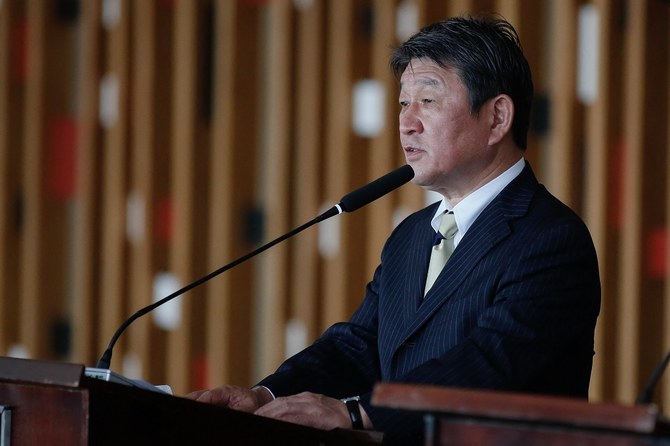
Motegi told a press conference at the ministry on Feb. 12 that this entry was the very first arrival of a probe from the Middle East to Mars. (File/AFP)
Short Url
Updated 12 February 2021
Follow

Mars Hope Probe success strengthens UAE-Japan partnership

  • Motegi told a press conference at the ministry on Feb. 12 that this entry was the very first arrival of a probe from the Middle East to Mars
  • This mission will also aim to carry out an investigation into the transformation of Mars, and its evolution

TOKYO: Japan’s Foreign Minister MOTEGI Toshimitsu praised the successful arrival of the UAE’s Hope Probe to Mars and its entry into orbit. Motegi also extended Japan’s congratulations to the UAE for this achievement, and pledged continued strategic bilateral cooperation in space and other fields.

Motegi told a press conference at the ministry on Feb. 12 that this entry was the very first arrival of a probe from the Middle East to Mars, that was carried on the Japan-made Mitsubishi H2A rocket launched from Tanegashima Space Center in Kagoshima Prefecture in July last year. 

“In Japan, we are very much happy that we have been able to contribute to that success that reflects the comprehensive strategic partnership between Japan and the UAE. Our bilateral relations and cooperation have been proceeding in various fields including the outer space, and (Hope Probe) is the symbol of that,” Motegi said.

On the day of the probe’s entry to Mars’ orbit, Thomas Zurbuchen, NASA’s science mission chief, also congratulated the UAE on its historic achievement: “Your bold endeavor to explore the Red Planet will inspire many others to reach for the stars. We hope to join you at Mars soon with Perseverance.”

The Hope Probe reached the red planet after a seven-month journey, and succeeded despite a 50% chance of failure, according to the UAE’s Vice President Sheikh Mohammed bin Rashid Al Maktoum.

The Hope Probe will play a momentous role in studying the Martian atmosphere over 685 Earth days and will also offer the first-ever planet-wide, 24×7 picture of Mars’ atmospheric dynamics and weather.

This mission will also aim to carry out an investigation into the transformation of Mars, and its evolution, while also inspiring younger students to tap into the field of science.

Throughout, Japan has played an important role in ensuring the missions success and the spacecraft is Japan’s flagship launch vehicle and is one of the most reliable launch vehicles in the world.

Read more here: UAE Hope Probe expected to provide first complete picture of Mars in 1 week


Kuwait to boost Islamic finance with sukuk regulation

Updated 05 February 2026
Follow

Kuwait to boost Islamic finance with sukuk regulation

  • The move supports sustainable financing and is part of Kuwait’s efforts to diversify its oil-dependent economy

RIYADH: Kuwait is planning to introduce legislation to regulate the issuance of sukuk, or Islamic bonds, both domestically and internationally, as part of efforts to support more sustainable financing for the oil-rich Gulf nation, Prime Minister Sheikh Ahmad Abdullah Al-Ahmad Al-Sabah said on Wednesday.

Speaking at the World Governments Summit in Dubai, Al-Sabah highlighted that Kuwait is exploring a variety of debt instruments to diversify its economy. The country has been implementing fiscal reforms aimed at stimulating growth and controlling its budget deficit amid persistently low oil prices. Hydrocarbons continue to dominate Kuwait’s revenue stream, accounting for nearly 90 percent of government income in 2024.

The Gulf Cooperation Council’s debt capital market is projected to exceed $1.25 trillion by 2026, driven by project funding and government initiatives, representing a 13.6 percent expansion, according to Fitch Ratings.

The region is expected to remain one of the largest sources of US dollar-denominated debt and sukuk issuance among emerging markets. Fitch also noted that cross-sector economic diversification, refinancing needs, and deficit funding are key factors behind this growth.

“We are about to approve the first legislation regulating issuance of government sukuk locally and internationally, in accordance with Islamic laws,” Al-Sabah said.

“This enables us to deal with financial challenges flexibly and responsibly, and to plan for medium and long-term finances.”

Kuwait returned to global debt markets last year with strong results, raising $11.25 billion through a three-part bond sale — the country’s first US dollar issuance since 2017 — drawing substantial investor demand. In March, a new public debt law raised the borrowing ceiling to 30 billion dinars ($98 billion) from 10 billion dinars, enabling longer-term borrowing.

The Gulf’s debt capital markets, which totaled $1.1 trillion at the end of the third quarter of 2025, have evolved from primarily sovereign funding tools into increasingly sophisticated instruments serving governments, banks, and corporates alike. As diversification efforts accelerate and refinancing cycles intensify, regional issuers have become regular participants in global debt markets, reinforcing the GCC’s role in emerging-market capital flows.

In 2025, GCC countries accounted for 35 percent of all emerging-market US dollar debt issuance, excluding China, with growth in US dollar sukuk issuance notably outpacing conventional bonds. The region’s total outstanding debt capital markets grew more than 14 percent year on year, reaching $1.1 trillion.