

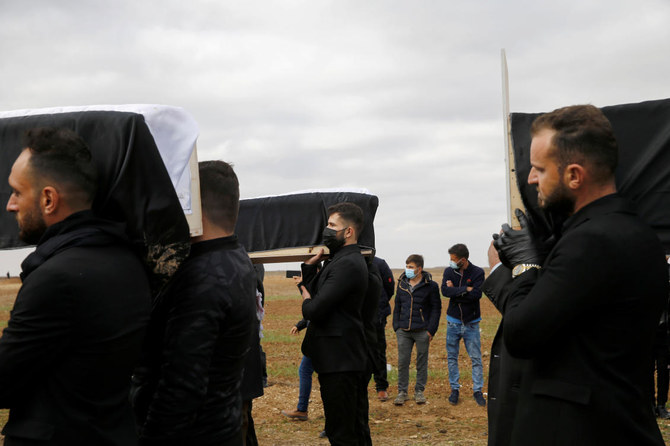

KOJO, Iraq: Thikran Kamiran Yousif was 15 when Daesh fighters surrounded his village in northern Iraq, rounded up residents and slaughtered several hundred of them, including his father, brother, grandfather and aunt.
Nearly seven years later, Yousif has returned to the village of Kojo in Sinjar district for the reburial of his father and 103 other Yazidis whose bodies had been dumped by Daesh in mass graves and have now been identified by DNA samples.
Yousif, now 22 and living in Germany, is still haunted by the massacre of August 2014.
“The most painful moment was when they separated me from my father. That was the last time I saw him,” Yousif told Reuters.
“To be able, after seven years, to bury (these people) where they were killed... means so much to us,” said Yousif, whose other slain relatives have not yet been identified.
The Yazidis are an ancient religious minority who combine Zoroastrian, Christian, Manichean, Jewish and Muslim beliefs.
Daesh, which views the Yazidis as devil worshippers, killed more than 3,000, enslaved 7,000 Yazidi women and girls and displaced most of the 550,000-strong community from its ancestral home in northern Iraq.
UNITAD, the UN team investigating Daesh crimes in Iraq, has discovered more than 80 mass graves in Sinjar and has exhumed 19 of them since March 2019. It has so far identified 104 bodies by DNA samples.
“You can almost see the territory controlled by Daesh by the number of mass graves in the area,” said Karim Khan, head of the United Nations team investigating Daesh crimes in Iraq (UNITAD). Daesh is another name for Daesh.
During the year-and-a-half he spent in the hands of Daesh, Yousif was moved around several times, used as a human shield in Mosul and forced to attend an Daesh-run school, where he was indoctrinated with the group’s teachings on violent jihad.
“They taught us that killing Yazidis is allowed,” he said. “They worked on our minds.”
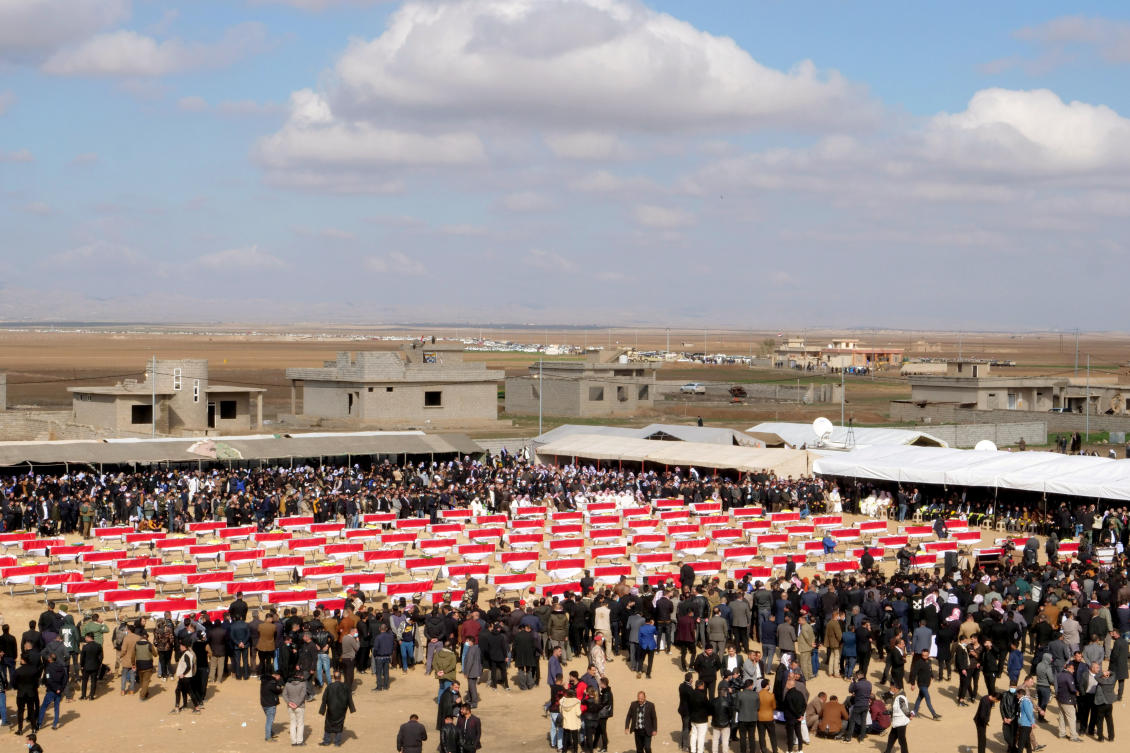
The funeral for 104 members of Iraq's Yazidi minoirty, who were killed by Daesh, took place on Saturday. (Reuters)
As bombings by the US-led coalition intensified over Daesh-held territory in northern Iraq, Yousif feared he would be killed or forced to fight for Daesh. In early 2016, he fled to Iraqi Kurdistan with his mother and sister.
“In the beginning it was very hard, psychologically. I was confused. I was telling myself that I should not forget what Daesh taught me,” Yousif said.
A year ago, Yousif, his mother and sister found refuge in Germany with the help of Air Bridge Iraq, a non-profit organization that advocates for the treatment and rehabilitation of Yazidi survivors of Daesh captivity outside of Iraq.
Iraqi President Barham Saleh and Prime Minister Mustafa Al-Kadhimi attended an official funeral ceremony for the 104 identified Yazidi victims on Feb. 4 in Baghdad, ahead of the burials in Kojo, which remains in ruins and uninhabited.
A reparation law for female survivors of Daesh captivity is awaiting ratification by the Iraqi parliament, but it excludes men and boys like Yousif who were also held captive.
And the Yazidis are demanding much more, including the legal recognition of their suffering as genocide.
“There is no legal architecture in place in Iraq to allow judges to conclude that the conduct of Daesh constituted an act of genocide, of crimes against humanity or war crimes,” Khan said, adding that UNITAD’s mandate was to provide evidence to bring the culprits to trial eventually.
About 30% of Sinjar district’s population has returned since the departure of Daesh, but the region is still racked by political instability and lacks basic services.
At his father’s graveside in Kojo, surrounded by other grieving Yazidis, mostly widows, Yousif said his community simply wanted justice.
“We want the world to see that there is a minority in Iraq that suffers,” he said. “We want the world to see us as human beings who have rights just like everyone else.”


