

Brand value of world’s top banks drops for 2nd year in row

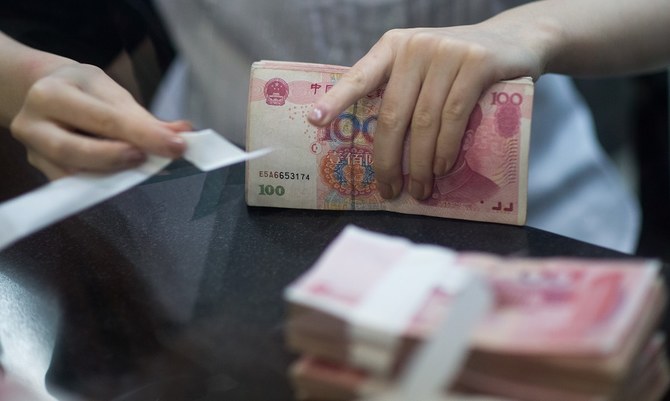
Chinese banks continued to dominate the rankings. (File/AFP)
Short Url
Updated 07 February 2021
Follow

Brand value of world’s top banks drops for 2nd year in row

  • The top-ranked banking brand in Saudi Arabia was Al-Rajhi Bank at 81st
  • The top UAE banking brand was Emirates NBD at 74th

Tough economic conditions have seen the brand value of the world’s banks decrease for the second year in a row, according to the latest report by consultancy firm Brand Finance.

The annual report found that nearly two-thirds of the world’s 500 most valuable banking brands have recorded brand value losses in the last 12 months.

The Brand Finance Banking 500 recorded an increase of 10 percent in the total value of all the brands analyzed in 2018.

The following year the value rose another 15 percent, but in the 2020 report it was down 2 percent.

In this year’s report, covering the period during the coronavirus pandemic, the total value was down 4 percent to $1.27 trillion.

“Banking institutions were the main culprit in the last financial crash; this time around they are a large part of helping people overcome the repercussions of COVID-19,” said Brand Finance CEO David Haigh.

“Brand Finance research shows that banks’ responses to the global pandemic have led to a year-on-year increase in overall reputation scores among customers, which no doubt could result in an uptick in brand values in the coming year.”

Chinese banks continued to dominate the rankings, accounting for one-third of total brand value and seven of the 10 top climbers by absolute brand value.

Despite a 10 percent drop in brand value to $72.8 billion, Industrial and Commercial Bank of China remains the world’s most valuable banking brand.

“This is undoubtedly an effect of China’s management of the COVID-19 pandemic, which has allowed its economy to continue functioning relatively unscathed, allowing space for banks to grow further,” said Haigh.

Bank of America was the biggest in the US, valued at $32.8 billion, despite a 7 percent drop. The other top US banks on the list were Citi (down 3 percent to $32.2 billion), Wells Fargo (down 22 percent to $31.8 billion), Chase (down 8 percent to $28.8 billion) and JP Morgan (up 3 percent to $23.6 billion).

The top-ranked banking brand in Saudi Arabia was Al-Rajhi Bank at 81st, down 1.7 percent to $3.4 billion, followed by National Commercial Bank (110th), Riyad Bank (185th), Samba Financial Group (212nd) and Saudi British Bank (237th).

The top UAE banking brand was Emirates NBD at 74th, down 9.7 percent to $3.7 billion.

The fastest-growing banking brand was the Union Bank of India, up 163 percent to $1.2 billion.


Egypt–Saudi power link set to boost regional energy integration, minister says 

Updated 22 February 2026
Follow

Egypt–Saudi power link set to boost regional energy integration, minister says 

RIYADH: Electricity interconnection projects between Egypt and Saudi Arabia will strengthen regional energy cooperation and economic integration, Egypt’s minister of electricity and renewable energy said during a visit to a key cross-border power facility. 

Mahmoud Esmat made the remarks while inspecting the Egypt–Saudi electricity interconnection station linking the two countries’ power grids, where he reviewed construction progress and equipment testing ahead of trial operations expected in the coming weeks, according to a statement from the Egyptian State Information Service. 

The project is described as the first of its kind in the Middle East in terms of scale, manufacturing technology, operation, and application in grid interconnection lines. 

The initiative supports the state’s broader vision to implement sustainable solutions aimed at ensuring the stability of the national unified grid and enhancing the reliability and quality of electricity supply. 

It also aligns with Egypt’s allocation of 136.3 billion Egyptian pounds ($2.8 billion) to the electricity and renewable energy sector in its 2025–26 development plan, nearly double the 72.6 billion pounds set aside the previous year. 

The plan focuses on diversifying energy sources, expanding renewable capacity, and strengthening the national grid to meet rising demand. 

The statement said: “The minister toured the station’s departments and control and operation center, following up on the completion of testing for all equipment and components in preparation for launching operations and synchronizing the project with the unified power grids of Egypt and Saudi Arabia in the coming weeks.” 

It added: “Esmat reviewed the implementation rate of the project and testing works, as well as the project’s timeline. He highlighted finalization of operational tests at the Badr transformer station and the Sakakin Taba 2 station, as well as the 500 kilovolts overhead transmission line extending approximately 320 km.”  

The minister said the project forms part of broader efforts to build an integrated power network connecting the two countries, facilitating efficient and flexible electricity exchange and laying the groundwork for a unified Arab electricity market. 

He added that the initiative reflects a clear vision and comprehensive strategy to strengthen the efficiency of the energy system while delivering both immediate and long-term solutions to safeguard grid stability and enhance service quality.