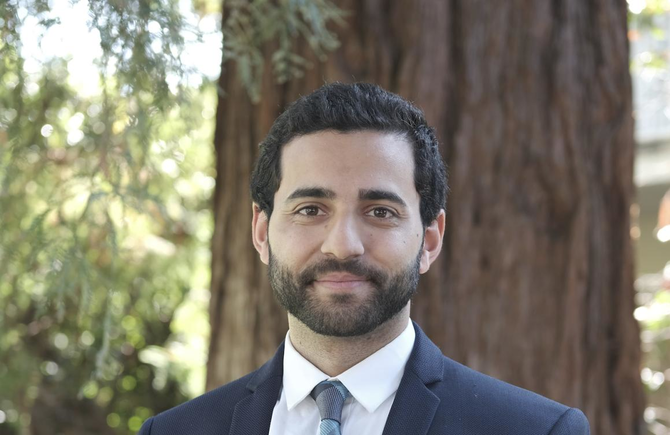
BOSTON: The Harvard Law Review has named a Los Angeles-born Egyptian-American as what it believes is its first Muslim president in its 134-year history, elevating him to the top of one of the most prestigious US law journals.
Harvard Law School student Hassaan Shahawy said he hoped his election represented “legal academia’s growing recognition of the importance of diversity, and perhaps its growing respect for other legal traditions.”
Among the legal and political luminaries who have worked at the Harvard Law Review was former US President Barack Obama, named the journal’s first Black president in 1990. Three serving members of the US Supreme Court were editors of the Harvard Law Review, as were the late Justices Ruth Bader Ginsburg and Antonin Scalia.
“Coming from a community routinely demonized in American public discourse, I hope this represents some progress, even if small and symbolic,” Shahawy, 26, told Reuters in an email.
Law reviews are staffed by the top students at US law schools, who are often recruited for judicial clerkships and other prestigious jobs in the profession.
The review’s first female president, Susan Estrich, was elected in 1977. Other presidents have been Latino and openly gay. The first Black woman was elected president in 2017.
Shahawy graduated Harvard as an undergraduate in 2016 with a degree in History and Near Eastern Studies. He then attended the University of Oxford as a Rhodes Scholar to pursue a doctorate in Oriental Studies and studied Islamic law.
Shahawy said he has been active working with refugee populations and on criminal justice reform. His future plans are unclear, though he cited the possibility of becoming a public interest lawyer or working in academia.


![]()


Harvard Law Review elects first Muslim president
Short Url
https://arab.news/82jb6
Harvard Law Review elects first Muslim president
- Shahawy said he hoped his election represented “legal academia’s growing recognition of the importance of diversity”
- Coming from a community routinely demonized in American public discourse, I hope this represents some progress: Shahawy


Minnesota gears up for anti-immigration enforcement protest Friday despite dangerous cold
MINNEAPOLIS: A vast network of labor unions, progressive organizations and clergy has been urging Minnesotans to stay away from work, school and stores Friday to protest against immigration enforcement in the state.
“We really, really want I.C.E. to leave Minnesota, and they’re not going to leave Minnesota unless there’s a ton of pressure on them,” said Kate Havelin of Indivisible Twin Cities, one of the more than 100 groups that is mobilizing. “They shouldn’t be roaming any streets in our country just the way they are now.”
The Twin Cities of Minneapolis and St. Paul have seen daily protests since Renee Good was fatally shot by a US Immigration and Customs Enforcement officer during an operation on Jan. 7. Federal law enforcement officers have surged in the area for weeks and have repeatedly squared off with community members and activists who track their movements online and in streets.
On Thursday, a prominent civil rights attorney and at least two other people involved in an anti-immigration enforcement protest that disrupted a Sunday service at a Minnesota church were arrested.
Vice President JD Vance visited Minneapolis to meet with ICE officials. He said repeatedly that he believed the fraught situation in Minneapolis would improve upon better cooperation from state and local officials, and he encouraged protests to remain peaceful.
Friday’s mobilization was planned as the largest coordinated protest action to date, including a march in downtown Minneapolis despite dangerously cold temperatures that the National Weather Service forecast in the single to double digits below zero (-20 to -30 degrees Celsius).
While organizations have asked participants to prepare for the cold, Havelin compared the presence of immigration enforcement to just such winter weather warnings.
“Minnesotans understand that when we’re in a snow emergency … we all have to respond and it makes us do things differently,” she said. “And what’s happening with ICE in our community, in our state, means that we can’t respond as business as usual.”
More than a hundred small businesses in the Twin Cities, largely coffee shops and restaurants, said they would close in solidarity or donate part of their profits, organizers said.
Ethnic businesses especially have lost sales during enforcement surges as both workers and customers stay away fearing they would be detained.
But some are deciding to close anyway, preferring to take a stance in solidarity rather than the “unscheduled interruption” of having agents apprehend staff, said Luis Argueta of Unidos MN, a civil rights group.
Many schools were planning to be closed for a variety of reasons. The University of Minnesota, which has about 50,000 students enrolled, said there would be no in-person classes because of the extreme cold warning, and the St. Paul public school district said there would no classes for the same reason. Minneapolis Public Schools were also scheduled to be closed Friday “for a teacher record keeping day.”
Clergy planned to join the march as well as hold prayer services and fasting, according to a delegation of representatives of faith traditions ranging from Buddhist to Jewish, Lutheran to Muslim.
Bishop Dwayne Royster, leader of the progressive organization Faith in Action, arrived in Minnesota on Wednesday from Washington, D.C.
“We want ICE out of Minnesota,” he said. “We want them out of all the cities around the country where they’re exercising extreme overreach.”
Royster said at least 50 of his network’s faith-based organizers from around the US were joining in the protest.
About 10 faith leaders were planning to travel to Minnesota from Los Angeles while others from the same group planned a solidarity rally in California, said one of the organizers there.
“It was a very harrowing experience,” said the Rev. Jennifer Gutierrez of the large enforcement operation in Los Angeles last year. “We believe God is on the side of migrants.”
“We really, really want I.C.E. to leave Minnesota, and they’re not going to leave Minnesota unless there’s a ton of pressure on them,” said Kate Havelin of Indivisible Twin Cities, one of the more than 100 groups that is mobilizing. “They shouldn’t be roaming any streets in our country just the way they are now.”
The Twin Cities of Minneapolis and St. Paul have seen daily protests since Renee Good was fatally shot by a US Immigration and Customs Enforcement officer during an operation on Jan. 7. Federal law enforcement officers have surged in the area for weeks and have repeatedly squared off with community members and activists who track their movements online and in streets.
On Thursday, a prominent civil rights attorney and at least two other people involved in an anti-immigration enforcement protest that disrupted a Sunday service at a Minnesota church were arrested.
Vice President JD Vance visited Minneapolis to meet with ICE officials. He said repeatedly that he believed the fraught situation in Minneapolis would improve upon better cooperation from state and local officials, and he encouraged protests to remain peaceful.
Friday’s mobilization was planned as the largest coordinated protest action to date, including a march in downtown Minneapolis despite dangerously cold temperatures that the National Weather Service forecast in the single to double digits below zero (-20 to -30 degrees Celsius).
While organizations have asked participants to prepare for the cold, Havelin compared the presence of immigration enforcement to just such winter weather warnings.
“Minnesotans understand that when we’re in a snow emergency … we all have to respond and it makes us do things differently,” she said. “And what’s happening with ICE in our community, in our state, means that we can’t respond as business as usual.”
More than a hundred small businesses in the Twin Cities, largely coffee shops and restaurants, said they would close in solidarity or donate part of their profits, organizers said.
Ethnic businesses especially have lost sales during enforcement surges as both workers and customers stay away fearing they would be detained.
But some are deciding to close anyway, preferring to take a stance in solidarity rather than the “unscheduled interruption” of having agents apprehend staff, said Luis Argueta of Unidos MN, a civil rights group.
Many schools were planning to be closed for a variety of reasons. The University of Minnesota, which has about 50,000 students enrolled, said there would be no in-person classes because of the extreme cold warning, and the St. Paul public school district said there would no classes for the same reason. Minneapolis Public Schools were also scheduled to be closed Friday “for a teacher record keeping day.”
Clergy planned to join the march as well as hold prayer services and fasting, according to a delegation of representatives of faith traditions ranging from Buddhist to Jewish, Lutheran to Muslim.
Bishop Dwayne Royster, leader of the progressive organization Faith in Action, arrived in Minnesota on Wednesday from Washington, D.C.
“We want ICE out of Minnesota,” he said. “We want them out of all the cities around the country where they’re exercising extreme overreach.”
Royster said at least 50 of his network’s faith-based organizers from around the US were joining in the protest.
About 10 faith leaders were planning to travel to Minnesota from Los Angeles while others from the same group planned a solidarity rally in California, said one of the organizers there.
“It was a very harrowing experience,” said the Rev. Jennifer Gutierrez of the large enforcement operation in Los Angeles last year. “We believe God is on the side of migrants.”
Latest updates


© 2026 SAUDI RESEARCH & PUBLISHING COMPANY, All Rights Reserved And subject to Terms of Use Agreement.