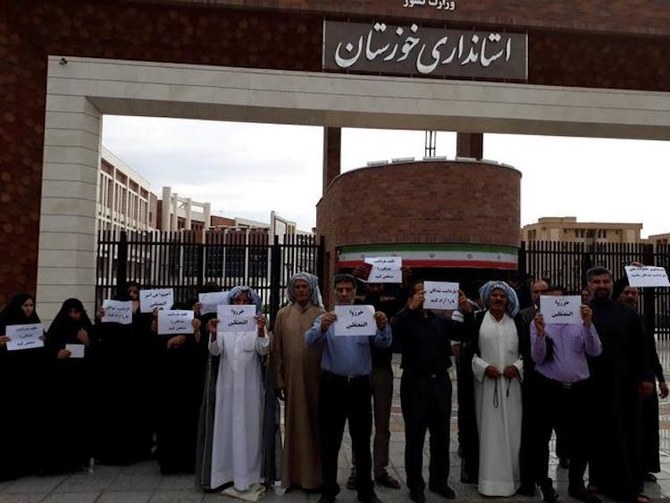

LONDON: Amnesty International has urged Tehran to “immediately halt” plans to execute eight people, including four Ahwazi Arabs, and condemned the country’s “alarming rise” in executions of ethnic minority prisoners.
“The recent escalation in executions of Baluchis and Ahwazi Arabs raises serious concerns that the authorities are using the death penalty to sow fear among disadvantaged ethnic minorities, as well as the wider population,” said Diana Eltahawy, deputy director for the Middle East and North Africa at Amnesty.
“The disproportionate use of the death penalty against Iran’s ethnic minorities epitomizes the entrenched discrimination and repression they have faced for decades.”
Among those minorities regularly targeted by Tehran are the Ahwazi Arabs, four of which are currently facing execution.
Three of them — Ali Khasraji, Hossein Silawi and Jassem Heidari — have sewn their lips shut and are currently on hunger strike, Amnesty said.
The fourth, Naser Khafajian, has been forcibly disappeared and is at risk of torture or summary execution.
At least four Balochis are also facing imminent execution, just days after the hanging of Balochi Javid Dehghan.
Javaid Rehman, UN special rapporteur on the situation of human rights in Iran, said Dehghan was executed despite “serious violations of his fair trial rights, including claims he was tortured.”
Rehman and other UN experts slammed the decision to execute Dehghan despite serious miscarriages of justice during his trial.
“International human rights law is clear,” they said. “A state that has not abolished the death penalty can only implement it for a ‘most serious crime’ involving intentional killing and following a judicial process that strictly adheres to fair trial and due process guarantees.
“The concerns raised in this case of serious fair trial violations, including lack of an effective right of appeal and a torture-induced forced confession, mean that the Iranian Government’s implementation of his death sentence amounts to an arbitrary execution.”
Thursday’s statements from Amnesty and the UN followed a joint letter sent on Wednesday by a coalition of rights groups denouncing Iran’s treatment and arbitrary arrests of members of its Kurdish minority population.
The signatories said “based on past patterns of documented human rights violations by the Iranian authorities,” they were seriously concerned that detained Kurdish citizens could be “at risk of torture or other ill-treatment aimed at extracting forced ‘confessions,’ and that these may be later used in grossly unfair trials for spurious national security related offenses.”

keywords