

Iran releases crew of South Korean tanker

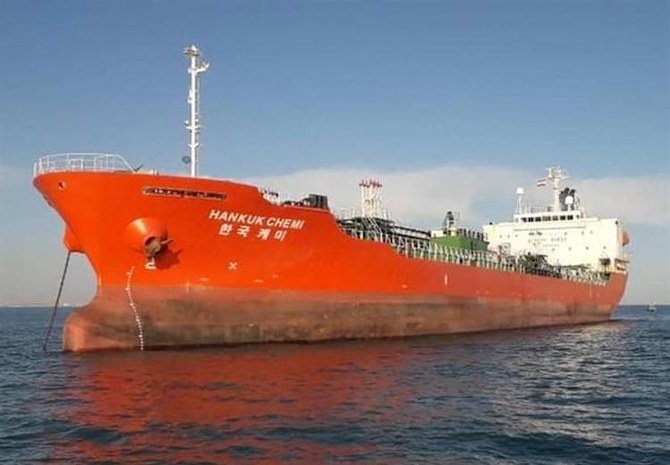
The South Korean-flagged MT Hankuk Chemi, which was seized by Iran’s Revolutionary Guards in Gulf waters, January 4, 2021. (Reuters)
Short Url
Updated 03 February 2021
Follow

Iran releases crew of South Korean tanker

  • The captain and the vessel, the MT Hankuk Chemi, will remain under detention as the Iranian judiciary investigates the tanker’s alleged marine pollution
  • The ship with 20 crew members on board was sailing from Saudi Arabia to the UAE when it was intercepted by Iran’s Islamic Revolutionary Guard Corps (IRGC) on Jan. 4

SEOUL: The Foreign Ministry here confirmed on Wednesday that Iran had released all sailors on a South Korean-flagged oil tanker seized by Iranian forces in the Arabian Gulf, capping a month-long negotiation with Tehran.

However, the captain and the vessel, the MT Hankuk Chemi, will remain under detention as the Iranian judiciary investigates the tanker’s alleged marine pollution.

“Iran’s Deputy Foreign Minister Abbas Araghchi has informed us that the Iranian government decided to first release all sailors except for the captain,” the ministry said in a press release.

The ship with 20 crew members on board was sailing from Saudi Arabia to the UAE when it was intercepted by Iran’s Islamic Revolutionary Guard Corps (IRGC) on Jan. 4.

The Iranian authorities have claimed the ship violated environmental protocols, which the vessel’s operator denies.

The seizure of the oil tanker followed Iran’s complaint about the difficulty of transferring money from Seoul to purchase coronavirus vaccines, as the country’s $7 billion worth of assets in Korean bank accounts were frozen in the wake of a broken nuclear deal between Teheran and Washington in 2018.

First Vice Foreign Minister Choi Jong-kun had telephone talks with Araghchi a day earlier to discuss the release of sailors, according to a ministry spokesman.

Choi visited Tehran last month to secure the early release of the sailors.

During the 30-minute talks, both sides agreed to restore friendly ties by resolving issues surrounding the frozen money, the spokesman said, asking not to be identified.

“Deputy Minister Araghchi pledged to ensure the humanitarian treatment of the captain and guarantee sufficient consular assistance for him pending a judicial process,” he said.

In return, Choi pledged efforts to address the issue of frozen assets speedily, while continuing consultations with the Biden administration in the US, he said.

“We promised to do what we can unilaterally and seek support from the US government in a transparent manner,” the spokesman said.

In a bid to appease Iran, South Korea is expected to pay Iran’s overdue UN membership fees using its frozen assets at two South Korean banks.

A senior diplomat here confirmed on Monday that his ministry had received Teheran’s request over the UN membership fees.

Iranian Foreign Ministry spokesperson, Saeed Khatibzadeh, also revealed the proposal, urging the UN to guarantee the safe transfer of payments.

The Swiss Humanitarian Trade Arrangements (SHTA) is also seen as a method for sending locked Iranian funds in Korean banks to Switzerland to purchase humanitarian items for Iran.

Iran made a request in February last year that Seoul transfer $1 billion from the frozen assets using the SHTA method, and the Seoul government submitted a proposal to the US State Department and requested the exemption of sanctions in May.

The State Department has yet to respond to the request, according to the foreign ministry.

Seoul and Tehran established strong economic ties, with South Korea the third-largest importer of Iranian oil, in 2017.

South Korea was the biggest buyer of Iranian condensate, which its petrochemical industry processed in refineries designed to handle the commodity.

After the Trump administration reimposed sanctions against Iran, however, South Korea’s oil imports from Iran had plummeted from $7.8 billion to $2.1 billion by 2019.


Carney says Canada has no plans to pursue free trade agreement with China as Trump threatens tariffs

Updated 26 January 2026
Follow

Carney says Canada has no plans to pursue free trade agreement with China as Trump threatens tariffs

TORONTO: Canadian Prime Minister Mark Carney said Sunday his country has no intention of pursuing a free trade deal with China. He was responding to US President Donald Trump’s threat to impose a 100 percent tariff on goods imported from Canada if America’s northern neighbor went ahead with a trade deal with Beijing.
Carney said his recent agreement with China merely cuts tariffs on a few sectors that were recently hit with tariffs.
Trump claims otherwise, posting that “China is successfully and completely taking over the once Great Country of Canada. So sad to see it happen. I only hope they leave Ice Hockey alone! President DJT”
The prime minister said under the free trade agreement with the US and Mexico there are commitments not to pursue free trade agreements with nonmarket economies without prior notification.
“We have no intention of doing that with China or any other nonmarket economy,” Carney said. “What we have done with China is to rectify some issues that developed in the last couple of years.”
In 2024, Canada mirrored the United States by putting a 100 percent tariff on electric vehicles from Beijing and a 25 percent tariff on steel and aluminum. China had responded by imposing 100 percent import taxes on Canadian canola oil and meal and 25 percent on pork and seafood.
Breaking with the United States this month during a visit to China, Carney cut its 100 percent tariff on Chinese electric cars in return for lower tariffs on those Canadian products.
Carney has said there would be an initial annual cap of 49,000 vehicles on Chinese EV exports coming into Canada at a tariff rate of 6.1 percent, growing to about 70,000 over five years. He noted there was no cap before 2024. He also has said the initial cap on Chinese EV imports was about 3 percent of the 1.8 million vehicles sold in Canada annually and that, in exchange, China is expected to begin investing in the Canadian auto industry within three years.
Trump posted a video Sunday in which the chief executive of the Canadian Vehicle Manufacturers’ Association warns there will be no Canadian auto industry without US access, while noting the Canadian market alone is too small to justify large scale manufacturing from China.
“A MUST WATCH. Canada is systematically destroying itself. The China deal is a disaster for them. Will go down as one of the worst deals, of any kind, in history. All their businesses are moving to the USA. I want to see Canada SURVIVE AND THRIVE! President DJT,” Trump posted on social media.
Trump’s post on Saturday said that if Carney “thinks he is going to make Canada a ‘Drop Off Port’ for China to send goods and products into the United States, he is sorely mistaken.”
“We can’t let Canada become an opening that the Chinese pour their cheap goods into the U.S,” US Treasury Secretary Scott Bessent said on ABC’s “This Week.”
“We have a , but based off — based on that, which is going to be renegotiated this summer, and I’m not sure what Prime Minister Carney is doing here, other than trying to virtue-signal to his globalist friends at Davos.”
Trump’s threat came amid an escalating war of words with Carney as the Republican president’s push to acquire Greenland strained the NATO alliance.
Carney has emerged as a leader of a movement for countries to find ways to link up and counter the US under Trump. Speaking in Davos before Trump, Carney said, “Middle powers must act together because if you are not at the table, you are on the menu” and he warned about coercion by great powers — without mentioning Trump’s name. The prime minister received widespread praise and attention for his remarks, upstaging Trump at the World Economic Forum.
Trump’s push to acquire Greenland has come after he has repeatedly needled Canada over its sovereignty and suggested it also be absorbed into the United States as a 51st state. He posted an altered image on social media this week showing a map of the United States that included Canada, Venezuela, Greenland and Cuba as part of its territory.