TALLAHASSEE: Florida lawmakers, including Gov. Ron DeSantis, intensified their battle with Facebook, Twitter and Silicon Valley when they announced new proposals Tuesday aimed at reigning in platforms they accuse of squelching the free speech of conservatives.
“Over the years, these platforms have changed from neutral platforms that provide Americans with the freedom to speak to enforcers of preferred narratives,” the governor said Tuesday during a news conference at the Florida Capitol.
Social media companies have been simultaneously praised and condemned in recent weeks as they cracked down on inciteful posts they said could foment further violence after the Jan. 6 insurrection at the US Capitol.
Conservatives have long accused social media companies and other tech giants of harboring bias against them. Republicans in other states are considering similar bills that push back against social media giants they deem unfriendly.
“Florida is taking back the virtual public square as a place where information and ideas can flow freely. We’re demanding transparency from the big tech giants,” state House Speaker Chris Sprowls said.
About four in every five Americans — some 250 million people — have profiles on social media. Th ose with substantial followings, including elected officials, celebrities and other public figures, have platforms they can readily deploy to amplify their messaging.
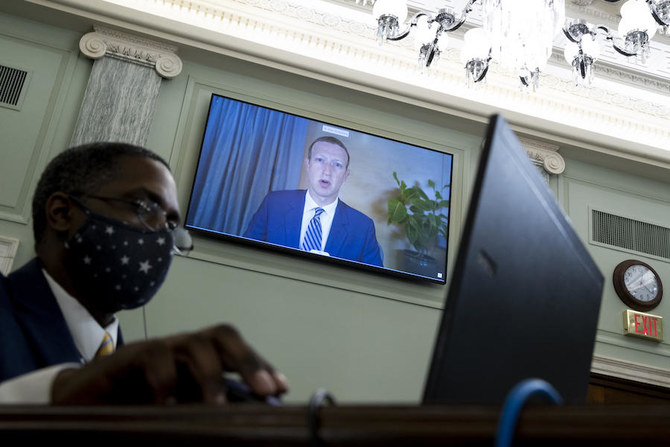
On a call with analysts last week, Facebook founder Mark Zuckerberg said the social media giant was attempting to “turn down the temperature and discourage divisive conversations and communities.” He added that “people don’t want politics and fighting to take over their experience on our services.”
Amazon booted Parler off its web-hosting service five days after the Capitol insurrection. It said in court filings that it did so as a last resort to keep Parler from being used as a venue to disseminate plans for disrupting government and last month’s inauguration of President Joe Biden.
A federal judge in Seattle later ruled Amazon would not be required to restore web service to Parler, an online social media platform that mostly attracts conservatives and supporters of former President Donald Trump.
The moves by Florida lawmakers may end up being mere political theater because it’s uncertain if the state would have the authority to act on companies with such national and global reach. In fact, the federal Telecommunications Act of 1996 shields Internet companies from many legal challenges.
Legal experts say states and other local jurisdictions have a high bar in justifying regulations that might infringe on free speech issues — but the matter could be ripe for a national discussion on how to regulate Internet companies, according to Clay Calvert, a first amendment expert at the University of Florida’s law school.
Besides, he said, “do we want a crazy quilt of state regulations or do we want uniform rules adopted on the federal level?”
State Senate President Wilton Simpson suggested that the federal arena may be the proper venue for regulating tech companies.
“There’s not much we can do as a state. But we need Congress to act on a nationwide basis,” he said.
“The big tech companies have the duty to allow differing views on their public platforms. No one should be excluded,” Simpson said. “But let’s be clear: They are targeting conservatives.”
He said it amounts to political censorship.
One proposal in the state Senate would force Facebook, Twitter and other social media platforms to give users a month’s notice before their accounts are disabled or suspended. The bill was filed after Twitter suspended Trump’s account after his supporters stormed the US Capitol.
Another proposal that was to be filed Tuesday would prohibit companies from suspending the account of a political candidate and be subject to a fine of $100,000 for each day the account of a statewide candidate is blocked, or $10,000 a day for other office seekers.
The proposal also would allow consumers to the sue if they’ve been treated unfairly and would authorize the state attorney general to take on the country’s largest tech companies for anti-competitive practices. Social media companies would be required to reveal how they became aware of any content they censor.
“We’re definitely at a boiling point,” said Darrell West, the vice president of governance studies at the Brookings Institution. “Most of these issues have come up just in the last year, as social media platforms have become more aggressive about regulating their own space.”
While Republicans lawmakers assert bias against conservative thought, a New York University study released Monday concludes that is a baseless claim.
“Conservatives are drawn to the established platforms for the same reason liberals are: That’s where you can reach the largest audiences and enjoy the benefits of the network effect,” said the study’s authors.
“And as much as they condemn supposed social media favoritism,” the authors continued, “conservatives appear to relish wielding the bias-claim cudgel, even though it’s based on distortions and falsehoods.”


Florida lawmakers challenge Silicon Valley over ‘censorship’
https://arab.news/cgghw
Florida lawmakers challenge Silicon Valley over ‘censorship’

- Florida lawmakers are taking aim at Twitter, Facebook and other tech giants over free speech and censorship
- Proposals before the state’s Republican-controlled Legislature would seek to limit Big Tech’s ability to disable or suspend a person’s account


Paris exhibition marks 200 years of Le Figaro and the enduring power of the press
- The exhibition celebrated the bicentennial of Le Figaro, offering visitors a rare opportunity to step inside the newspaper’s vast historical archive
PARIS: One of France’s most influential newspapers marked a major milestone this month with a landmark exhibition beneath the soaring glass nave of the Grand Palais, tracing two centuries of journalism, literature and political debate.
Titled 1826–2026: 200 years of freedom, the exhibition celebrated the bicentennial of Le Figaro, offering visitors a rare opportunity to step inside the newspaper’s vast historical archive. Held over three days in mid-January, the free exhibition drew large crowds eager to explore how the title has both chronicled and shaped modern French history.
More than 300 original items were displayed, including historic front pages, photographs, illustrations and handwritten manuscripts. Together, they charted Le Figaro’s evolution from a 19th-century satirical publication into a leading national daily, reflecting eras of revolution, war, cultural change and technological disruption.
The exhibition unfolded across a series of thematic spaces, guiding visitors through defining moments in the paper’s past — from its literary golden age to its role in political debate and its transition into the digital era. Particular attention was paid to the newspaper’s long association with prominent writers and intellectuals, underscoring the close relationship between journalism and cultural life in France.
Beyond the displays, the program extended into live journalism. Public editorial meetings, panel discussions and film screenings invited audiences to engage directly with editors, writers and media figures, turning the exhibition into a forum for debate about the future of the press and freedom of expression.
Hosted at the Grand Palais, the setting itself reinforced the exhibition’s ambition: to place journalism firmly within the country’s cultural heritage. While the exhibition has now concluded, the bicentennial celebrations continue through special publications and broadcasts, reaffirming Le Figaro’s place in France’s public life — and the enduring relevance of a free and questioning press in an age of rapid change.