Oman considers stricter measures as people are caught violating quarantine

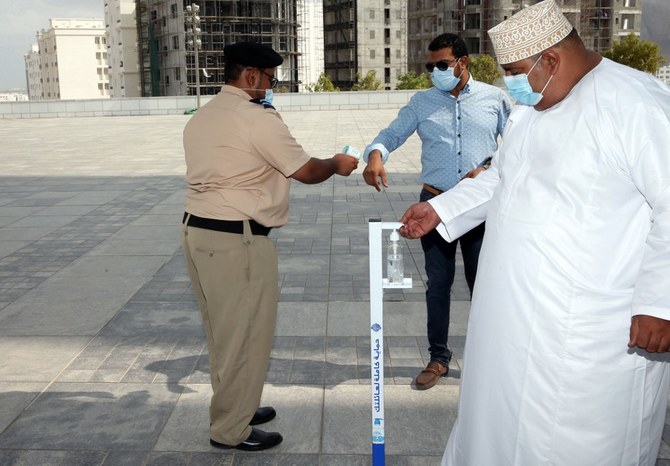
Mask-clad men use disinfecting gel and get their temperature checked before entering the Mohammed al-Amin Mosque in the Omani capital Muscat on Nov. 15, 2020. (File/AFP).
Short Url
Updated 02 February 2021
Follow

Oman considers stricter measures as people are caught violating quarantine

  • The country’s Supreme Committee for COVID-19 said a full lockdown will be the last resort
  • The number of COVID-19 patients in the intensive care units has doubled in the past two weeks

DUBAI: People have been avoiding self-quarantining in Oman by getting elderly members of their families to wear their tracking bracelets, national daily Times of Oman reported on Tuesday, citing the Ministry of Health.

“We have received messages of some people taking off their tracking bracelet after arriving at the country’s border crossings, and putting them on elderly people who do not usually leave the home,” the report quoted the Minister of Health Ahmed bin Mohammed Al-Saidi.

Meanwhile, the country’s Supreme Committee for COVID-19 said a full lockdown will be the last resort.

“Potential lockdown steps will be the last treatment of the pandemic situation and that the panel hopes not to go that far… It is our duty to protect ourselves and society through strict adherence to precautionary measures,” Al-Saidi said.

The number of COVID-19 patients in the intensive care units has doubled in the past two weeks, which is “a highly alarming and disillusioning indicator,” he said.

The committee is considering renewing airport suspensions, but hoped it would not be required.


Turkiye’s Kurdish party says Syria deal leaves Ankara ‘no excuses’ on peace process

Updated 2 sec ago
Follow

Turkiye’s Kurdish party says Syria deal leaves Ankara ‘no excuses’ on peace process

ANKARA: Turkiye’s pro-Kurdish DEM Party said on Monday that the Turkish government had no more “excuses” to delay a peace process with the Kurdistan Workers Party (PKK) now that a landmark integration deal was achieved in neighboring Syria.
On Sunday in Syria, the Kurdish-led Syrian Democratic Forces (SDF) agreed to come under the control of authorities in Damascus — a move that Ankara had long sought as integral to ‌its own peace ‌effort with the PKK. “For more than a ‌year, ⁠the ​government ‌has presented the SDF’s integration with Damascus as the biggest obstacle to the process,” Tuncer Bakirhan, co-leader of the DEM Party, told Reuters, in some of the party’s first public comments on the deal in Syria.
“The government will no longer have any excuses left. Now it is the government’s turn to take concrete steps.” Bakirhan cautioned President Tayyip Erdogan’s ⁠government against concluding that the rolling back Kurdish territorial gains in Syria negated the need ‌for a peace process in Turkiye. “If the ‍government calculates that ‘we have weakened ‍the Kurds in Syria, so there is no longer a ‍need for a process in Turkiye,’ it would be making a historic mistake,” he said in the interview.
Turkish officials said earlier on Monday that the Syrian integration deal, if implemented, could
advance the more than year-long process with the ​PKK, which is based in northern Iraq. Erdogan urged
swift integration of Kurdish fighters into Syria’s armed forces. Turkiye, the strongest ⁠foreign backer of Damascus, has since 2016 repeatedly sent forces into northern Syria to curb the gains of the SDF — which after the 2011–2024 civil war had controlled more than a quarter of Syria while fighting Islamic State with strong US backing.
The United States has built close ties with Damascus over the last year and was closely involved in mediation between it and the SDF toward the deal.
Bakirhan said progress required recognition of Kurdish rights on both sides of the border.
“What needs to be done is clear: Kurdish rights must be recognized ‌in both Turkiye and Syria, democratic regimes must be established, and freedoms must be guaranteed,” he said.