
BEIRUT: One Syrian was killed on Sunday and four injured after Kurdish security forces opened fire at pro-regime demonstrators in a northeastern city, according to a report.
The pro-regime news agency SANA said the Kurdish forces opened fire at demonstrators protesting the siege on their neighborhood in Hassakeh city.
The area is known as the security square and is controlled by regime forces.
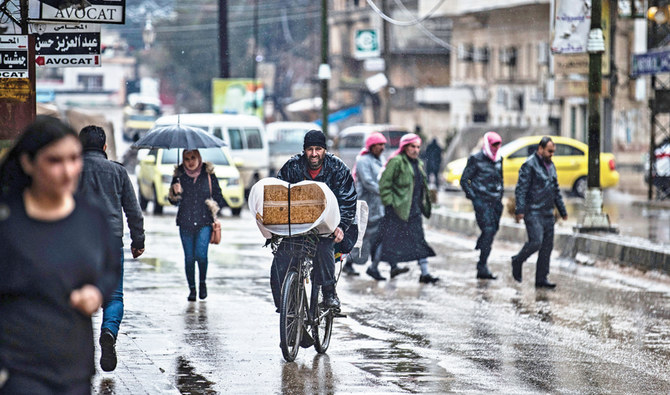
A video of the rally showed dozens of men gathering in a street on a rainy day as fire rang out over their heads. The men began chanting: “With our souls, our blood we sacrifice for you Bashar,” in reference to the Syrian leader Bashar Assad.
A Kurdish-run news agency, Hawar, said security forces at a checkpoint in the city had come under fire, prompting its members to respond to the source of fire.
The clashes led to the death of a security member of the regime, the agency said.
The different accounts could not be immediately reconciled or independently verified in the city where both security forces have presence.
The Kurds, Syria’s largest ethnic minority, have carved out a semi-autonomous enclave in Syria’s north since the start of the civil war in 2011. In the area, they run their own affairs and control most of the country’s oil resources.
In both Hassakeh and Qamishli cities, they share control with regime forces — which have presence in security zones, near the airport and in some neighborhoods.
Both cities have a sizable Kurdish population.
Tension occasionally erupts between the two sides, but the Kurdish forces have more presence and control there.
In recent weeks, Kurdish forces have imposed a siege on the regime neighborhoods in Hassakeh and to a lesser degree in Qamishli.
In Hassakeh, the Kurdish forces prevented flour from entering the regime-controlled areas, forcing bakeries to shut down in the last week.
BACKGROUND
The Kurdish forces are backed by the US-led coalition, with which they fought Daesh in Syria and ended their territorial control of large parts of the country in a military campaign that ended in 2019.
Fuel and water have also been prevented from passing through checkpoints erected around the neighborhoods.
Amid the tension, the two sides have conducted arrest campaigns against each other’s supporters and security members.
There was no immediate comment from the Kurdish forces.
But Kurdish officials have previously said they were reacting to regime troops which have imposed a siege and are harassing Kurdish-dominated neighborhoods in the northwestern Aleppo province where the regime is in control.
The Kurdish forces are backed by the US-led coalition, with which they fought Daesh in Syria and ended their territorial control of large parts of the country in a military campaign that ended in 2019.
The US-led coalition still has forces in Kurdish-controlled areas in Syria, citing continued joint efforts to weed out the militants’ remnants.
The presence of US troops is another reason for tension between the Kurdish and regime forces.
Russia, which conducts patrols in northeastern Syria and is a main backer of the Syrian regime, has offered to mediate between the Kurdish forces and the government.
The Britain-based Syrian Observatory for Human Rights said government forces have besieged Kurdish areas in northwestern Aleppo for month — preventing foods and medical supplies from entering.
Also on Sunday, car bombs killed at least 12 people, including seven civilians, in two separate incidents in Turkish-held northern Syria.
The first attack near a cultural center in the town of Azaz killed seven civilians, including a young girl, the Observatory said.
In the second incident, a car bomb targeted a checkpoint manned by pro-Ankara rebels near the town of Al-Bab, killing five fighters, the Observatory added.